Singapore to build fourth storage tank at LNG terminal

Kristie Neo Channel NewsAsia 24 Oct 12;

SINGAPORE: Singapore will be investing half a billion dollars to build a fourth storage tank at its Liquefied Natural Gas (LNG) terminal on Jurong Island.

Speaking at the Gas Asia Summit, Minister in the Prime Minister's Office and Second Minister for Trade & Industry S Iswaran said the fourth tank will enhance Singapore's energy security by allowing further diversification of its fuel sources.

"We want to diversify our sources of fuel and energy, and LNG gives us a very important opportunity to do that," said Mr Iswaran. "And with the recent developments in US and other parts of the world, in terms of shale gas, that enhances the opportunity."

The tank is expected to begin operations by 2017 and it will boost the capacity of the LNG terminal to about nine million tonnes per annum (Mtpa).

Mr Iswaran added that the increased storage infrastructure could also catalyse business opportunities such as LNG trading, break-bulk services and LNG bunkering.

The first phase of the LNG terminal development at Jurong Island with two LNG storage tanks is nearly complete and it is on track to begin commercial operations in the second quarter of 2013.

A third LNG storage tank, targeted for completion by the fourth quarter of 2013, will increase the throughput capacity to six Mtpa.

Mr Iswaran also did not rule out the possibility of building more tanks in future.

Jurong Island still has room for another two to three tanks.

Along with Singapore's experience in oil trading, experts agree this new tank brings Singapore a step closer to realising its aim to become an LNG trading hub.

"(Singapore) has some expertise in oil trading and that can be extended into LNG trading as well and investors also have confidence in putting in their money, given that we have been fairly successful as an oil trading hub," said Chloe Hang, associate editor of Asia LNG at Platts.

Mr Iswaran said authorities will now be focusing on front-end engineering design, as well as calling for tenders for the new project.

- CNA/ck

$500m plan to grow LNG terminal
Fourth gas storage tank will help diversify Republic's fuel sources
Feng Zengkun Straits Times 25 Oct 12;

SINGAPORE will build a fourth storage facility at its new liquefied natural gas (LNG) terminal that will begin operations next year.

The new tank, which is likely to cost $500 million and be completed by 2017, will increase the terminal's capacity by 50 per cent to nine million tonnes a year.

This will enhance the Republic's energy security by allowing it to import gas from more countries and also tap into new opportunities created by the growing global supply of natural gas.

Minister in the Prime Minister's Office and Second Minister for Trade and Industry S. Iswaran announced this yesterday at the opening of Gas Asia Summit, part of this year's Singapore International Energy Week.

Now in its fifth year, the annual energy event is a platform for professionals, policymakers and commentators to discuss issues.

Currently, about 80 per cent of Singapore's electricity is generated using piped natural gas from Malaysia and Indonesia.

The other 20 per cent comes from fuel oil and other sources such as waste and renewable energy.

After the LNG terminal begins operations next year, Singapore will be able to import and store liquefied gas from other countries around the world.

This is the second time the capacity of the terminal has been expanded even before it starts operations. The initial plan was to have two storage tanks and handle 3.5million tonnes of LNG each year.

Just months after the terminal's ground-breaking ceremony in March 2010, a third tank was announced to boost capacity to six million tonnes a year.

Mr Iswaran said the fourth tank will improve Singapore's energy security by allowing further diversification of the country's sources for the fuel.

"The increased storage infrastructure could also catalyse business opportunities such as LNG trading, break-bulk services and LNG bunkering," he added.

A report by the International Energy Agency (IEA) in June estimated that global natural gas consumption will rise 17 per cent to 3.94 trillion cubic metres by 2017 from 2011, with Asia powering the growth in demand.

Global gas supply increased by 93 billion cubic metres, or 3 per cent, from 2010 to last year, with the increase coming largely from the United States, Russia and Qatar, said the IEA report.

Mr Iswaran noted that, in the past few years, global energy players such as Shell, BP and Gazprom have set up trading desks here.

The new tank is also timely because shale gas, another fuel, has become more viable in the US and other countries, replacing their need for imported gas.

"With energy demand in Europe slowing due to the economic downturn, LNG suppliers have turned towards Asia, where demand for gas remains bolstered by economic growth and Japan's shift from nuclear power to gas," said Mr Iswaran.

"We're also seeing shorter-dated contracts as opposed to long- term (contracts) and I think there's room for greater development of a spot market."

Energy experts said Singapore could take advantage of these global trends to become a regional LNG trading hub.

Singapore is already one of the world's biggest oil-refining hubs and a major bunkering port.

Mr Iswaran also said yesterday that the take-up of LNG from the new terminal has been"faster than initially anticipated".

He added that the Government is now studying possible frameworks for the future import of LNG.


Read more!

First vertical farm to boost supply of local greens

Each tower produces up to 10 times more vegetables than usual methods

Jessica Lim Straits Times 25 Oct 12;

LAND-SCARCE Singapore has its first vertical farm on a plot of land in Lim Chu Kang the size of about five football fields.

Vegetables - Chinese cabbage, nai bai and xiao bai cai - grow on 120 towers and the harvest is sold at five NTUC FairPrice Finest outlets.

The innovation is also a boost for the country's efforts to widen food-supply sources.

Each 9m-tall tower, made of tiers of planting troughs rotating around an aluminium frame, produces five to 10 times more vegetables than conventional methods in the same land area.

A water-pulley system, using rainwater collected in overhead reservoirs, rotates the troughs so that the plants get a uniform amount of sunlight.

A prototype of the tower was developed in 2010 by private company Sky Greens, which owns the farm, and the Agri-Food and Veterinary Authority.

The farm, which officially opened yesterday, produces 500kg of greens daily.

At FairPrice Finest, a 200g bag of xiao bai cai from Sky Greens costs $1.25 while a 250g bag of Pasar brand xiao bai cai from Indonesia costs 75 cents.

Although the local greens cost more, the supermarket chain hopes to leverage on their freshness. It takes three hours from harvest for Sky Greens produce to hit the shelves. Imported vegetables take three days to three weeks.

Sky Greens plans to have 300 towers by early next year and 2,000 by end-2014. By then, $28 million would have been spent on the project - an amount funded with the help of investors like Spring Singapore.

Interested parties, say, local farmers, can also buy the 2m-by-3m tower for $15,000.

Senior Minister of State for National Development Lee Yi Shyan, who toured the farm yesterday, said: "We are always looking at ways to increase our sources of food supply; our vegetables are mostly imported. If we can produce some in Singapore, it can go some way to meet local demand."

Such devices, he said, make it possible to farm in other areas, such as industrial spaces, and they will also help Singapore meet its targets for local production.

The goal is to raise local output of leafy vegetables from the current 7.2 per cent to 10 per cent.

Singaporeans ate 131,000 tonnes of leafy vegetables last year and a large proportion of it came from China, Malaysia and the United States.

The director of Sky Greens, Mr Jack Ng, 49, said the farm will soon grow other produce such as Shanghai greens, lettuce and kailan. He added that farmers from the US and China have expressed interest to buy the towers.

"But we want to cater to the local market first. We need to ramp up volume. We will see what happens after we meet FairPrice's supply demands," he said, adding that other chains like Cold Storage have also contacted him.

NTUC FairPrice's managing director of group purchasing, merchandising and international trading, Mr Tng Ah Yiam, said some of its outlets started selling Sky Greens vegetables in April.

"Response has been very good. Store managers call to ask for more," he added, noting that the cooperative also wants to support local farms. The plan is to roll out the produce to more outlets when there is enough supply.

Consumer Rosalind Tan, 72, is not fazed by the higher cost. "The prices are still reasonable and the vegetables are very fresh and very crispy," she said. "Sometimes, with imported food, you don't know what happens at farms there."

First commercial vertical farm opens in Singapore
Olivia Siong Channel NewsAsia 24 Oct 12;

SINGAPORE: Singapore now has its first commercial vertical farm, which means more local options for vegetables.

The technique uses aluminium towers that are as tall as nine metres, and vegetables are grown in troughs at multiple levels.

The technique utilises space better -- an advantage for land-scarce Singapore.

Sky Greens farm first started working on the prototype in 2009, and has opened a 3.65-hectare farm in Lim Chu Kang.

It produces three types of vegetables which are currently available only at FairPrice Finest supermarkets.

They cost 10 to 20 cents more than vegetables from other sources.

Despite the higher prices, the greens have been flying off supermarket shelves.

Ms Ivy Lim, a customer, said: "(The price) is not a very big difference, it's just marginal... I think as compared to organic (produce), the price is very attractive."

"The response has been very good. Even before the official launch, the vegetables were sold out in the last few days," said Mr Tng Ah Yiam, managing director of group purchasing, merchandising and international trading at FairPrice.

"Actually, the store manager called me and said we need more vegetables. So I think it's a good sign that the consumer supports local vegetables."

But prices may drop as the farm ramps up supply.

The farm currently has 120 vertical towers, and hopes to increase the number to 300 by next year.

This will increase its current daily supply of vegetables from 0.5 tonnes to two tonnes by 2013.

"The challenge will be to get investors interested. This type of farm needs (relatively) higher capital," said Dr Ngiam Tong Tau, the chairman of Sky Greens. "This is a new system, so people need to be trained (and) we need to attract people to come here to work."

The farm's expansion is expected to cost some S$27 million.

Currently, about seven per cent of Singapore's vegetables are grown locally.

It is hoped with more innovative farming methods, it will help meet the target of 10 per cent in the future.

"We are always looking at ways to increase our sources of food supply and if we can produce some in Singapore, then that can go some way to meet local demand," said Mr Lee Yi Shyan, Senior Minister of State for National Development and Trade and Industry.

- CNA/xq


Read more!

Malaysia: Malacca Fisheries Dept acknowledges the population of udang galah along Sungai Linggi is declining

R.S.N. Murali The Star 25 Oct 12;

MALACCA: The Malacca Fisheries Department has acknowledged that the population of udang galah that once flourished along the banks of Sungai Linggi has seriously depleted.

The department embarked on an initiative to increase the population by cultivating and releasing fries into the river where udang galah netting was the main source of income for 450 registered fishermen in Kuala Linggi and nearby areas deemed as fishing enclaves.

Department director Rosmawati Ghazali said the population of the freshwater species had gradually depleted due to unmonitored netting along the riverbanks by unregistered fishermen.

“We have increased our efforts to increase the population of the species through various methods including releasing the fries,” she said after a ceremony where 110,00 fries were released by Kuala Linggi assemblyman Datuk Ar Ismail Othman along the riverbank close to the Malacca/NegriSembilan border, about 50km from here, on Tuesday.

Rosmawati said the department also released 210,000 fries between the Sungai Linggi and Sungai Ramuan Cina river estuaries.

She said through the effort, the department hoped the local fishermen could still enjoy a bountiful catch and generate a steady income for their families.

On an average, a single fisherman could land a catch of five kilogrammes a day during fine weather, she said.

Rosmawati said the department also released fish fries into other rivers in Malacca, with the of helping part-time anglers earn supplementary income.

She said the different species were released based on the pH content of waters as extreme pH levels could make the river unsuitable for the fries to survive.

She said that acidic water also speeds the leaching of heavy metals that was harmful to fishes.

“For instance in Sungai Malim, we released fries that was compatible to the pH level of the river as the acidic barometer was high as the river passes through industrial estates,” she said adding that the department had released 83,000 fries into rivers in the state since early 2011.

She also said that the department was conducting a workshop for fishermen on how to utilise Global Positioning System (GPS) to boost their catch.

The workshop, she said would concentrate on to sea-going fishermen and gradually to those other fishing villages.

Rosmawati alsowarned fishermen not to overlook on regulations which required them to store lifejackets inside their vessels.

She said those found disobeying regulations would have their monthly aid of RM200 provided by the department, revoked.


Read more!

Malaysia: Three areas reclassified as Class 1 Forest Reserves

Roy Goh New Straits Times 25 Oct 12;

CONSERVATION: Mount Magdalena, Ulu Segama, Danum Valley get more protection

CONSERVATION was the big winner yesterday as three forested areas, which put together, measure bigger than the state of Malacca, were reclassified to be further protected.

The state assembly passed a bill to declare 484,890ha at Mount Magdalena in Sandakan as well as 127,890ha at Ulu Segama and part of the Danum Valley in Lahad Datu, as Class I Forest Reserves which prohibits any form of land conversion and timber exploitation.

In the same bill to amend the Forests (Constitution of Forest Reserves and Amendment) Enactment 1984 tabled by Assistant Minister to the Chief Minister's Department Datuk Radin Malleh, three other forests were also reclassified for conservation.

The areas were Solimpopon Forest Reserve in Kalabakan (1,902ha), Dalit Forest Reserve in Keningau (740ha) and Menumbok Forest Reserve in Beaufort (2,000ha).

The move to protect the total 4,642ha of forest came in tandem with other forest reserves which were reclassified as state land.

He said the Mount Magdalena area, formerly known as the Gunung Rara Forest Reserve Class II, was suitable as a wildlife corridor and served as a buffer for the world renowned Maliau Basin Conservation Area, which recently hosted the Duke and Duchess of Cambridge Prince William and Kate Middleton.

As for Ulu Segama, which also included the Danum Valley Forest Reserve Class I (Extension), Radin said it was suitable as a water catchment area and has high conservation value because of its vast biodiversity.

Both the Gunung Rara and Ulu Segama areas, including a section of the Danum Valley, were previously classified as commercial forests.

In tabling the bill, Radin had also proposed the reclassification of seven degraded protected forestsmeasuring 4,560ha to be declared state lands as they are occupied by indigenous communities.

This includes two plots that would be issued with communal titles -- Tanjung Nagas (708ha) and Mount Pock (1,388ha) in Semporna.

Other similar areas to be given recognition as settlements were Gumantong-Guluang-Gesusu in Kudat (590ha), Bukau Api-Api (1,239ha), Dalit in Keningau (512ha), Kuala Bonggaya and Kuala Labuk (102ha) and Lahad Datu (21ha).

"These areas were found to be unsuitable to be retained as forest reserves," Radin said.

In a supplementary question, Datuk Liew Teck Chan (SAPP-Likas) asked if there were still valuable timber within the reclassified areas.

Chief Minister Datuk Seri Musa Aman responded there was no timber in the areas, adding that those currently living on the lands had been there for generations.

"We also plan to issue titles for people who do not have lands in the areas."


Read more!

Indonesia: Turtle conservation shows good results after four decades

Bali Daily Jakarta Post 24 Oct 12;

After around four decades of turtle conservation in Indonesia, the work to save some of the endangered species has shown significant results with around 50 percent of the population in the 10 largest hatching sites in Indonesia being saved from various threats.

Data from the 10 sites across Indonesia shows that 100 percent of the eggs could be protected from various threats, including theft, predators and nature. The data also shows that an average of 50 percent of the baby turtles could be saved.

There are four turtle species included in the data: the green turtle, hawksbill turtle, leatherback turtle and olive ridley turtle.

The data, presented during the recent symposium on turtle conservation in Lombok, West Nusa Tenggara, was taken from Abun in West Papua, Derawan in East Kalimantan, Paloh in West Kalimantan, Pangumbahan in West Java, Meru Betiri National Park in East Java, Karabak Ketek In West Sumatra, Tamiang Bay in South Kalimantan, Alas Purwo National Park in East Java, as well as Perancak, Kedonganan and Serangan in Bali.

Ida Bagus Windia Adnyana, head of turtle study at Udayana University’s veterinary faculty, said that the highest achievement was in the hatching sites in Kalimantan, which managed to save 70 to 80 percent of the population.

“It is because the turtles could be saved on the nesting beach, and there was not much exploitation there,” he told Bali Daily.

In Sumatran nesting sites, the percentage of turtles saved was lower, less than 50 percent, because egg smuggling was still rampant, particularly in West Sumatra and Aceh.

Meanwhile, in Java and Bali, the percentage of turtles saved reached 50 percent on average.

Windia said the turtle population in Java and Bali had been impacted by the activities of turtle conservation-based tourism.

“In some cases, the baby turtles could not survive because of incorrect treatment. Baby turtles should be released right after hatching.”

Overall, he said, the efforts had shown significant results, which were expected to improve further because people had become more aware about conservation.

“This is a success for conservation efforts in Indonesia. We have to be optimistic about the work that has been carried out for the last four decades because it has shown significant results,” he said.

Particularly in Bali, the improved results have been proven by the increasing number of nests along the island’s southern coast, stretching from Saba in Gianyar to Pengambengan in Jembrana.

He said that comprehensive quantitative data on the turtle population was not yet available, because there was no data on hatching sites nationwide.

During the symposium, 19 speakers from various Indonesian turtle conservation sites presented their data, experience and lessons learned from managing turtle conservation.

Wawan Ridwan, director of the marine and fishery program at the World Wildlife Fund (WWF) Indonesia, said that there were still a lot of threats against turtles.

“Trade in turtle meat and eggs is still rampant. Besides, there is also an increasing demand for plastron [the ventral surface of the turtle’s body] on the international market for medicinal purposes,” he said.

There are also threats from predators, unselective fishing — in which turtles are a bycatch, as well as the impact of climate change, for example eggs that failed to hatch because of coastal abrasion, he added.

“These various threats are forcing us to improve our conservation strategy by adapting to the current situation,” Wawan said.

Threats from outside, including the plastron trade, could not be overcome only by enforcing local laws, but needed joint regional or international efforts.

According to WWF, the issue of bycatch had been overcome by modifying fishing gear. The number of turtles that could survive after they had been erroneously caught and were released back to the sea reached 98 percent.

Participants in the symposium also discussed the development of turtle conservation-based tourism in places such as West Java, East Java, Bali and West Nusa Tenggara.

They agreed that the initiative needed to be supported by a policy and technical procedures that were in line with the biological needs of the turtles.


Read more!

Indonesia: EPA concludes fact finding on Indonesia’s palm oil

Linda Yulisman The Jakarta Post 24 Oct 12;

A visiting delegation from the United States’ Environmental Protection Agency (EPA) has completed fact finding on the operation of oil palm plantations in Indonesia, a step that may lead to a review of the eligibility of palm oil to join renewable fuel programs in the world’s largest energy market.

EPA representative Regina McCarthy said on Tuesday in Jakarta that despite the end of the mission, her agency did not have any immediate plan to recalculate greenhouse emissions generated from palm oil based biofuel.

“We will continue to talk and understand what the technical issues are and once we’re comfortable, we will make a decision, but not before,” she told reporters at a workshop on sustainable palm oil production.

McCarthy underlined that the EPA’s analysis would not restrict the entry of palm oil to the US.

Previously the EPA has stated that palm oil cannot be included in the US renewable fuel program (RFS) based on its assessment of greenhouse gas (GHG) emissions from biofuel production, distribution and tailpipe emissions.

Palm oil-based biodiesel cut green house emissions by only 17 percent compared to gasoline and the diesel fuels it is set to replace, slightly lower than the 20 percent threshold required to qualify.

Deforestation is the key issue faced by the oil palm industry, especially in Indonesia where lowland rainforests contain high levels of biodiversity, and peat lands are home to globally significant carbon reserves.

Deputy Agriculture Minister Rusman Heriawan said that what should concern local stakeholders are opportunities in the US market if the renewable energy project was fully executed.

“Our palm oil exports to the US are still relatively small, but the market will become much bigger as the country aims to replace fossil fuel with other fuels. If it’s confident our palm oil is eco-friendly, this will be good for our palm oil prospects in the future,” he said on the sidelines of the workshop.

The RFS is scheduled to reduce US dependence on fossil fuel by more than 328 million barrels per year, and cut GHG by more than 138 million metric tons a year when fully phased in by 2022.

The EPA’s evaluation should be an impetus for palm oil producers to improve their compliance with sustainability standards, Rusman added.

The government has introduced the Indonesian Sustainable Palm Oil (ISPO) scheme to address concerns over rapid deforestation and the massive destruction of carbon-rich peat land, particularly caused by the incremental expansion of oil palm plantations.

The Agriculture Ministry wants to issue sustainability certificates for up to 20 oil palm plantations before the end of this year.


Read more!

Plastic Trash Invades Arctic Seafloor

Megan Gannon LiveScience.com Yahoo News 25 Oct 12;

Plastic bags strangling sea sponges. Beer bottles colonized by sea lilies. Such images of ocean pollution aren't usually associated with the remote, icy waters of the Arctic, but snapshots of the seafloor suggest the northern region is becoming increasingly littered with plastic.

Scientists regularly drag an underwater camera just above the sea bed during expeditions to HAUSGARTEN, a deep-sea Arctic observatory in the eastern Fram Strait, between Greenland and Norway's Svalbard archipelago. The photos it takes are usually analyzed for the presence of sea cucumbers, fish, shrimp and other large inhabitants, which could indicate changes in Arctic biodiversity. But the camera sometimes catches unwelcome guests: plastic bags and other trash resting on the seafloor.

"The study was prompted by a gut feeling," said researcher Melanie Bergmann in a statement. "When looking through our images I got the impression that plastic bags and other litter on the seafloor were seen more frequently in photos from 2011 than in those dating back to earlier years. For this reason I decided to go systematically through all photos from 2002, 2004, 2007, 2008 and 2011."

Bergmann, a biologist with the Alfred Wegener Institute for Polar and Marine Research, found waste in 1 percent of the pictures from 2002 and 2 percent in the 2011 images, marking a twofold increase over the decade. The sharpest rise in garbage occurred between 2007 and 2011, according to the study of more than 2,000 images.

Two percent is a high figure for a region thought to be one of the most secluded on the planet, the researchers said. Bergmann pointed out that they recorded more garbage in their study than was observed in a deep-sea canyon not far from the industrialized Portuguese capital Lisbon.

Almost 70 percent of the litter in the pictures was in contact with deep-sea organisms, the researchers said, warning that garbage can injure creatures like sea sponges and impair their ability to breathe and absorb food. Moreover, chemicals in plastic can have toxic effects and alter gas exchange on the seafloor.

Plastic even poses a threat when it's no longer visible to the naked eye. Earlier studies have demonstrated how plastic that has broken down into microscopic particles can soak up pollutants such as polychlorinated biphenyls, or PCBs. When ingested by tiny ocean animals, these toxin-loaded plastic particles contaminate the food chain.

On a positive note, waste could provide a good surface for some organisms to latch on to and flourish, but researchers are not sure how this would affect the deep-sea composition of species and biodiversity in the region.

The scientists, whose study appears online this month in the journal Marine Pollution Bulletin, pointed to melting sea ice and increasing ship traffic in the Arctic as possible causes for the rise in plastic.

"The Arctic sea ice cover normally acts as a natural barrier, preventing wind blowing waste from land out onto the sea, and blocking the path of most ships," Bergmann explained. "Ship traffic has increased enormously since the ice cover has been continuously shrinking and getting thinner. We are now seeing three times the number of private yachts and up to 36 times more fishing vessels in the waters surrounding Spitsbergen compared to pre-2007 times."


Read more!

Best of our wild blogs: 24 Oct 12


A New Taxon for Singapore!
from Butterflies of Singapore

Tigertail seahorse feeding
from Pulau Hantu and Damselfish nesting

Northern Expedition in the news!
from Mega Marine Survey of Singapore

What has the Mega Marine Survey found so far?
from Mega Marine Survey of Singapore

VIP visit and otter again at the Northern Expedition Day 9
from Mega Marine Survey of Singapore

Another Ladybird Mimic?
from Macro Photography in Singapore


Read more!

Northern Expedition: Creatures of the sea, great and small


200 scientists and volunteers taking part in biggest marine life audit, dredging the seas and examining waterways
Grace Chua Straits Times 24 Oct 12;

BENEATH the scorching noon sun and pelting rain, a small army of scientists and volunteers have been scouring Singapore's northern shores.

Whether they are examining the Chek Jawa mudflats or trawling the sea off Changi by boat, their lives have revolved around tide tables, boat landings and the persistent smell of fish.

The researchers are taking part in Singapore's largest marine biodiversity expedition to date. Close to 200 people - including 20 scientists from abroad - are involved in the audit of marine life around the Republic's northern islands and coasts.

The Northern expedition, which started on Oct15, is led by the National University of Singapore (NUS) and National Parks Board, and is part of the five-year Comprehensive Marine Biodiversity Survey.

About $1.5million in funding has been obtained for the survey from corporate sponsors and the Government, but at least another $1.5million needs to be raised, said the board's deputy chief executive, Dr Leong Chee Chiew, at the expedition's official launch at Pulau Ubin yesterday.

Senior Minister of State for National Development Tan Chuan-Jin, who was at the launch, said the survey will allow government planners to assess and prioritise the areas to conserve.

Mr Tan, who is also Acting Manpower Minister, said in a Facebook post last night: "Much as we would like to, we will not be able to conserve all areas with biodiversity as some of these areas will be needed for development."

A typical day for those taking part in the expedition goes as follows: A pair of young scientists from the United States might lug metres of net out to catch thumbnail-sized ponyfish that give off their own light.

A National University of Singapore shrimp researcher might sift through bits of shell and coral as though panning for gold. And an Australian fish expert might net gobies in tide pools.

The highlight of the expedition is a series of seabed trawls and dredges, for example, between Pulau Ubin and Punggol. Dredges are preferable to diving in Singapore's murky waters.

Scientists and crew on the university's 12m-long boat, the Galaxea, winch a beam trawl - a net with a beam to keep it open - 18m down to the seabed. When it comes up 15 minutes later, it is full of spider crabs, soft corals and even a small electric stingray.

Mishaps can happen. NUS biologist Peter Ng sprains his hand as he stumbles backwards while trying to shake a crab out of a tree. But he is richly rewarded: The crab lives only on nipah palms, and this is the first time it has been spotted in Singapore.

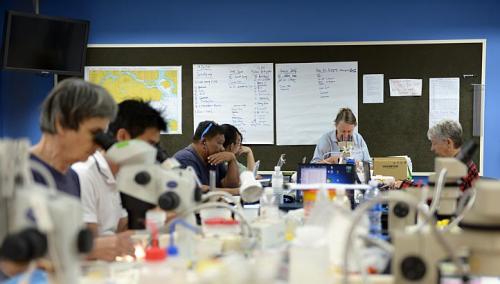
Specimens are lugged back to Outward Bound School on Pulau Ubin, where student volunteers in a large shed pore over trays of tiny shells, looking for movement and sorting out the creatures.

Dr Kathe Jensen, of the University of Copenhagen Zoological Museum, is excited over a minuscule sea snail that looks like a leaf. It has been seen in Australia before, but not here.

Said Professor Ng: "The myth of Singapore is that because we are so urbanised, everything has changed, and there's not much around." But Singapore plays host to a third of the world's hard coral species, and other creatures are still being discovered. Some may be tiny and not "sexy", he said. "But at the end of the day, these are all fellow Singaporeans."

Additional reporting by Melody Zaccheus

Photos by Ng Sor Luan

An assortment of sea creatures dredged up from the seabed near Coney Island off Punggol. The creatures, originally covered in mud, have been given a rinse and are awaiting an initial phase of sorting out on the dredging vessel. The creatures are caught by lowering a beam trawl - a net with a beam to keep it open - 18m to the seabed.

Scientists study specimens brought in from the field trips and dredging (above, left) in a temporary laboratory at the Outward Bound School on Pulau Ubin, while (above, right) Dr Joelle Lai and Dr Arthur Anker of NUS pan for shrimp, which Dr Anker studies, at Chek Jawa's seagrass beds.

These ponyfish give off their own light. The Northern expedition is led by the National University of Singapore and National Parks Board, and is part of the five-year Comprehensive Marine Biodiversity Survey.

Creatures like this crab may not be "sexy", says NUS biologist Peter Ng, but they are "all fellow Singaporeans". The myth of Singapore, he says, is that everything has changed with urbanisation.But discoveries are still being made, and the survey will help the Republic decide what to conserve and how to develop industry with minimal harm to marine life here. -- ST PHOTOS: NG SOR LUAN

1,000 specimens collected in marine biodiversity expedition
Today Online 23 Oct 12;

Singapore - About 1,000 specimens have been collected, including five new records and two rediscoveries, as the country's biggest scale marine biodiversity expedition gets underway in the Johor Straits.

Among the new discoveries included Subtidal Lantern Shells, which are found in intertidal habitats, as well as Plate Crabs, known from several places in the Indian Ocean and the Pacific.

The expedition is part of Singapore's first Comprehensive Marine Biodiversity Survey, which is a national initiative to take stock of the Republic's marine ecosystem, species diversity and distribution.

The survey, launched in 2010, was initially projected to last for only three years, but has been extended to five, in view of the diversity and volume of specimens collected, said the National Parks Board (NParks) today.

The three-week long expedition, which began on Oct 15, involves 150 local scientists, conservation officers and volunteers. A team of 20 renowned scientists from 10 countries is also participating in the expedition to help collect and study specimens from Singapore's estuarine and seabed habitats.

NParks said it plans to conduct coral reef surveys next year. There are also plans for deep sea surveys, to sample the seabed fauna in areas which are deeper than 80 metre.

New marine specimens found in Johor Straits
Today Online 24 Oct 12;

SINGAPORE - About 1,000 specimens, including five new records and two rediscoveries, have been collected in Singapore's biggest-scale marine biodiversity expedition in the Johor Straits. Among the new discoveries are Subtidal Lantern Shells, which are found in intertidal habitats, as well as Plate Crabs, known from several places in the Indian Ocean and the Pacific.

The expedition, which begins on Oct 15, is part of Singapore's first Comprehensive Marine Biodiversity Survey, a national initiative to take stock of the Republic's marine ecosystem, species diversity and distribution.

The survey, launched in 2010, was initially projected to last for only three years but has been extended to five, in view of the diversity and volume of specimens collected, the National Parks Board (NParks) said yesterday.

NParks added that it plans to conduct coral reef surveys next year. There are also plans for deep sea surveys, to sample the seabed fauna in areas which are deeper than 80m.

Scientists take part in largest ‘sea-fari’
The Star 25 Oct 12;

Beneath the scorching noon sun and pelting rain, a small army of scientists and volunteers have been scouring Singapore’s northern shores.

Whether they are examining the Chek Jawa mudflats or trawling the sea off Changi by boat, their lives have revolved around tide tables, boat landings and the persistent smell of fish.

The researchers are taking part in Singapore’s largest marine biodiversity expedition to date. Close to 200 people – including 20 scientists from abroad – are involved in the audit of marine life around the Republic’s northern islands and coasts.

The northern expedition, which started on Oct 15, is led by the National University of Singapore (NUS) and National Parks Board, and is part of the five-year Com­­prehensive Marine Biodiversity Survey.

About S$1.5mil (RM3.75mil) in funding had been obtained for the survey from corporate sponsors and the government, but at least another S$1.5mil needed to be raised, said the board’s deputy chief executive Dr Leong Chee Chiew at the expedition’s official launch on Pulau Ubin yesterday.

Senior Minister of State for National Development Tan Chuan-Jin, who was at the launch, said the survey would allow government planners to assess and prioritise the areas to conserve.

Tan, who is also Acting Manpower Minister, said in a Facebook post on Tuesday night: “Much as we would like to, we will not be able to conserve all areas with biodiversity as some of these areas will be needed for development.”

A typical day for those taking part in the expedition goes as follows: A pair of young scientists from the United States might lug metres of net out to catch thumbnail-sized ponyfish that give off their own light.

A National University of Singa­pore shrimp researcher might sift through bits of shell and coral as though panning for gold. And an Australian fish expert might net gobies in tide pools.

The highlight of the expedition is a series of seabed trawls and dredges, for example, between Pu­­­lau Ubin and Punggol. Dredges are preferable to diving in Singa­pore’s murky waters.

Specimens are lugged back to Outward Bound School on Pulau Ubin, where student volunteers in a large shed pore over trays of tiny shells, looking for movement and sorting out the creatures. — The Straits Times / Asia News Net­work

Related links
Chinese media reports on the Raffles Museum News blog.


Read more!

Malaysia: Stalking sea mammals in Langkawi

Marc De Faquite The Star 23 Oct 12;

Marine biologist Dr Louisa Ponnampalam is ‘living her dream’, studying marine mam mals. Marine biologist Dr Louisa Ponnampalam is ‘living her dream’, studying marine mam mals.

Biologists are collecting data on cetaceans in Langkawi in a bid to understand how best to protect them.

WHENEVER Langkawi is mentioned, it usually conjures up images of sandy beaches, rainforests, waterfalls, mangroves and duty-free shopping. Few visitors realise that the waters around Langkawi’s 104 islands are home to dolphins, porpoises and even whales.

Marine biologist Dr Louisa Ponnampalam, co-founder of the MareCet Research Organisation which is involved in marine mammal research, hopes that this will change and is working hard to increase awareness and collect data about marine mammals in the island off Kedah.

“If we can do good research here in Langkawi, then we can start to think about starting similar research projects in places like Penang and Perak,” she says.

Last month, she conducted a week-long survey of marine mammals with volunteers and members of Langkawi Dolphin Research, a project of MareCet. The organisation derives its name from the Latin mare – meaning sea – and a contraction of the word cetacean, which is the collective noun for whales, dolphins and porpoises. As the name suggests, these are the animals that are the object of Ponnampalam’s study.

“We’ve been doing this since 2010. The more data we collect, the more we will know about the habits of these mammals in their natural environment. We can use this knowledge to understand how best to protect them.”

Some of the data gathered during the field trip includes new information on the distribution of marine mammals around Langkawi, including estimates of group size and the movement and abundance of these groups. By comparing photos from previous field trips, Ponnampalam has shown that some individual humpback dolphins seem to prefer certain sites around Langkawi, while others tend to move around the archipelago a bit more.

When asked why the organisation chose to focus on Langkawi, she replies: “We had already heard of quite a few sightings in Langkawi, so we knew there were marine mammals here, but there was no reliable data to say exactly how many and of what species. Since Langkawi is one of Malaysia’s top tourism destinations, we felt it important to understand the dynamics of how land-based and water-based human activities may be affecting the animals and their marine environment. The fact that Langkawi is easily accessible compared to the islands on the east coast of the peninsula makes a difference, too.”

As well as spending time at sea looking for cetaceans, members of MareCet are also actively involved in establishing a dialogue with local fishermen who are also an important source of first-hand information about the presence and behaviour of marine mammals. MareCet provides guidelines to them on safe fishing practices, particularly the types of nets and hooks to be used to avoid injuring or killing marine mammals. Their website also provides advice for tourism operators, which include not allowing anyone to feed, touch or swim with the animals.

Living her dream

Ponnampalam is a dynamic young woman who clearly has the dedication and drive necessary for her chosen career.

“This is what I’ve always wanted to do,” she says. “I am living my dream. When I was 13, I told everyone that I would go to Hawaii and study to become a marine biologist and that I would set up my own research facility back in Malaysia. I haven’t quite achieved the second part yet, but MareCet is a starting point.”

Although she studied in Hawaii and Scotland and did research for her PhD in Oman, she always planned on returning to Malaysia. “I love to travel, but Malaysia is my home. And the marine mammals here are begging to be studied. Marine biology is still very young in Malaysia. Compared to other countries, there is still a lot to do here. That makes it exciting to be a marine biologist in Malaysia. In a way, we are pioneers.”

During last month’s survey, the group sighted Indo-Pacific finless porpoises, Indo-Pacific humpback dolphins, Indo-Pacific bottlenose dolphins and Bryde’s whales around Langkawi as well as Irrawaddy dolphins close to Kuala Perlis. Group sizes for the dolphins and porpoises ranged from one to 150 individuals but for whales, only one or two were seen at a time.

I was lucky enough to be invited to join the survey team on two of their field trips. Both days, we set off before 7am and did not get back until 10pm. Most of that time was spent out on the water.

“It’s a reality check for some of the young students who are considering a career in marine biology,” says Ponnampalam. “My friends say, ‘Oh, you’re so lucky to go out on the boat’ but they don’t see the long hours we put in. Not everyone is willing, or able, to spend time in such basic conditions, or eat peanut butter sandwiches every day,” she says with a laugh.

Most of her days on board are spent in a high seat that reminds me of a tennis umpire’s chair. From that vantage point, there is a greater field of vision, but it is exhausting to keep watching the waves for any sign of movement in the water. Every wave and shadow makes you wonder if something is there.

The first morning, after barely half an hour out of Kuah harbour, we spot something. The boat idles to a halt. The silence ringing in my ears after the engine cuts out is soon replaced by the splash of waves against the fibreglass hull of the boat.

“Indo-Pacific finless porpoise – three, possibly five,” calls out Ponnampalam from her perch, looking through a pair of binoculars. This information is noted down, along with the GPS coordinates. Visibility and wave swell height according to the Beaufort scale are jotted down as well and we take measurements of depth, water temperature, salinity, level of dissolved oxygen and the presence of any other boats in the vicinity. All this raw data will be fed into a computer at the end of the day and will provide Ponnampalam with plenty of work at her post in the Institute of Ocean and Earth Sciences in Universiti Malaya, Kuala Lumpur.

“We’ve seen large groups of Indo-Pacific humpback dolphins during this trip and they appear to consist mainly of mother-calf pairs, perhaps a strategy of ‘safety in numbers’. We also observed very high-energy social and sexual activity in the groups of humpback dolphins that we encountered.”

Helpful technology

This year, another boat has joined in the survey. Dr Satoko Kimura of Nagoya University in Japan is an acoustics specialist conducting research on freshwater ρnless porpoises found in the Yangtze River in China and has come to Langkawi to further her research.

“We are very lucky that she can join us on this field trip,” says Ponnampalam. “It’s the first time that we are using acoustic methods to study dolphins in Malaysia.”

I join Kimura’s boat in the afternoon. The skipper is a sleepy fisherman who spends his nights fishing for squid. I help Kimura keep him awake, but occasionally he falls asleep and the boat steers wildly off course. Her boat travels more slowly than the lead boat and trails a long cable with specially designed microphones attached.

“Dolphins and porpoises make sounds all the time,” says Kimura. “If there is poor visibility, they use sounds to let each other know where they are. They communicate in very high-frequency sounds that humans cannot hear. We can hear 16-20 hertz but Yangtze finless porpoises can hear up to 125 hertz.”

There are two NBHF (Narrow-Band High-Frequency) units on the cable, each with two microphones. Analysing the sounds by triangulation can give the precise location of a mammal and, in a small group, give an idea of the number of individuals present. This data will later be compared to Ponnampalam’s visual sightings.

“Maybe she can see two or three dolphins but the acoustic readings can sometimes show that there were more individuals below the surface. This gives us more accurate data,” says Kimura.

Other than the few porpoises in the morning, we don’t see anything else for the rest of the day. The steady hypnotic hum of the boat engine and the rocking of the waves conspire to lull me to sleep. I wake to find that the wind has picked up. White crests are zipping across the peaks of the waves as the weather hovers between three and four on the Beaufort scale.

GPS coordinates have been pre-set and we follow invisible transect lines along the sea, ranging from almost all the way south to Pulau Payar, where fishing trawlers hover just beyond the border of the designated marine park, close to Kuala Perlis in the north, just a couple of nautical miles shy of the border with Thailand. It is dark by the time we return to Kuah harbour.

Biggest fish

The following evening, Ponnampalam tells me that the team sighted 152 Indo-Pacific humpback dolphins. This was something I really wanted to see, so I joined the team again the following day in the hopes of sighting something similar. This time, the transect lines were shorter and ranged more to the south of Langkawi, skirting Pulau Tuba, Pulau Dayang Bunting and dozens of smaller islands with isolated empty beaches and interesting rock formations. I discovered parts of Langkawi that I had never seen before, well off the paths of the standard island-hopping tours that are so popular with the island’s visitors.

I was travelling in Kimura’s boat. Ponnampalam and her team had reached the end of the line and were waiting for us to arrive. Suddenly everyone was standing up and pointing at something in the water. I saw see a few ripples, but couldn’t tell what it was.

“A whale shark,” shouts Ponnampalam excitedly. I took from her demeanour that this was something quite exceptional.

Our boatman took us in a bit closer to the ripples, but I still couldn’t see anything except the reflected glare off the surface of the water. Then suddenly it was there right beside our boat, barely a metre beneath the surface. I was stunned by the size of it – almost as long as our boat and more than big enough to overturn us if it should so wish, but the whale shark seemed content to let us admire the rows of star-like patterns on its back and give us the time to snap a few photos. The whale shark is the world’s biggest fish and can measure up to 14m. The creature we spotted is roughly half that size.

After a few minutes, it dived deeper and then the surface ripples appeared further out. The boatmen turned their boats and we headed back towards the main island.

“According to local fishermen, they are found near Langkawi from September to February,” says Ponnampalam .

The following day, the MareCet team made two more whale shark sightings in addition to all the other data gathered over the week.

Malaysia is a maritime nation and a fish-eating nation. It depends on the health of its waters to feed its population and maintain its fisheries. In order to protect its maritime assets, more has to be understood about these complex ecosystems and that requires dedicated researchers like Ponnampalam and her team and the facilities necessary to do their work.

“I hope that we can raise awareness of the importance of marine conservation in Malaysia and that the work we are doing will someday materialise into a permanent research facility here in Langkawi,” says Ponnampalam.


Read more!

World pledges more money to protect biodiversity

Mariette le Roux (AFP) Google News 21 Oct 12;

HYDERABAD, India — Efforts to stem the worrying loss of Earth's dwindling natural resources received a boost Saturday when a UN conference in India agreed to double biodiversity aid to poor countries.

But in a week that saw 400 plants and animals added to a "Red List" at risk of extinction, some observers said this was not enough to reverse the decline in species and habitats that humans depend on for food, shelter and livelihoods.

A quarter of the world's mammals, 13 percent of birds, 41 percent of amphibians and 33 percent of reef-building corals are now at risk of extinction, according to the International Union for Conservation of Nature.

"Efforts to conserve nature must be urgently scaled up if we want to meet the 2020 deadline to save all life on Earth," it said of the deal.

Governments reached an early-morning agreement after long nights of tough bargaining in Hyderabad, south India, to double biodiversity-related funding to developing countries by 2015 and maintain the rate until 2020.

This was from a baseline of average annual aid in the period 2006-2010, said a document issued at the close of the Convention on Biological Diversity (CBD) meeting.

No figures were mentioned, but there was consensus among observer groups that a doubling of government biodiversity aid from developed countries to poor ones should yield an annual figure of about $10 billion (8 billion euros).

It was also agreed that at least 75 percent of recipient countries must report on their spending by 2015 and draw up national biodiversity plans.

UN countries decided at the last CBD conference in Nagoya, Japan, two years ago to an ambitious 20-point plan to turn back the tide of biodiversity depletion by 2020.

The so-called Aichi Biodiversity Targets include halving the rate of habitat loss, expanding water and land areas under conservation, preventing the extinction of species on the threatened list, and restoring at least 15 percent of degraded ecosystems.

Green group WWF said about $200 billion must be invested in biodiversity every year if the targets are to be met.

"What's been agreed in Hyderabad represents less than half this number," it said in a statement and called the deal "disappointing".

Conservation International, too, said much more must be done.

"We do have concerns about what the investment levels will actually be and whether or not they will be sufficient," said the group's biodiversity director Lina Barrera.

In crunch talks that once again saw battle lines drawn between developing and affluent states, negotiators in Hyderabad clashed over the extent and timing of additional aid.

Canada objected to the deal, but did not block its adoption, complaining that many recipient countries had failed to meet a target for reporting on their biodiversity spending and needs.

Francisco Gaetani, chief negotiator for Brazil -- a country which other delegates accused of taking a tough stance on behalf of the developing world -- said the deal "could be more ambitious", but the country was "satisfied".

CBD member countries lamented at the close of the talks that "the lack of sufficient financial resources" was hampering progress.

And they called on one another in a joint statement "to consider all possible sources and means that can help to meet the level of resources needed".

The global economic troubles have left governments less keen to divert money to conservation, especially in developing countries battling inflation, poverty and unemployment.

"In the context of the financial crisis, this is a good deal," French Environment Minister Delphine Batho told AFP.

And European commissioner for the environment Janez Potocnik said it was "an essential contribution".

The conference awarded the next CBD meeting in 2014 to South Korea.

It also identified more than 50 zones that need protection on the high seas, where no national laws apply and international rules are often vague, leaving them vulnerable to damaging fishing and oil prospecting practices.

The CBD, to which 193 countries are signatories, marks its 20th anniversary this year.

It has already missed one key deadline when it failed to meet the target set to arrest biodiversity loss by 2010.


Read more!

GM Crops To Boost Malaysia's Food Security

Linda Khoo and Nur Syuhada Shamsudin Bernama 22 Oct 12;

KUALA LUMPUR, Oct 22 (Bernama) -- Rapid population growth, climate change, escalating food prices, diminishing agricultural land and water resources pose a serious setback in increasing food output to feed the world's fast growing population.

Hence, scientists have to seek better solutions for farmers for increasing productivity on smaller tracts of land using less water, energy, fertilisers and pesticides.

Local researchers, like their counterparts in the developed world, believe that Genetic Modification (GM) Technology could well be the holy grail for enhancing the country's food output in the future.

GM crops not only help to boost yields and nutrients, but also enhance taste and quality, improve resistance to diseases and pests which in turn reduces the use of pesticides and herbicides.

Malaysia is making significant progress in GM crops with the first genetically modified crop set to make its way to the farms or fields within the next six to eight years.

GETTING INTO THE GM BANDWAGON

GM crops not only help to enhance output using fewer resources but also help in addressing many nutritional and health issues confronting Malaysian society, like those pointed out by the Malaysian Agricultural Research Institute's (Mardi) Deputy Director of Molecular Biology and Genetic Engineering Programme, Dr Indu Bala Jaganath.

"While Malaysia is not on the verge of a food crisis, it is facing nutritional insecurity where communal diseases such as cardiovascular disease (CVD), diabetes and cancer are increasing.

"Genetic Modification (GM) can be applied to increase the nutritional and therapeutic status of the crop," explained Dr Indu, providing the Transgenic Golden rice variety being developed by the International Rice Research Institute (IRRI) to address Vitamin A deficiency as an example.

Mardi has already embarked on developing a variety of genetically modified rice with better traits, including better adaptability to climatic changes such as drought, submergence (flood) and tolerance/resistance to pests and diseases.

"We cannot depend on conventional agriculture techniques alone.

"We need robust technological innovations to revolutionise current agriculture to meet food self sufficiency. We have to radically transform agriculture.

"GM technology may hold the key. We cannot afford to overlook GM technology, in our efforts to address the global challenges of growing population, compounded with changing climate and limited fertile land," she said to Bernama.

GM TECHNOLOGY IN MALAYSIA

Dr Indu noted that Mardi is developing GM rice that could withstand sheath blight caused by the fungus Rhizoctonia Solani. Sheath blight is a major disease that affects the yield and grain quality whereby farmers suffer huge losses.

As rice varieties resistant or tolerant to the disease are lacking, farmers and researchers cannot depend on conventional breeding methods to improve the resistance to sheath blight.

Looking at the fact that there is no effective chemical or agricultural practice to control the disease, Mardi has adopted the GM approach to develop rice varieties resistant to the disease.

"We are currently working at the lab and confined field level. Our next step will be to carry out open field evaluation where comprehensive bio safety analysis will be conducted.

"We can see the first GM crop in Malaysia within the next six to eight years. However, it all depends on the success of the trials and the stability of the incorporated gene," she said.

DELAYED-RIPENING PAPAYA

Meanwhile, Mardi's Director of Biotechnology Research Centre Dr Umi Kalsom Abu Bakar said that transgenic papayas with delayed-ripening traits were being developed to enable the fruit to stretch its shelf life and maintain its quality during shipment.

"If we want to export our papaya by air, it is very costly. To reduce post-harvest losses and improve the quality and marketability of papayas, Mardi is developing delayed-ripening papaya to slow down the ripening process to help the exporters.

"The idea of developing papaya with longer shelf life for export has been there for quite some time but we did not have the particular traits then. Now, since we have the traits, we hope to develop them further and commercialise them soon," she said.

Several potential transgenic Eksotika papaya lines with delayed-ripening characteristic have been produced and further confined field trial evaluation is on the way to validate the required trait in the GM papaya.

Dr Umi added that apart from this Mardi has been developing papaya varieties with resistance to dieback disease that destroys papaya plants.

Papaya dieback disease was first reported in 2003 and the disease caused papaya export volumes to plunge from 57,000 tonnes in 2003 to 10,000 tonnes in 2008, and the losses amounted to RM51.5 million.

"Papaya dieback disease is a threat to Malaysia's papaya plantation industry. Our scientists are working hard to identify the resistant gene that can withstand the papaya dieback disease."

ECONOMIC AND ENVIRONMENTAL BENEFITS

Meanwhile, the Director of PG Economics Limited, Graham Brookes said that GM crops have reduced pesticide use by 438 million kgs and this has decreased the environmental impact associated with herbicide and insecticide use in the area planted with biotech crops by 17.9 per cent.

Brookes, who is also the co-author of the seventh annual report on "Global Impact of Biotech Crops: Economic and Environmental Effects 1996-2010", said GM crop has significantly reduced greenhouse gas emissions from agricultural practices.

In 2010, this was equivalent to removing 19.4 billion kg of carbon dioxide from the atmosphere or removing 8.6 million cars from the road for a year.

"After 16 years of growing and consuming biotechnology crops, there has been no credible and documented evidence of any negative safety, health or environmental impact," he said referring to the scepticism harboured by the opponents of GM crops.

In a nutshell, GM crops could well be the answer for feeding mankind in the future and Malaysia is well aware of the GM crops' vast potential in achieving its food security target.

-- BERNAMA


Read more!