NEA awards S$300m integrated cleaning contracts for north-east, south-east regions

Alice Chia Channel NewsAsia 3 Jun 14;

SINGAPORE: About S$300 million worth of integrated contracts for cleaning the north-east and south-east regions in Singapore have been awarded by the National Environment Agency (NEA) on Tuesday (June 3).

A seven-year contract worth S$143 million was awarded to Chye Thiam Maintenance to clean the north-east region, while Ramky Cleantech Services was awarded the eight-year contract worth S$158 million to clean the south-east region, the NEA said.

NEA's Department of Public Cleanliness have consolidated all the cleaning works for the country's public areas into seven contracts for greater efficiency and better coordination. The contracts cover the cleaning of areas such as PUB drains, NParks public parks and URA car parks.

The management of public area cleaning was previously done by various agencies.

Four integrated contracts for other regions in Singapore have already been awarded, leaving one remaining tender for the south-west region left to be awarded, the agency said.

It added the various town councils will continue with their existing scope of cleaning the public housing estates.

- CNA/kk


Read more!

Room for growth for businesses going green

Nicole Tan Channel NewsAsia 3 Jun 14;

SINGAPORE: More Singapore businesses have been going green in recent years, but experts say there is still much room for growth.

And while greater efficiency brings about substantial cost savings, analysts note that the upfront spending needed to implement sustainability initiatives may pose a challenge to some small firms.

Those that do invest in installing eco-friendly features and systems can see the benefits of going green.

"We can safely say through more than eight years of operation, the energy load of the buildings have been reduced by about 30 per cent, from just the presence of this rooftop system," said Sylvain Richer De Forges, Director of Sustainability, Siloso Beach Resort.

The resort sits on a natural spring reservoir and this also helps to improve water efficiency.

With features that help to improve energy efficiency, including better ventilation and the optimisation of the use of natural light, the hotel is more than 30 per cent more efficient than the average hotel in Singapore, according to data from the Building and Construction Authority.

Experts say businesses in Singapore are generally taking the issue of sustainability more seriously, particularly as consumers are increasingly becoming environmentally-minded.

Consumer research and consulting firm, Nielsen, reported that 55 per cent of consumers in Asia Pacific buy environmentally friendly products regardless of price; higher than the global average of 46 per cent.

The number of firms reporting on sustainability using international benchmarks outlined in the Global Reporting Initiative has grown.

But they say there is room for improvement.

"We went from three to 50 (firms reporting), that's a hundred percent growth rate every year," said Kenneth Richards, Musim Mas Professor of Sustainability at NUS Business School. "If you compare that to Hong Kong and Taiwan, they are not even close, either in terms of growth rate or absolute numbers.

"At the same time it's a fairly low percentage of those companies that could be reporting. The SGX has close to 800 listed companies -- which means we are only in the range of six or seven per cent.

"So there's a lot of room for growth."

However, industry watchers highlight that the upfront costs may be a hurdle for some firms hoping to embark on sustainability measures.

"MNCs and the big local companies have more resources than the SMEs, so they move faster in terms of sustainability," said Eugene Tay, Director, Green Future Solutions. "In terms of implementing green measures, there's always this upfront costs involved.

"It depends on the company as well as the industry, but if you look at green buildings, the payback period is about three to seven years."


- CNA/rw


Read more!

Water, solid waste to be treated at adjacent facilities in Tuas

John Leong and Alice Chia Channel NewsAsia 3 Jun 14;

SINGAPORE: Singapore will see the implementation of more innovative environmental technologies, following announcements made at the Singapore International Water Week on Tuesday.

In the first initiative of its kind, used water and solid waste will be treated at facilities located next to each other in Tuas.

The National Environment Agency's Integrated Waste Management Facility can handle up to 50 per cent of Singapore's waste treatment capacity, when it is completed by 2024.

Next to it will be the new Tuas Water Reclamation Plant, which will feature an integrated NEWater factory. The integration of multiple treatment processes will help optimise energy and resource recovery, contributing to the long-term goal of increasing NEWater supply to meet up to 55 per cent of total water demand.

This is part of phase two of the Deep Tunnel Sewerage System, with the extension of tunnels to collect used water from the western parts of Singapore.

"Singapore actually benefits from a complete sewage system, which actually will save the land that is used for used water infrastructure. In fact, we would have saved the land used by 50 per cent,” said Chew Men Leong, chief executive of PUB.

“More importantly with its completion, we will actually be able to increase the capacity for recycling of water. That will help us move towards a higher level of recycling."

In another development, Singapore and Denmark agreed to deepen ties in environmental and water sustainability.

Environment and Water Resources Minister Dr Vivian Balakrishnan and the Danish Minister for the Environment Kirsten Brosbol signed a memorandum of understanding (MOU) on Tuesday on the sidelines of the Singapore International Water Week.

Areas covered include the development and deployment of innovative environmental technology as well as flood management.

"We are going to have to invent new solutions to deal with the existential challenges that we will face,” said Dr Balakrishnan.

“If we can successfully devise new solutions, and even more so, by collaborating with each other, I think there will be a world market for our services and our products."

- CNA/ec

Mega waste treatment plant to open in 2024
Feng Zengkun The Straits Times AsiaOne 4 Jun 14;

AN INTEGRATED waste treatment plant capable of processing up to half of Singapore’s solid waste will be in operation from 2024.

The National Environment Agency (NEA) will build the facility in Tuas. It can handle solid waste, food waste, recyclables from the National Recycling Programme and, in a first, sewage sludge from water treatment plants.

It will extract resources like biogas and energy from the waste, joining four existing waste-toenergy incineration plants in Tuas and Senoko and a fifth to be completed by 2018.

Incineration reduces waste’s volume by 90 per cent, so Singapore’s Semakau Landfill will be able to last until at least 2035.

In another first, the integrated facility will be located next to national water agency PUB’s new water reclamation plant, which will be completed in the early 2020s, so they can benefit from each other. Both have been allocated 68ha – about the size of 95 football pitches – in total.

The waste facility can generate power for the water plant which, in return, will supply it with treated used water for cooling and washing.

The close proximity also makes it easier and cheaper to transport the water plant’s sludge for treatment next door. By mixing food waste and sludge, the waste facility can produce more biogas and power.

“These synergies will keep the cost of solid waste disposal affordable in the long term,” said NEA chief executive Ronnie Tay.

PUB’s new water plant will have an integrated Newater factory to boost Singapore’s water self-sufficiency, and is part of the agency’s Deep Tunnel Sewerage System (DTSS) – Singapore’s long-term solution to used water management.

The DTSS is slated to be completed by 2022, and comprises tunnels to move used water by gravity to three advanced treatment plants in Kranji, Changi and Tuas.

These will feature new technology which will help them be more energy-efficient and produce less sludge.

When the DTSS project is completed, two conventional plants in Jurong and Ulu Pandan and their intermediate pumping stations will be shut down progressively.

The entire DTSS will reduce the used water infrastructure’s land footprint by 50 per cent, freeing up land for other uses.

The NEA and PUB yesterday announced at a Singapore International Water Week event that a partnership between design and consultancy firm Aecom and engineering giant Black & Veatch had won a tender to be the lead consultant for the second phase of the DTSS and the waste facility.

Phase 1 cost $3.4 billion and was completed in 2008. It covered northern and eastern Singapore, while Phase 2 will cover the west.

PUB chief executive Chew Men Leong signed the contract with the firms’ representatives yesterday, and said: “For a densely populated city state with limited land, the DTSS is a more strategic solution than renewing and expanding the used water infrastructure.”

Minister for the Environment and Water Resources Vivian Balakrishnan, guest of honour at the signing, added: “Embarking on Phase 2 will bring us closer to fulfilling the vision we set out almost a decade ago.”

Last year, about three million tonnes of solid waste were disposed of.


Read more!

Malaysia: Saving rhinos -- Our fatal blunders

TAN CHENG LI The Star 2 Jun 14;

Mistakes of the past have cost us many rhinos. Now’s the time to learn from the errors.

Between 1984 and 1995, a total of 22 Sumatran rhinos were captured in Peninsular Malaysia and Sabah for a captive breeding project. Except for one which was already pregnant when captured, none bred while in captivity, and all have since died.

Today, there are three captive rhinos in Sabah, taken from the wild in recent years – a male in 2008 and two females in 2011 and in 2014. They are our last hope to breed the critically endangered species in a final bid to boost their numbers.

In the wild, exact numbers are unknown, but rhino experts say the species is most likely extinct in Peninsular Malaysia and on the verge of extinction in Sabah, which has fewer than 10. In short, the Sumatran rhino is “functionally extinct” in Borneo and in Malaysia – meaning that the few individuals remaining are insufficient to save the species.

How did we reach this dire state? A paper “Preventing the extinction of the Sumatran rhinoceros” by three experts from the Borneo Rhino Alliance (Bora) gives a critical account of how Malaysia blundered in its attempt to wrest the species from the brink of extinction.

It points to a combination of lack of knowledge on rhino reproduction biology, poor husbandry and veterinary care in captive centres, a misguided approach in focusing on protecting rhinos in the wild, and lack of co-operation between rhino range states that led to today’s rhino crisis. The paper was authored by Bora chairman Dr Abdul Hamid Ahmad, executive director Dr Junaidi Payne and veterinarian Dr Zainal Zahari Zainuddin,

“There is finally a realisation in Malaysia that it muddled through with Sumatran rhinoceros in the past 50 years, recycling fabricated population estimates and refraining from making necessary conservation decisions,” states the authors in the paper published in the Journal Of Indonesian Natural History (December 2013). It also publicly reveals for the first time, information on the causes of deaths of captive rhinos.

Hunted out

Rhino horns have long been favoured as a folk remedy. In the first decades of the 20th century, extensive hunting had already led to a precipitous decline in its distribution and numbers. By the mid-20th century, the species was depleted from its former range and in danger of extinction in Malaya and Borneo and elsewhere on mainland Asia.

By the early 1980s, wildlife experts estimated the Malaysian population at between 52 and 75, including 20 to 25 individuals in the Endau-Rompin area in Johor, and 15 to 30 in Sabah. In 1995, Dr Zainal found evidence of only five adult rhinos in Endau-Rompin, showing that published estimates of rhino numbers were notoriously unreliable, and that actual numbers had declined by half over the preceding decade.

The United Nations-led Sumatran Rhinoceros Conservation Strategy project (1995–1998) also pointed to a dwindling population, but “... inflated numbers kept appearing in public domain, largely due to some proponents’ disbelief that two decades of effort had failed.” As recent as 2007, official figures still put the rhino population at 70 to 100 in Peninsular Malaysia and 30 in Sabah. The far-from-accurate population figures could have jeopardised conservation efforts.

After the plight of the Sumatran rhino surfaced in the early 1980s, the International Union for Conservation of Nature in 1984 convened the first Sumatran Rhino Crisis Summit, in Singapore. Some 20 representatives from governments, zoos and wildlife institutions made plans to prevent the species’ extinction, which included enhanced protection of wild rhino populations, raising awareness, and developing a global captive breeding population.

From 1984 to 1995, 22 Sumatran rhinos were captured in Malaysia (see table) for a breeding programme. At that time, nothing was known of rhino reproductive biology. The paper says an analysis reveals several kinds of failures which should not have been allowed to occur with such a precious, critically endangered species.

Many rhinos were kept in conditions which caused them poor health and stress. It was known that rhinos live in closed-canopy forest and typically wallow in clean mud for five to six hours daily. However, most captive rhinos were kept in conditions of exposure to sunlight and in some cases without access to clean mud wallows. Frequent sunlit conditions have been linked to partial and complete blindness in some captive rhinos. Other mistakes included feeding unsuitable milk to an infant rhino and unsuitable enclosures which caused one rhino to be trapped between bars, and asphyxiate.

Deaths at rhino centres

Most shocking of all, basic hygiene was generally poor. Some rhinos were kept for long periods in facilities that lacked basic hygiene protocols and biosecurity measures, leading to bacterial infections and eventually, deaths. There was also a lack of experienced veterinary care, causing identification and treatment of disease to come late or not at all. Prior to the development of the Sungai Dusun Rhino Conservation Centre in Selangor, rhinos were maintained at Melaka Zoo, where treated piped water was installed only after the deaths of Sri Delima and Julia.

The tragic death of all six rhinos at Sungai Dusun between April and November 2003 put an end to the captive breeding effort. The cause of deaths was reported to be due to trypanosomiasis originating from buffaloes on nearby land. The paper disputes this. It says long-term monthly monitoring of blood for parasites and blood parameters showed no trypanosomes (a parasitic protozoa) in the rhinos. Also, no trypanosome infection was detected in the blood of the buffaloes. In the post-mortem, trypanosomes were detected in only two of the seven rhinos that died, while abundant bacterial growth was found in the vital organs; mucoid Escherichia coli in five animals and Klebsiella pneumoniae in four.

The paper states that the death of male rhino Shah in January 2002 from mucoid E. coli should have prompted the facility to be on strict alert. Sensitivity tests were done in 2002 and gentamycin was found to be the only effective treatment but it was not used on the ill animals. (The tragedy recurred seven years later – from Sept 17-29, 2010, seven Malayan tapirs died from mucoid E. coli at Sungai Dusun, which by then had been turned into a tapir breeding centre. Only one tapir showed trypanosomes in the blood.)

The paper says trypanosomes might have infected the rhinos and tapirs at any time at Sungai Dusun, and that natural resistance effectively suppressed their growth until the advent of poor health and compromised immune response resulting from chronic mucoid E. coli and Klebsiella infection.

“The conclusion that trypanosomes were the cause of the Sungai Dusun deaths may have been reached erroneously, in order to allow parties involved to avoid responsibility for chronic poor hygiene in the facilities,” says the paper.

It sums up the reasons for the failure of the 1984-1995 effort on captive breeding:

> Insufficient knowledge of Sumatran rhino breeding biology and inadequate high-quality veterinary care and husbandry in captive facilities.

> Unsuitable diet in some facilities, with insufficient attention paid to the risk of iron ferritin disease.

> Stress on rhinos due to weaknesses in facilities design and poor visitor control.

> Over half of all female rhinos have reproductive tract pathology, making natural breeding difficult or impossible.

> Absence of suitable males in Peninsular Malaysia; males in Sabah with low or no sperm production.

> Rhinos were not shared between Peninsular Malaysia and Sabah due to beliefs that they were different subspecies, and between Peninsular Malaysia and Indonesia due to loss of trust after the initial exchange.

> Rhinos were not sent to the United States for breeding programmes.

> Some pairings involved inexperienced or incompatible rhinos.

> Artificial insemination was never attempted due to lack of knowledge.

Failure in preserving wild rhinos

With the deaths of the captive rhinos, the breeding project became unpopular and the focus shifted to saving rhinos in the wild rather than bringing them into fenced, managed conditions. This proved to be a misguided approach as according to the paper, no one knows for sure whether wild populations are of sufficient size and fecundity to assure their survival, even in the absence of poaching.

Moreover, this approach does not address the impact of various factors on small, isolated wild populations or the Allee effect, which refers to a “positive correlation between population size or density and the mean individual fitness”. The Allee effect states that when a population declines to very low numbers, breeding success declines in tandem. This is because factors associated with low numbers (difficulty in finding a mate, narrow genetic base, skewed sex ratio, reproductive tract pathology linked to long periods without breeding) contribute to drive rhino numbers lower and lower, even in places with suitable habitat and no hunting.

“In small, scattered and non-contiguous populations, it is just a matter of time before the average annual death rate exceeds the annual birth rate, and before the population goes extinct.” The authors of the paper believe that the Allee effect was significantly impacting survival of wild rhinos because:

> All records of wild juveniles were anecdotal, with no information on actual annual increase (or decrease) in wild population size.

> Rhino numbers have been very low for many decades in most if not all areas where they are still present, so inbreeding was likely.

> A skewed sex ratio was observed during the capture of rhinos from 1984 to 1995. The male to female ratio was 1:9 in Peninsular Malaysia and 8:1 in Sabah, and all the captured males were old.

> Reproductive tract pathology is common in the captured females, a phenomenon associated with lack of either breeding or carrying of foetuses to successful birth.

“The Allee effect has likely been present in all Sumatran rhino populations over an extended period, effectively entering the Sumatran rhino into the extinction vortex irrespective of whatever protective measures might be put in place in the wild,” declares the paper.

The lesson from Malaysia, it says, is that the priority should have been to increase the number of rhino pregnancies rather than to hope that the mortality rate of wild rhinos through poaching could be reduced. “Protecting wild rhinos may be an over-ambitious option and captive breeding may have a greater chance of success than prevailing wisdom admits.”

What now?

Last April, 100 wildlife experts convened the second Sumatran Rhino Crisis Summit in Singapore. They concluded that without immediate and committed conservation intervention, the Sumatran rhino will go extinct soon. Indonesia and Malaysia were urged to collaborate.

Simulations done during the summit showed that the species stands a good chance of surviving if there are at least 30 individuals with a birth interval of three years or less. The future of populations smaller than that is bleak even if they are healthy and protected. Using a more realistic birth interval of seven years, a starting population of 50 rhinos will have a negative growth rate of about -3% per year.

“This means that, without intervention, all possible known wild and captive populations are in an extinction vortex and are not sufficiently abundant to increase populations in isolation of each other.”

The paper says to reduce the current captive population’s extinction probability to below 10%, some 16 rhinos need to be transferred into captivity and managed with an interval of three years.

To date, there have been only four captive births, all descendants from the same pair in Cincinnati Zoo, the United States. The Sumatra-caught rhinos, Emi and Ipuh, both fertile and compatible, had received excellent care there, resulting in rhino births in 2001, 2004 and 2007. Their offspring, Andalas, was sent to the Sumatran Rhino Sanctuary in Way Kambas National Park, Sumatra, in 2007 and five years later, fathered a male calf.

Lesson learned

“Much of the fear over captive breeding stems from past failures,” says the paper. “But knowledge on rhino biology, animal husbandry and reproductive technology has improved.” Advances include the cryo-preservation of egg cells by vitrification, successful artificial insemination and subsequent live births of the white and Indian rhinos, and in vitro fertilisation.

The paper points to a general consensus that the sole imperative now is to produce Sumatran rhino embryos. This can only be done by bringing every rhino into closely managed facilities, and making maximum use of their gametes.

“Having these rhinos and gametes as part of a globally managed meta-population (separated populations, but with some interaction) is essential, and attempts at natural breeding and artificial insemination must continue as long as either is possible.”

The paper states that in the absence of agreement to share rhinos and gametes between nations and facilities, the current scope in Malaysia is limited. Thus, a key element of current effort is the cryo-preservation of gametes and cells that might be used in the future to restore the species after its extinction in Malaysia.


Raising hope for baby rhinos
LIM CHIA YING The Star 2 Jun 14;

Last-ditch effort: Advanced reproductive technology offers hope for the Sumatran rhino's survival.

Lying chest-down in a quiet, dignified manner, Iman slowly shuts her eyes. She’s taking a rest, says her caretaker, but cutting a forlorn figure, it’s possible that she is trying to contain the discomfort from the pain inside her. A bunch of tumours are growing inside the female rhino’s womb, causing her to bleed.

Some 20 minutes later, she awakens and inches her way to the front of her enclosure to get her feed of leaves and fruits. She appears to have forgotten her pain, and happily gnaws at her food.

Here at the Borneo Rhino Sanctuary (BRS) located in Tabin Wildlife Reserve near Sabah’s east coast town of Lahad Datu, I watch Iman going about her daily routine with a mixture of delight and heartbreak – delight in noting that she continues to eat like a healthy rhino, and heartbreak from the fact that she may never recover from the ailment she has been inflicted with.

The sanctuary is what she calls home now, together with two other rhinos, a male called Tam and a female named Puntung. All were captured from the wild and transferred to the sanctuary where proper care is rendered to ensure their well-being and survival.

The Sumatran rhino is critically endangered; some would say they are on the verge of extinction. Less than 100 are believed to exist in Borneo (Sabah in Malaysia and East Kalimantan in Indonesia) and Sumatra.

Since 2009, Yayasan Sime Darby has put in RM11.4mil for operational expenses and running of the BRS programme. The facility was built by the Sabah Wildlife Department while non-governmental organisation Borneo Rhino Alliance (Bora), led by its executive director Datuk Dr John Payne and veterinarian Dr Zainal Zahari Zainuddin, manages the husbandry and breeding efforts.

Much excitement abounded when Iman was captured on March 10 in one of two traps laid out for her in the Danum Valley Conservation Area. Hopes were high that she would conceive and bear babies, but that soon dissipated after she was found with eight non-malignant tumours in her reproductive tract. In Puntung, her uterus has cysts, making it impossible for her to become pregnant or sustain an embryo.

Iman is being treated to flush out pus as well as halt blood loss and further enlargement of her tumours. Payne reckons that her condition is under control, though the tumours can drain her energy.

“It’s unfortunate that female rhinos have a tendency of being infected by tumours and cysts if they do not produce babies once becoming sexually mature,” he says. “In the case of Puntung, it’s likely that she suffered a failed pregnancy in the past while Iman’s condition implies that she had been sick for a long time.

“Both may be young but their reproductive defects mean it’s highly unlikely they can breed naturally. Our best bet now is to harvest their eggs and sperm from our mature bull Tam for in-vitro fertilisation attempts later on. Now is the time for us to keep trying. There’s no giving up on this final salvation with our last batch of Sumatran rhinos.”

He says Bora has embarked on advanced reproductive biotechnology in partnership with the Leibniz Institute for Zoo and Wildlife Research (IZW) in Berlin, Germany.

“We are engaging IZW to assist us with lab breeding of the embryos as the institute specialises in reproductive problems of mammals in captivity. On May 9, we had IZW’s Dr Thomas Hildebrandt and his veterinary team in Malaysia to remove two oocytes (immature egg cells) from Iman. They are stored in a buffer solution at rhino body temperature, as the idea is to mature them in the lab.

“I’m cautiously optimistic of mixing the oocytes and sperm, which can be done either through in-vitro fertilisation if there are plenty of sperms, or the intracellular sperm injection technique, which is to inject single, individual sperms into the egg,” says Payne.

IZW has had success with in-vitro fertilisation with the black rhinoceros, though the fetus died eventually. While such fertilisation attempts have yet to be tried on critically endangered species, Payne says the method has been successful with the European bison (numbers at one point were down to 50 before they were captive-bred and saved from extinction in the 1920s and 30s) and the Arabian oryx (numbers rebounded following release of captive-bred animals into the wild from the 60s to 80s.)

“It will be good for the Malaysian government to be made aware that advanced reproductive biotechnology is the way forward to produce baby rhinos to ensure the species’ continuity through generations to come. When a species becomes scarce, the only option is to keep them in captivity and carry out breeding, assisted or otherwise,” says Payne.

He says the technique includes preserving rhino genomes through the freezing of cells.

“We are also looking to synchronise the oestrous cycle (period of sexual receptivity) of Puntung and Iman through use of hormones so that both can produce eggs on a date that can be predicted. This is done to enable more extraction of oocytes when the IZW team return to harvest the second batch.”

Tam will contribute his sperm in more frequent sessions of the electro-ejaculation procedure, regarded as a safe collection of semen samples performed under general anaesthesia.

Payne says if the assisted reproductive attempts succeed, the next step is to seek surrogate rhino mothers for the embryos to grow.

“We have the option of either using two the fertile female rhinos in captivity in Indonesia, or other rhino species available in zoos, which would be the last resort.

“There have been interactions between the Malaysian and Indonesian governments, and we are open to any moves from Indonesia to collaborate. I think it is fair to say that Indonesia, though having few Sumatran rhinos themselves but a lot more than us, will play the key nation role to save the species from extinction,” he says.

The Sumatran Rhino Crisis Summit held in Singapore last April had acknowledged the importance of an alliance and had proposed for governmental collaboration.

Payne says he wishes to clarify the general perception that Sumatran rhinos are dying out from problems related to deforestation, habitat loss and poaching – factors which he says are not true.

“Their deaths have nothing to do too with the oil palm industry, that’s just a misguided (perception). Rather, it is more linked to the biology of the species. It must be said that even during the 1930s, Sumatran rhinos were already very rare,” he says.

Giving a low-down on the animal’s ancient existence, he says the Sumatran rhino, the world’s smallest rhino, is a prehistoric relic dating back 20 million years when they roamed the lowlands. They survived and evolved along the different periods when other species were wiped out, and until about 1,000 years ago, the Sumatran rhino was hunted for its horn after it was widely presumed to contain anti-inflammatory and cooling properties. This depressed the population size from a long time ago, says Payne.

The Sabah government had, last March, decided to trap all remaining wild rhinos rather than leave them in the forest where chances of meeting a mate and breeding are low.

“This is why we will continue looking rigorously for more wild rhinos and the focus is on Danum Valley this year, where we believe there are still a few more out there,” says Payne.

Yayasan Sime Darby chief executive officer Yatela Zainal Abidin says a new facility will be ready in Danum Valley in July to house new rhinos caught there. The RM1.4mil centre is funded by Sabah Forestry while Yayasan contributed RM250,000.

“The scenario seems bleak and desperate, but we are not giving up. We are hopeful that the scientific approach can boost birth of babies and save these rhinos from vanishing,” says Yatela.

Yayasan’s commitment to the rhino project spans six years through 2015, after which it will be reviewed for future extensions.


Read more!

Malaysia: Large swarm of giant moths invades Kuantan

The Star 4 Jun 14;

KUANTAN: The capital of Pahang has seen an invasion of giant moths over the past week, raising questions among residents and visitors alike.

They are active at night and often converge in areas with bright lights.

The Darul Makmur Stadium was a target during the Pahang-Johor Darul Takzim FA Cup semi-final match last Friday.

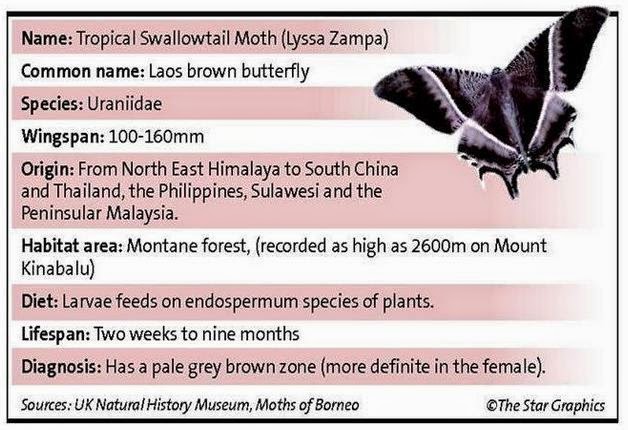
Universiti Sains Malaysia School of Biological Sciences entomology professor Che Salmah Mat Rawi said the insect was also known by its scientific name lyssa zampa docile.

She said numerous theories could be tied to the emergence of these giant moths, such as a change in the weather.

“Normally, the insects are found in the highlands but they can also be found in large numbers in agriculture or development areas, especially from May to August each year.

“This giant moth is nocturnal and is attracted to bright lights. During the day, it will rest in a shaded and cool area, such as under the roof of a house or at the foot of large trees,” she said.

Che Salmah said that other than a change in the weather and the bright lights, the presence of the moths could also be due to ample food supply as well as a lack of natural enemies.

“Although studies indicate that the insect is not poisonous, the moth can cause itchiness.

“The hair on their wings can also disturb respiration and this can be most sensitive to asthma sufferers,” she said. — Bernama

Moths smother Kuantan
New Straits Times 4 Jun 14;

KUANTAN: Swarms of moths invaded the state capital over the past three weeks.

Lured by the bright lights, the insects were spotted flying in eateries, offices, homes and over electronic billboards.
The unwelcomed guests stole the limelight during the FA Cup semifinal match between Pahang and JDT on May 30, when they swarmed the Darul Makmur Stadium. Their presence has created an eyesore as thousands were often spotted lying dead in huge piles along corridors outside shoplots.

M. Leenakumari, 37, said the light from the television in her living room was enough to draw the moths into her home and she was forced to sweep the house twice daily to remove the dead ones.

“It is annoying, especially when the moths fly around in the bedroom or living room. Sometimes they crash into the ceiling fan blades and end up all over the floor.”

Hashim Mohd, 45, an engineer, said the moths had swarmed guests at his son’s birthday party last week and he was forced to cover the birthday cake, fearing the insects might land on it.

Universiti Sains Malaysia School of Biological Sciences entomology Professor Che Salmah Md Rawi said the moths, from the Lyssa zampa docile species, were commonly seen towards the end of the wet and the beginning of the dry season.

Attracted to lights, she said the abundance of the species in Kuantan could be because of availability of food, absence of natural predators, weather conditions and change in daily temperatures.

She said there had been no report of any toxic material produced by this species but direct contact with the moth could cause some skin irritation due to the presence of urticating scales on the underside of the insect’s abdomen.

'Lack of predators cause moths to thrive'
LOH FOON FONG AND RAHMAH GHAZALI The Star 5 Jun 14;

PETALING JAYA: A lack of predators such as caterpillar-feeding birds could have led to the sudden swarm of giant moths in Kuantan and other parts of the country, said an expert.

Calling it “unprecedented” and “abnormal”, Universiti Kebang-saan Malaysia entomologist Dr Norela Sulaiman said the “invasion” by giant tropical swallowtail moths (Lyssa zampa) could be a “one-off occurrence”.

“I believe there is a lack of predators such as birds which usually eat the catterpillars,” said Dr Norela.

Entomological Society of Malaysia president Prof Dr Idris Abdul Ghani said the “invasion” could also be due to the large availability of food plants.

“At the same time, it could be that their natural enemies, such as parasites and other pathogens, are not active enough to harm them and they thrive,” he said.

Asked on reports that the moths had congregated at the Kuala Lumpur City Centre (KLCC), he said there could be host plants in the nearby Bukit Nenas forest reserve.

“The bright lights in KLCC could have attracted them there.”

It's that time of the moth
DINA MURAD The Star 5 Jun 14;

PETALING JAYA: Giant moths are swarming – and bugging people – across Malaysia, with sightings reported in many areas besides Kuantan, where their presence is already causing a buzz.

Netizens posted on The Star Online’s Facebook page that they had observed moths in Perak, Kuala Lumpur, Malacca, Johor, Penang, Selangor, Negri Sembilan and Sabah.

Napsiah Wan Salleh said she saw giant moths in the Klang Valley.

“I saw four light brown moths with white straight line on the wings in my area the last few days.

“I saw one again this morning,” she said, attributing it to a boom in caterpillar population due to the rain coming soon after the dry weather earlier this year.

Addell Tan said he found two moths on his car in Malacca, while Johnny Lum and Pauline Goh reported seeing them in Ipoh and Pontian.

“They are kind of pretty but it is scary that they are so big.

“(I) always find them dead on the side of the buildings in the mornings,” said Ketiswary Nachiar from Kuantan.

“Strangely, I saw one this morning in Kota Kinabalu.

“I was surprised because TV reported (that) there were many in Kuantan,” wrote Sim Josie.

“I saw four at my condo last week and I live on the 23rd floor. (I) was just thinking why so many,” said Maggie Song.

Although some welcomed the sight of the fluttering insect, others were more cautious as these creatures were traditionally believed to bring ill omen.

“Old people say someone is visiting,” said Olivia Airine Sue, alluding to the myth that moths were physical manifestations of departed loved ones.

“Not a good omen,” said user Tom Said, while Vivien Wong wrote that it “must be a sign that bad things are going to happen soon”.

Other netizens provided advice for those who might come across the insects.


Read more!

Malaysia: One-stop environmental platform

VICTORIA BROWN The Star 3 Jun 14;

KUALA LUMPUR: If you are passionate about the environment and want to be part of a movement to help Mother Earth, but do not know where to start or what to do, a Malaysian website will show you how.

The one-of-a-kind Malaysia Environmental Sustainability Youth Movements website, co-founded by Dr Jun-E Tan and her Argentine husband Leonardo Losoviz, is an innovative online hub for the Malaysian environmental scene and a platform for those who want to get involved

“There are many different activities and events happening in Malaysia, but these organisations are not connected. So we basically put all these environmental events and activities happening around Malaysia on a single platform so that everybody can access it,” said Losoviz.

“Our mission is to connect the green dots where different people, sectors, communities and ideas are linked together to create a bigger picture,” said Dr Tan.

“We’re giving people information so that they can participate and we’re urging people to participate by giving them the who, what, when, where, and how,” she added.


Read more!

Action needed to safeguard genetic diversity of the world's forests

FAO publishes first global study of forest genetic resources
FAO 3 Jun 14;

3 June 2014, Rome - FAO today urged countries to improve data gathering and research to promote the conservation and sustainable management of the world's forest genetic resources, which are coming under increasing pressure.

According to the first-ever edition of The State of the World's Forest Genetic Resources report, half of the forest species reported as regularly utilized by countries are threatened by the conversion of forests to pastures and farmland, overexploitation, and the impacts of climate change.

"Forests provide food, goods and services which are essential to the survival and well-being of all humanity. These benefits all rely on safeguarding the rich store of the world's forest genetic diversity - which is increasingly at risk," said FAO Assistant Director-General for Forestry Eduardo Rojas-Briales. "This report constitutes a major step in building the information and knowledge base required for action towards better conservation and sustainable management of the planet's precious forest genetic resources," he added.

Linda Collette, Secretary of the FAO Commission on Genetic Resources for Food and Agriculture (CGRFA), said: "Data from 86 countries illustrate that insufficient awareness of the importance of forest genetic resources in improving forest production and enhancing ecosystems, often translate into national policies that are partial, ineffective, or non-existent."

Collette added: "Only about 3 percent of the world's tree species are actively managed. Governments need to act and implement the Global Plan of Action for Forest Genetic Resources and FAO and its Commission stand ready to guide, support and assist countries in the conservation and sustainable use of forest genetic resources."

Genetic diversity critical

The contribution of forests and trees to boosting food security, reducing poverty, and promoting sustainable development depends on the availability of a rich diversity of tree species.

Biodiversity in forest genetic resources is essential to improving both forest species' productivity and the nutritional value of the foods they produce - which includes leafy vegetables, honey, fruits, seeds, nuts, roots, tubers and mushrooms.

Genetic diversity allows breeders to increase their production in quality and quantity. A wide variability in desirable traits, such as fruit size, growing speed, oil composition and pulp proportion is a prerequisite for breeding and domesticating improved tree species.

At the same time, genetic diversity is needed to ensure that forests can adapt to changing environmental conditions, including those stemming from climate change, and also strengthens their resilience to stresses such as pests and disease.

Additionally, the inclusion of diverse tree varieties in agroforestry systems can reduce farmers' production risks and provide nutrients to consumers all year round, the report stressed.

Eight thousand forest species used, one-third actively managed

Today's report covers 8,000 species of trees, shrubs, palms and bamboo that are among the most utilized by humans. However, overall the number of existing tree species in the world is estimated at between 80,000 and 100,000, it notes.

Of that total, around 2,400 (around 3 percent) are actively managed for the products and services they provide.

Just around 700 species are actively improved through selection or breeding, meaning that less than one percent of all existing tree species are being assessed for improved production and adaptability in different planting site conditions or under selection or breeding programmes.

Urgent action needed

The State of the World's Forest Genetic Resources -- prepared under the guidance of FAO's intergovernmental Commission on Genetic Resources for Food and Agriculture -- calls for urgent action to better manage forests and their genetic resources to sure that rural people who depend on them for their nutrition, livelihoods and resilience will be able to rely on their benefits over the long term.

Through the FAO Global Plan of Action for Forest Genetic Resources, countries have committed themselves to improve the dissemination of, and access to, information on forest genetic resources, as well as to enhance collaboration to combat invasive species affecting forest genetic resources. Developing and reinforcing national seed programmes to ensure the availability of genetically-appropriate tree seeds is also vital.

And forest genetic resource conservation and management should be integrated into wider policies and programmes at the national, regional and global levels, the report says.

In three weeks, countries of the world will gather at FAO to discuss pressing issued related to the sustainable management of forests during the biannual meeting of the Organization's Committee on Forestry (23-27 June, 2014).


Read more!

Conservationists split over 'biodiversity offsetting' plans

First global conference on market system of conservation hears of conflicting experiences in Australia and the US
John Vidal theguardian.com 3 Jun 14;

Conservationists around the world are split over whether to let developers destroy green space in return for paying cash to restore equivalent space elsewhere, a meeting at London Zoo on Tuesday found.

Britain and 38 other countries have, or are in the process of setting in place, policies which will allow “biodiversity offsetting”, a market system of conservation used in the US and Australia which aims to ensure that there is no net loss of nature from any development.

But giant oil and mining companies, as well as conservationists and governments at the first global conference on offsetting, heard that evidence from projects where offsets have been used is conflicting and that while they can be made to work there is no guarantee of success and many examples of failures.

“There is a great deal of public distrust about offsetting biodiversity. The concept of ‘no net loss’ is seen as questionable,” said Kerry ten Kate, director of the Washington-based Business and Biodiversity Offsets Programme (Bbop), which works with corporations and others to develop offsets. “It could generate an order of magnitude greater investment in biodiversity but it must be done well,” she said at the meeting.

The offset debate is central to future British nature conservation because environment secretary, Owen Paterson, is keen to have laws passed here which would allow ancient woods, wetlands and sites of special scientific interest to be destroyed to make way for road, housing and rail developments in return for new woods being planted or areas being flooded.

The UK government, which is analysing six pilot projects, has been taken aback by the public reaction.

“I don’t think I have ever seen so much suspicion on either side of a debate,” said Peter Unwin, director general of the policy delivery group at the Department for the Environment, Food and Rural Affairs. “Clearly we cannot trade some aspects of biodiversity for others, but business is getting engaged."

Jonathan Baillie, conservation director at the Zoological society of London, said: “Biodiversity offsetting is controversial. It polarises the conservation community. [We must accept] there is going to be development and changes as world population increases from 7bn to 9.2bn by 2050. It may be appropriate to do offsets but that should be as a last resort."

Baillie gave the example of potential oil exploitation in the world heritage-classified Virunga national park in the Democratic Republic of Congo (DRC). “For this there should not be offsets. There are many other examples where offsets are just not applicable,” he said.

But Julia Martin-Lefevre, director general of the International Union for Conservation of Nature, said the rights of countries to develop should be respected.

“Mining is central to many developing country governments. Offsetting must only be used as a means of last resort. It must be like-for-like. We must recognise the limits of biodiversity offsetting,” she said. "We cannot compensate for loss in world heritage sites like Virunga. Nor can projects go ahead if it means the extinction of a species. We have to take a precautionary approach."

Tom Tew, director of the UK Environment bank, led calls for offsetting to be embraced by environmentalists. “It is a great opportunity to fund landscape-scale restoration projects. There is little money in biodiversity. [Offsetting ] can deliver local schemes or regional or landscape-scale ones.”

He was backed by South African offset developer Susie Brownlie who said offsets were a way for mining industries to contribute to conservation. “When developers are told that they will have to offset their plans, they often back off. Offsets mean nature cannot be traded off so easily. They are an opportunity for developers to contribute to conservation. But we need to put in place very clear rules”, she said.

This was dismissed by several European-based organisations.

“It is a license to trash. It make the assumption that you can swap nature. We lose things when we offset things. It reinforces the belief that we can keep going with business as usual”, said Hannah Mowat, of Fern, which tracks EU forest policies. “Destruction of complex and site specific biodiversity cannot be offset. It is time to be clear that offsetting will not tackle biodiversity loss but may impoverish communities."

“I am terrified,” said Ariel Brunner, head of EU policy at Birdlife International. ”Offsetting very easily becomes an off-the-shelf way to trash biodiversity and allow developers to bypass regulations.”

Friends of the Earth and Fern have released details of several UK cases where offsetting is already being proposed by developers.

“One case is Smithy Wood, near Sheffield, an ancient woodland much loved by local people, which is now threatened by a motorway service station. The developer has proposed planting new trees and improving management of another woodland to offset the damage, but local campaigners say they would still lose a forest that it would take 850 years to re-establish,” saids Sandra Bell of Friends of the Earth.

“Developers are already gearing up to use biodiversity offsetting to bulldoze some of our most precious wildlife sites. There is no clear evidence that biodiversity offsetting works – attempts abroad have frequently ended in failure,” she said.

“It can be used as a tool of great benefit but it can be dangerous”, said former head of Friends of the Earth, Tony Juniper. “Where there is no alternative, biodiversity offsets can be useful. But offsetting can be abused. If governments want to use this as a window-dressing for a pro-growth agenda, as I fear that Britain does, it can be very dangerous."


Read more!

World not moving fast enough on renewable energy, says IEA

Energy supply investement at $1.6trn annually but needs to rise to $2trn to stop dangerous global warming, energy thinktank finds
Fiona Harvey theguardian.com 3 Jun 14;

The world is not moving fast enough on investment in low carbon energy to tackle climate change, new research from the International Energy Agency has found.

About $1.6 trillion is invested annually in the global energy supply, but while that represents a doubling of investment since the turn of the century, the amount needs to rise to $2 trillion if the world is to limit global warming to no more than 2C of temperature rises, the energy thinktank said.

Energy efficiency will be key, the IEA said, with about $130bn spent on it globally each year at present, an investment that must rise to more than $550bn by 2035.

Companies and governments are still investing heavily in fossil fuels, which could leave $300bn in 'stranded assets', such as coal-fired power plants and oil extraction infrastructure, it added.

But President Obama’s decision this week to try to cut carbon dioxide emissions from power generation in the US was welcomed by Fatih Birol, chief economist at the IEA and one of the world’s foremost experts on energy, as “very encouraging”.

He said China was also “moving in the right direction” with measures to cut air pollution, which have a knock-on effect on greenhouse gases. A senior adviser to the Chinese government said on Tuesday the country was going to put an absolute cap on its future emissions.

Birol said he was still hopeful of a strong global agreement on climate change being signed at a crunch meeting in Paris at the end of next year. This would be vital to securing the investment needed in renewable energy and other low-carbon forms of supply, as energy demand is set to continue rising, he said.

Maria van der Hoeven, chief executive of the IEA, the world’s gold standard for energy research, warned: “The reliability and sustainability of our future energy systems depend on investment, but this won’t materialise unless there are credible policy frameworks in place as well as stable access to long-term sources of finance. Neither of these conditions should be taken for granted. There is a real risk of shortfalls, as well as the risk that investments are misdirected because environmental impacts are not properly reflected in prices.”

Investment in renewable energy technologies made up about 60% of the total investment in power plants from 2000 to 2012.

Separately on Tuesday, renewable energy non-profit REN21 reported growth of more than 8% in renewable energy generation capacity in the past year. The group said developing countries were forging ahead, with 95 poor nations putting in place policies to stimulate renewable energy investment, up from just 15 such countries in 2005.

The European Environment Agency also said on Tuesday that the EU’s greenhouse gas emissions had declined to the lowest level recorded, putting Europe on track to meet its international commitments on emissions cuts.

But the UK bucked the downward trend, with emissions up more than 3% between 2011 and 2012. This was due to an increase in the use of coal, the price of which has fallen on international markets as less of it is being burned in the US, where shale gas is booming.


Read more!

China plan to cap CO2 emissions seen turning point in climate talks

Kathy Chen and Stian Reklev PlanetArk 4 Jun 14;

China said on Tuesday it will set an absolute cap on its CO2 emissions from 2016 just a day after the United States announced new targets for its power sector, signalling a potential breakthrough in tough U.N. climate talks.

Progress in global climate negotiations has often been held back by a deep split between rich and poor nations, led by the United States and China, respectively, over who should step up their game to reduce emissions. But the fact that the two biggest emitters of greenhouse gases made unprecedented announcements on climate within 24 hours of each other sparked optimism among observers hoping to see the decades-old deadlock broken. The steps come ahead of a global meet on climate change starting on Wednesday in Germany.

China, the world's biggest emitter, will set a total cap on its CO2 emissions when its next five-year plan comes into force in 2016, He Jiankun, chairman of China's Advisory Committee on Climate Change, told a conference in Beijing.

Carbon emissions in the coal-reliant economy are likely to continue to grow until 2030, but setting an absolute cap instead of pegging them to the level of economic growth means they will be more tightly regulated and not spiral out of control.

"The Chinese announcement marks potentially the most important turning point in the global scene on climate change for a decade," said Michael Grubb, a professor of international energy and climate policy at University College London.

It is not clear at what level the cap would be set, and a final number is unlikely to be released until China has worked out more details of the five-year plan, possibly sometime next year.

The announcement comes a day after the United States, the world's second-biggest emitter, for the first time announced plans to rein in carbon emissions from its power sector, a move the Obama administration hopes can inject ambition into the slow-moving international climate negotiations.

"The China-US one is a key trust relationship (in climate talks) and if they are rising above that it sends a very powerful signal to the rest of the world to get serious," said John Connor, CEO of Melbourne-based The Climate Institute.

TALKS IN BONN

Focus will now turn to Bonn in Germany, where negotiators from over 190 nations meet from Wednesday for the latest 10-day round of talks in a process meant to lead to a new global climate treaty in Paris in December 2015.

"Interesting hint from Beijing, although the key point will be where (the cap) is set. If ambitious and announced well in advance of Paris, it could be a game changer," said a spokesman for EU Climate Action Commissioner Connie Hedegaard.

China, often blamed by rich countries for holding back progress in U.N. talks on emissions due to its reluctance to take on a binding target, is stepping up efforts to clean up or shut down carbon-emitting sources such as coal-fired power plants, factories and vehicles, because they have also created a much-publicised pollution crisis that ends hundreds of thousands lives prematurely every year.

Despite the absolute cap on CO2, adviser He said China's greenhouse gas emissions would only peak in 2030, at around 11 billion tonnes of CO2-equivalent. Its emissions currently stand at around 7-9.5 billion tonnes. But He said that would depend on China achieving a real reduction in coal consumption from sometime around 2020 or 2025, and on the nation meeting its target of having 150-200 gigawatts of nuclear power capacity by 2030. The share of non-fossil fuels in China's energy mix would reach 20 to 25 percent in 2030, He added.

(Additional reporting by Michael Szabo in LONDON; Editing by Joseph Radford and Muralikumar Anantharaman)

China to limit carbon emissions for first time
Absolute cap to come into effect, climate adviser says on the day after US announces ambitious carbon plan
Adam Vaughan and Tania Branigan in Beijing theguardian.com 3 Jun 14;

China, the world's biggest greenhouse gas emitter, will limit its total emissions for the first time by the end of this decade, according to a top government advisor.

He Jiankun, chairman of China's Advisory Committee on Climate Change, told a conference in Beijing on Tuesday that an absolute cap on carbon emissions will be introduced.

"The government will use two ways to control CO2 emissions in the next five-year plan, by intensity and an absolute cap," Reuters reported He as saying. Though not a government official, He is a high level advisor.

However, Jiankun later in the day appear to row back on the comments. "What I said today was my personal view. The opinions expressed at the workshop were only meant for academic studies. What I said does not represent the Chinese government or any organisation," he told Reuters.

While environmentalists broadly welcomed his initial remarks, they cautioned that it was far from clear at what level the cap would be set and said it needed to be enforceable.

China's emissions have risen dramatically in the last two decades, overtaking those from the US – the previous biggest producer – in 2006. Although the average Chinese person's carbon footprint is still much lower than the average American's, it is catching up, and is now on a par with the average European's.

He's remarks come just a day after the Obama administration implemented tough new rules to cut carbon emissions from power plants 30% by 2030.

“The timing is very auspicious,” said Frank Jotzo, an expert on the economics and policy of climate change at Australian National University and a lead author on the fifth assessment report from the IPCC, the UN’s climate science panel.

Jotzo, who is attending the conference in Beijing, added: “Globally I think we are in a much better situation than we were leading into the [major UN climate change talks] Copenhagen summit in 2009. One and a half years out from the Paris climate conference, where a new agreement is to be struck, we very likely have some coordination behind the scenes and some competition for leadership on the issue.”

But he cautioned: “The announcement of intent of an absolute target doesn’t tell us anything substantive....[On the US side] we have a policy for the electricity sector but not an overall national number.”

China set its first ever carbon targets in 2009, in the run-up to the Copenhagen summit, which was attended by Obama, Gordon Brown, Angela Merkel and other world leaders but ended in a weak deal with non-binding targets. The previous target was for a cut of emissions relative to its economic growth, by 40-45% by 2020, compared to 2005 levels, meaning absolute carbon emissions could still increase as China's economy grew.

But the new cap will be the first time that the country, which has been plagued by pollution problems in large part due to the burning of carbon-intensive coal, has promised to limit absolute emissions. Officials have not yet put a figure on what level the cap will be.

He told Reuters that the country's emissions were likely to peak at around 11bn tonnes CO2 equivalent – up from 7-9.5bn tonnes CO2e now – by 2030.

The move is likely to be welcomed by Christiana Figueres, the executive secretary of the UN climate secretariat, who oversees long-running efforts to reach an international deal on climate change. The Copenhagen meeting, but countries have agreed to reach a new deal next year at a blockbuster summit in Paris. The UN climate negotiations resume on Wednesday in Bonn.

Doug Parr, Greenpeace UK's chief scientist, said that the move by China, so shortly after the US announcement, showed "momentum" in the climate talks process.

“In the last 24 hours we’ve had two major announcements from China and the US which send a powerful signal to other world leaders ahead of crucial climate talks later this year. The Chinese government has already set out ambitious plans to cut the country’s reliance on coal – an additional cap on CO2 suggests the country’s leaders are serious about tackling their emission problem," he said.

Li Shuo, climate and energy campaigner for Greenpeace in China, said a carbon cap was a “positive and natural step forward” following the adoption of a cap on energy use, announced in 2011.

“The signal He Jiankun delivered, if it does represent the government view, is a positive note. But we need to see a number and we need some clarification,” he said. “The key battle we lost with the energy cap is that it’s aspirational and not attached to administrative consequences. That makes the seriousness of the target questionable.”

The overall figure needed to be broken down into regional targets, with officials evaluated on their success in meeting them, to be effective, he argued. He also warned that it would be a “climate disaster” if China’s emissions did not peak until 2030.

Wu Changhua, greater China director of the Climate Group, said the comments should be seen in the context of China’s pilot carbon trading schemes. Many people were keen to see a swift move to the establishment of a national mechanism, he said, while others thought that in the meantime there should be an expansion and linking up of existing regional platforms.


Read more!

Obama unveils historic rules to reduce coal pollution by 30%

• New EPA rules spur prospects for deal to end climate change
• Climate groups welcome 'momentous development'
• Coal lobbyists say plans will create new US energy crisis
Suzanne Goldenberg The Guardian 2 Jun 14;

The Obama administration unveiled historic environment rules cutting carbon pollution from power plants by 30% on Monday, spurring prospects for a global deal to end climate change but setting up an epic battle over the environment in this year's mid-term elections.

The new rules, formally announced by the Environmental Protection Agency, represent the first time Barack Obama, or any other president, has moved to regulate carbon pollution from power plants – the largest single source of carbon dioxide emissions that cause climate change.

The EPA said the regulations, which would cut carbon pollution from power plants 30% from 2005 levels by 2030, would “fight climate change while supplying America with reliable and affordable power”.

The EPA administrator, Gina McCarthy, said the new rules would be critical to Obama's efforts to deliver on his promise – to Americans and the international community – to fight climate change.

"The EPA is delivering on a vital piece of President Obama's climate action plan by proposing a clean power plan that will cut harmful carbon pollution from our largest source – power plants," she said in a statement.

“This is not just about disappearing polar bears and melting ice caps,” McCarthy said in a speech at EPA headquarters. “This is about protecting our health and protecting our homes. This is about protecting local economies and this is about protecting jobs.”

The new rules were not as ambitious as some environmental groups had hoped. America is already a third of the way towards meeting the national average of a 30% cut in emissions. Some states, especially those in the north-east, have already exceeded the standard.

Even so, reaction from environmental groups to the new power plant rules ranged from “momentous” to “historic”. Al Gore said the new rules were “the most important step taken to combat the climate crisis in our country's history”.

Michael Brune, executive director of the Sierra Club, said "today, the president made good on his promise to American families that his administration would tackle the climate crisis, and clean up and modernize the way we power our country."

In an initiative organised by Ceres, the green investor network, 128 companies and 49 investors managing $800 billion in assets, sent letters to the White House and leaders of both parties in Congress supporting the new rules as "a critical step" to dealing with climate change.

But a lobby group for the coal industry – which will be hit hardest by the new rules – said the regulations would hurt the economy and lead to power outages. “If these rules are allowed to go into effect, the administration, for all intents and purposes, is creating America's next energy crisis,” the American Coalition for Clean Coal Electricity said.

Obama had initially sought to deal with climate change through Congress. But after that effort collapsed, and with Republicans in Congress uniformly opposed to cutting carbon emissions – or even acknowledging climate change was occurring – Obama decided last year to use his executive authority to cut carbon pollution.

In her announcement on Monday, McCarthy hit back at criticism from industry and conservative groups that the rules will lead to power outages or higher electricity prices. “Critics say that their energy bills will skyrocket. Well, they're wrong,” she said.

McCarthy said the new rules would result in pollution savings that amount to "double what every power plant in America generated in the way of pollution in 2012."

The result, she said, would be lower medical bills and fewer trips to the emergency rooms, especially for kids with asthma, the elderly and infirm.

McCarthy says the plan "is also about environmental justice" because "lower-income families and communities of color are hardest-hit."

Emissions creeping up again

Power plants are the largest single source of carbon pollution, accounting for nearly 40% of the emissions that cause climate change.

Obama, in his weekly radio address on Saturday, said it was past time to set national limits on carbon dioxide emissions – just as the EPA has done for years with arsenic, mercury and other toxins.

“Right now, there are no national limits to the amount of carbon pollution that existing plants can pump into the air we breathe. None,” he said. “They can dump unlimited amounts of carbon pollution into the air. It's not smart, it's not safe, and it doesn't make sense.”

Carbon dioxide emissions from power plants had been falling since 2005, because of the economic downturn and because of the switch from coal to cheaper natural gas.

Ethan Zindler of Bloomberg New Energy Finance said the power industry was already about a third of the way towards the 30% goal.

But emissions crept up last year and again in the first months of 2014, and the regulations would put America on course for long term and lasting cuts to carbon pollution.

Andrew Steer, the chief executive of the World Resources Institute, said it was a “momentous development” for America's efforts to deal with climate change.

“It's the most important action available to cut US emissions – and the Obama administration has seized the opportunity,” he said. “These new standards send a powerful message around the world that it's time to face the global threat of climate change.”

The rules could affect 1,600 power plants. About 600 of these operate on coal, including many that are nearly 50 years old and will have the most difficulty meeting the new standards.

Under the rule, states and power companies will have a range of options to meet the new standards: switching from coal to cleaner-burning natural gas; forming cap-and-trade markets; expanding renewables such as wind and solar power; or encouraging customers to use less energy by moving to more efficient heating and cooling systems and appliances.

That's a departure for the EPA, which generally has focused on curbing emissions from specific smoke stacks.

But the Natural Resources Defense Council, which produced models that helped guide the EPA, said a system-wide approach would make it easier and cheaper for power companies to reach the new standard.

The 30% national target will not be applied uniformly across the country. The EPA will set individual reductions targets for each state, taking into account their energy mix, according to those briefed on the plan.

States have until 2016 to come up with a strategy for meeting the targets. However, the EPA rules will not come into force in all states until 2020, according to one individual briefed on the plan.

“They are not going to spread it out smoothly all over the place like creamy peanut butter,” said Vicki Arroyo, who heads the climate centre at the Georgetown University law school. “It's going to be more lumpy than that. Some states will have less ambitious targets, and some states will have more.”

The idea is to take account of the available energy sources in each state, as well as the measures some states have already undertaken to cut carbon pollution. North-eastern states have already cut their power plant emissions by 40% compared with 2005.

McCarthy said Monday the plan is tailored for the states. "The glue that holds this plan together ... is that each state's goal is tailored to their own circumstances ... each state's different, so each goal, and each path, can be different," she said.

Arroyo said it was possible the rule could bring about the same level of reductions in carbon pollution as a climate change bill that was defeated by Congress five years ago.

The new EPA rule bypasses Congress, relying on Obama's executive authority and supreme court decisions, to propose new rules under the Clean Air Act.

The Chamber of Commerce, the country's biggest business lobby, said last week the new rules would cost the economy $51bn and put 224,000 people out of work.

Coal-mining companies, some power companies and Republican state officials have accused the EPA of overstepping its authority, and will be studying the bill closely for possible legal challenges.

In their rebuttal to Obama's radio address, the Republicans said the new standards would "kill coal" and lead to power outages.

"We'll all be paying a lot more money for electricity – if we can get it," said Wyoming senator Mike Enzi.

But Obama has been marshalling his own supporters. Environmental and public health groups have been pushing hard for the new rules.

Researchers from Harvard and Syracuse universities put out a study last week saying that curbs on carbon pollution would also reduce smog and soot, avoiding premature deaths from heart attacks and lung disease.

That campaign effort is due to pick up again on Monday. Obama is scheduled to hold a conference call with the American Lung Association and other public health groups on Monday afternoon.

White House officials spent Sunday briefing governors and business leaders about the new rule.

U.S. unveils sweeping plan to slash power plant pollution
Valerie Volcovici and Jeff Mason PlanetArk 3 Jun 14;

U.S. unveils sweeping plan to slash power plant pollution
Steam rises from the stakes of the coal-fired Jim Bridger Power Plant supplied by the neighboring Jim Bridger mine that is owned by energy firm PacifiCorp and the Idaho Power Company

The U.S. power sector must cut carbon dioxide emissions 30 percent by 2030 from 2005 levels under federal regulations unveiled on Monday that form the centerpiece of the Obama administration's climate change strategy.

The Environmental Protection Agency's proposal is one of the most significant environmental rules proposed by the United States, and could transform the power sector, which relies on coal for nearly 38 percent of electricity. It also set off a political backlash likely to run well into next year.

Gina McCarthy, EPA administrator, said on Monday that between 2020 and 2030, the amount of carbon dioxide the proposal would reduce would be more than double the carbon pollution from the entire U.S. power sector in 2012.

States will have flexible means to achieve ambitious but attainable targets, regardless of their current energy mixes. States which rely heavily on coal-fired power plants are thought to have the toughest tasks ahead.

"The flexibility of our Clean Power Plan affords states the choices that lead them to a healthier future. Choices that level the playing field, and keep options on the table, not off," McCarthy said in remarks at EPA headquarters on Monday.

The plan had come under pre-emptive attack from business groups and many Republican lawmakers as well as Democrats from coal-heavy states like West Virginia before it was unveiled.

But the 645-page plan looked less restrictive than some had feared, with targets easier to reach because emissions had already fallen by about 10 percent by 2013 from the 2005 baseline level, partly due to retirement of coal plants in favor of cleaner-burning natural gas.

The plan gives states multiple options to achieve their emission targets, such as improving power plant heat rates; using more natural gas plants to replace coal plants; ramping up zero-carbon energy, such as solar or nuclear; and increasing energy efficiency.

States can also use measures such as carbon cap-and-trade systems as a way to meet their goals.

Share prices for major U.S. coal producers like Arch Coal, Peabody Energy and Alpha Natural Resources closed at or near multi-year lows on Monday.

A LEGACY ISSUE

Monday's rules cap months of outreach by the EPA and White House officials to an array of interests groups.

The country's roughly 1,000 power plants, which account for nearly 40 percent of U.S. carbon emissions, face limits on carbon pollution for the first time.

Climate change is a legacy issue for President Barack Obama, who has struggled to make headway on foreign and domestic policy goals since his re-election.

But major hurdles remain. The EPA's rules are expected to stir legal challenges on whether the agency has overstepped its authority. A 120-day public comment period follows the rules' release.

The National Association of Manufacturers, a long-time EPA foe, argued on Monday that the power plant plan was "a direct threat" to its members' competitiveness.

The electric utility industry, encompassing plants that use resources from coal and natural gas to wind was more circumspect about the plan.

"While the 2030 reduction target is ambitious, it appears that utilities may be allowed to take advantage of some of their early actions," the Edison Electric Institute said.

Lawmakers representing big coal states lashed out.

Mitch McConnell of Kentucky, Republican leader in the U.S. Senate, termed the rules a "dagger to the heart of the middle class" that would damage the economy.

Republicans are trying to wrest control of the Senate from Democrats in November's elections. Four of the states with Senate seats in play are among the top 10 coal producers nationally: West Virginia, Kentucky, Montana and Colorado.

Obama, on a conference call with public health groups, said Americans' electricity bills would shrink, not rise, as the rules spur investment in new technologies.

The EPA's McCarthy also forecast that the regulations could yield over $90 billion dollars in climate and health benefits.

Soot and smog reductions that would be achieved through the plan would translate into a $7 health benefit for every dollar invested in the plan, she said.

The EPA estimates that reducing exposure to particle pollution and ozone could prevent up to 150,000 asthma attacks in children and as many as 3,300 heart attacks by 2030, among other impacts.

The rules, when finalized, could give Washington more clout in international talks next year to develop a framework for fighting climate change. The United States is eager for emerging industrial economies such as China and India to do more to reduce their emissions.

(Additional reporting by Mark Felsenthal; Editing by Ros Krasny and Alden Bentley)


Read more!

Lowy poll: more Australians 'seriously concerned' about climate

Forty-five per cent want action now 'whatever the cost', as survey reveals a nine-point rise in the strongest response since 2012
Helen Davidson theguardian.com 3 Jun 14;

Australians’ concern about climate change and a desire for the government to take action is on the rise, according to a national poll released on Wednesday.

In a second consecutive annual increase, the number of Australians seriously concerned about climate change rose five percentage points to 45%, according to the 10th annual Lowy Institute poll.

Those respondents also believed Australia “should begin taking steps now even if this involves significant costs”.

Despite the federal government’s winding back of climate change initiatives, agencies and advisory bodies, Australians are more concerned about global warming than in recent years.

Successive polls from 2006 to 2012 revealed a declining concern about climate change. But the past two years have seen an increase of nine points in concerned adults. The rate was higher among young people aged 18-29 (51%), and with people who have a year 12 or tertiary education (50%).

“Only 15% take the most sceptical view that ‘until we are sure that global warming is really a problem, we should not take any steps that would have economic costs’,” said the report.

Just 7% of Australian adults say the government should take no action to reduce carbon emissions.

The author of the poll, Alex Oliver, told Guardian Australia the five-point bump to the “serious and pressing problem” response is a really significant measure.

“Between 2006 and 2012 the number of people who picked the strongest response – the most activist response – on the climate change issue, that fell year on year to a pretty low point,” she said.

“The weather may have been a factor, and by 2009 with the drought broken and the then prime minister Rudd deferring and then dropping the emissions trading scheme in 2010. Then the Gillard government scrapping it and then announcing it in 2011, all of those may have been playing into that decline, combined with a sense of easing of the weather and easing of the drought.”

Oliver said the changing weather, including a string of record-breaking months, seasons and years across the country, may also have played into the trend reversal.

“Otherwise maybe the change of government and some sort of awareness that this current government’s policy is a particular sort of policy setting when dealing with climate change,” she added.

Some 63% of those questioned in the poll said the Abbott government should be taking a leadership role on reducing carbon emissions. Only 28% believe the government should wait for an international consensus.

On Tuesday, climate change experts said tough environmental rules for US power plants, announced by the Barack Obama, confirm Australia’s own plans to combat climate change are inadequate. Obama announced a 2020 target of reducing carbon emissions from power plants by 30% compared with 2005 levels.

The Abbott government intends to abolish the Labor-instigated carbon tax and introduce a target of 5% reduction in emissions by 2020. This is at odds with a pre-election commitment to conditionally increase the target to 25%. The recommendation to increase Australia’s target came from the Climate Change Authority, a body Abbott is hoping to scrap.

In response to the report, the environment minister, Greg Hunt, said in February the 5% target would be met under the government’s Direct Action plan and “any additional targets will be reviewed in 2015 in the lead-up to the Paris conference, as has been our longstanding position”.


Read more!