Jurong Port to install solar panels at cost of S$30 million

Channel NewAsia 16 Jan 15;

SINGAPORE: Jurong Port on Friday (Jan 16) announced it will install solar panels on more than 95,000 square metres of warehouse roof space, which it touts would make it the largest port-based solar panel facility in the world.

The system is expected to generate 10 megawatts of electricity at its peak capacity - equivalent to the consumption of 2,800 units of 4-room Housing and Development Board (HDB) flats annually, it said in its press release.

The installation will cost S$30 million, and is a collaboration with solar leasing provider Sunseap and their partner SolarPV Exchange. The electricity generated will be used by Jurong Port, with excess electricity to be channelled into the Singapore power grid for other users, it said.

The installation agreement was inked on Friday, and works are expected to commence next month. Completion is expected in December this year, the company said.

“This project is testimony to our ongoing efforts to promote environmental sustainability,” said Jurong Port CEO Ooi Boon Hoe. “The project will help promote Singapore as a hub for green energy generation.”

- CNA/kk


Read more!

Malaysia: We do not predict floods, says weatherman

NEVILLE SPYKERMAN The Star 17 Jan 15;

PETALING JAYA: The Malaysian Meterological Department (MetMalaysia) says it has been wrongly blamed for what some say is its “failure to warn” people about the recent massive floods in east coast states.

MetMalaysia meteorological officer Ambun Dindang said the public had misconstrued the department’s role.

“Our role is to forecast the weather, which is not the same as predicting whether there will be flooding or not, or its severity, if at all.

“There’s a misconception. We are not in the business of flood prediction,” he told The Star.

Ambun said the third monsoon surge that caused major floods in Kelantan, Terengganu and Pahang were detected by the department on Dec 14.

As per standard operating procedures, MetMalaysia informed 11 different agencies, including the National Security Council, the police and the Fire and Rescue Department.

Ambun added that warnings were issued via e-mail, fax and short message services.

“We also informed the public via our daily live broadcast over television and public announcements over radio,” he said.

MetMalaysia’s warning are categorised as yellow, which indicates monsoon rain is expected to occur in two or three days; orange, which indicates moderate monsoon rain is currently occurring or expected to occur in the next 24 hours; and red, which means heavy widespread monsoon rain is currently occurring or expected to occur in the next few hours.

Ambun said a total of 11 yellow, 12 orange and two red stage heavy rainfall warnings were issued between Dec 14 and Dec 19.

However, he said the department was reviewing standard operating procedures to keep the public better informed of the arrival of inclement weather.

He said MetMalaysia, in collaboration with Radio Television Malaysia, would increase air time for weather forecasts over TV1 from three to four times daily during the north-east monsoon season (typically from November to March), other than posting warnings on Facebook and Twitter.

Leptospirosis cases tripled in Kelantan: Health Ministry
New Straits Times 16 Jan 15;

BALIK PULAU: The number of leptospirosis cases has tripled in Kelantan following massive floods last month, said Deputy Health Minister Datuk Seri Dr Hilmi Yahaya.

He said between 20 to 25 leptospirosis cases were recorded in Kelantan before the floods, but the number of cases went up to 94 after floods hit the state.

“Until this month, 94 leptospirosis cases were reported which is worrying as the disease is dangerous.

“Therefore, the ministry advises the public, especially residents of Kelantan and volunteers, to be more careful and to avoid using water from unclean sources,” he told reporters after a schooling aid presentation ceremony at Sekolah Menengah Kebangsaan Seri Balik Pulau, here today.

He said symptoms of the disease include fever, headache, shaking chills, nausea, vomiting, diarrhoea, dry cough and muscle pain.--BERNAMA


Read more!

2014 warmest year on record, say US researchers

Mark Kinver BBC News 16 Jan 15;

2014 was the warmest year on record, with global temperatures 0.68C (1.24F) above the long-term average, US government scientists have said.

The results mean that 14 of the 15 warmest years on record have occurred since the turn of the century.

The analysis was published on Friday by Nasa and Noaa researchers.

Last month, the World Meteorological Organization released provisional figures that predicted the past 12 months were set to be record breakers.

The long-term global average temperature is calculated from data collected between 1951 and 1980.

"This is the latest in a series of warm years, in a series of warm decades," said Gavin Schmidt, director of Nasa's Goddard Institute for Space Studies.

"While the ranking of individual years can be affected by chaotic weather patterns, the long-term trends are attributable to drivers of climate change that right now are dominated by human emissions of greenhouse gases," he added.

Nasa and the US National Oceanic and Atmospheric Administration (Noaa) maintain two of the three global datasets of global temperatures. The UK's Met Office maintains the third.

Data from all three are used by the World Meteorological Organization (WMO) and formed the basis of its provisional figures in December.

Talking to journalists, Dr Schmidt said the results from the two sets of data showed "a lot of warmth in the oceans".

"It shows very clearly that it has been the warmest year on record in the oceans but it wasn't quite the warmest year in the land records but combined it did give us the warmest year," he explained.

Hot water

During a presentation of the two agencies' reports, Thomas Karl, director of Noaa's National Climatic Data Center, said there was a "considerable amount of area where we saw the record highest temperature observed, such as many portions of Europe and every ocean had parts that were [the warmest on record]".

Australia was another nation to set record-breaking average temperatures.

But Dr Karl added that not all parts of the globe recorded temperatures above the long-term average.

"There were actually some areas that were cooler than average, particularly across some parts of the US that were much cooler than average," he observed.

"But that was overwhelmed by the far greater proportion of land and ocean areas that was much warmer than average or record temperatures.

"If you put it all together then it comes out as the warmest year on record."

Records stretch back to the late 19th Century when scientists began using scientific instruments to collect temperature data.

Today, as well as in-situ instruments recording information on the Earth's surface, satellites closely monitor temperatures across the planet.

During its review of extreme weather during 2014, the WMO highlighted a number of record-breaking events:

In September, parts of the Balkans received more than double the average monthly rainfall and parts of Turkey were hit by four times the average.
The town of Guelmin in Morocco was swamped by more than a year's rain in just four days.

Western Japan saw the heaviest August rain since records began.

Parts of the western US endured persistent drought, as did parts of China and Central and South America.

Tropical storms, on the other hand, totalled 72 which is less than the average of 89 judged by 1981-2010 figures. The North Atlantic, western North Pacific and northern Indian Ocean were among regions seeing slightly below-average cyclone activity.

Responding to the reports' findings, Bob Ward, policy and communications director at the Grantham Research Institute on Climate Change at the London School of Economics, said:

"The new global temperature record announced today completely exposes the myth that global warming has stopped.

"There is mounting evidence all around the world that the Earth is warming and the climate is changing in response to rising levels of greenhouse gases in the atmosphere."

A small but vocal number of people maintain that the observed temperature anomalies are not the result of greenhouse gas emissions from human activities warming the planet.

It is also a view that is held by a number of politicians, making them reluctant to introduce regulations or legislation aimed at cutting emissions.

He added: "No politician can afford to ignore this overwhelming scientific evidence or claim that global warming is a hoax.

"Climate change is happening, and as the Intergovernmental Panel on Climate Change, national scientific academies and scientific organisations across the world have all concluded [that] human activities, particularly burning of fossil fuels and deforestation, are primarily responsible."

Emma Pinchbeck, head of climate and energy policy at WWF-UK, said there were reasons to be optimistic that the international community would act to curb emissions.

"There is still time to cut emissions and keep the rise in global temperature under 2C (3.6F)," she said.

"This is the year for politicians in the UK and abroad to show leadership and to deliver the global agreements and national policy we need needed to avoid the worst impacts of climate change."

The UN climate summit in Paris at the end of the year has become the focus for campaigners and policymakers alike.

It is being billed as the time when nations will come together to agree on a global roadmap to reduce emissions from human activities and prevent dangerous climate change.

However, many commentators refer to the 2009 talks in Copenhagen that promised so much but, in the end, delivered so little.


Read more!

Best of our wild blogs: 16 Jan 15


Jane Goodall in Singapore!!! 1 to 4 Feb
from biodiversityconnections

NUS PEACE is recruiting!
from Otterman speaks

Oriental Pied Hornbill feeding on pupa
from Bird Ecology Study Group


Read more!

Malaysia gives nod for Princess Cove reclamation project in Johor Strait to resume

MARISSA LEE Straits Times 15 Jan 15;

SINGAPORE - Malaysia has given its go-ahead to a reclamation project in the Johor Strait which had suspended work last year after drawing concerns from the Singapore Government.

The reclamation works will involve extending the Johor Baru shoreline nearer to Singapore.

This project, called Princess Cove, is different from the approval of the Forest City project to raise four giant man-made islands off Tuas near the Second Link with Johor.

Malaysia's Department of Environment (DoE) on Tuesday gave the green-light for the Princess Cove high-rise luxury home project on a 47.1ha plot, that includes two land reclamations on both sides of the Causeway off Johor Baru.

Princess Cove will showcase hotels, offices, skyparks, clubhouses and shopping malls.

The two reclamations span 31.7ha - roughly the size of 45 soccer fields.

The developer, Hong-Kong listed Guangzhou R&F Properties, had obtained the land title in November 2013.

Construction began in April last year upon approval by the Malaysian government, but was halted in June when the DoE decided that a detailed environmental impact assessment (DEIA) report and hydraulic studies would have to be carried out, given the plot's proximity to the Singapore border.

With reclamation works set to resume, the farthest end of the proposed landform will be 290m from the Singapore boundary upon completion, said the Princess Cove DEIA report.


Read more!

Wildlife loss in the global ocean not as dire as on land

University of California - Santa Barbara Science Daily 15 Jan 15;

Over the past 500 years, approximately 500 land-based animal species have gone the way of the dodo, becoming extinct as a result of human activity. In the ocean, where scientists count only 15 or so such losses, the numbers currently aren't nearly as dire.

But that doesn't mean they aren't yet heading in that direction.

A consortium of scientists, including UC Santa Barbara's Douglas McCauley, has found that the same patterns that led to the collapse of wildlife populations on land are now occurring in the sea. According to the researchers, wildlife populations in the oceans are as healthy as those on land were hundreds or thousands of years ago. However, they warn, that may be about to change as the next 100 years promise to present major challenges to marine life. Their findings are published in the journal Science.

The new paper compares the march of the Industrial Revolution on land to current patterns of human use of the world's oceans. During the 1800s vast tracts of farmland and factories beat back forests and sucked up resources that were mined and drilled out of the ground. As a result, many terrestrial species were driven to extinction. In the ocean, however, fishing continued to rely on sailing ships clustered in small slivers of near-shore water.

"A lot has changed in the last 200 years," said lead author McCauley, a professor in UCSB's Department of Ecology, Evolution and Marine Biology (EEMB). "Our tackle box has industrialized."

Co-author Steve Palumbi of Stanford University lists several emerging threats to the oceans. "There are factory farms in the sea and cattle-ranch-style feed lots for tuna," he noted. "Shrimp farms are eating up mangroves with an appetite akin to that of terrestrial farming, which consumed native prairies and forest. Stakes for seafloor mining claims are being pursued with gold-rush-like fervor, and 300-ton ocean mining machines and 750-foot fishing boats are now rolling off the assembly line to do this work."

According to the authors, increasing industrial use of the oceans and the globalization of ocean exploitation threaten to damage the health of marine wildlife populations, making the situation in the oceans as grim as that on land. As McCauley pointed out, we now fish with helicopters, satellite-guided super trawlers and long lines that can stretch from New York to Philadelphia.

"All signs indicate that we may be initiating a marine industrial revolution," he said. "We are setting ourselves up in the oceans to replay the process of wildlife Armageddon that we engineered on land."

One solution the paper highlighted involves setting aside more and larger areas of the ocean that are safe from industrial development and fishing. However, co-author Robert Warner, an EEMB research professor at UCSB, cautioned that reserves alone are not enough. "We need creative and effective policy to manage damage inflicted upon ocean wildlife in the vast spaces between marine protected areas," he said.

Among the most serious threats to ocean wildlife is climate change, which according to the scientists is degrading marine wildlife habitats and has a greater impact on these animals than it does on terrestrial fauna. "Anyone that has ever kept a fish tank knows that if you crank up your aquarium heater and dump acid into the water, your fish are in trouble," said co-author Malin Pinsky, an ecologist at Rutgers University. "This is what climate change is doing now to the oceans."

Still, as the researchers emphasized, the relative health of the oceans presents an opportunity for saving them. "Because there have been so many fewer extinctions in the oceans, we still have the raw ingredients needed for recovery," said McCauley. "There is hope for marine species that simply does not exist for the hundreds of terrestrial wildlife species that have already crossed the extinction threshold."

The ocean's future is yet to be determined, the researchers said. "We can blunder forward and make the same mistakes in the sea that we made on land, or we can collectively chart a different and better future for our oceans," Warner concluded.

Journal Reference: D. J. McCauley, M. L. Pinsky, S. R. Palumbi, J. A. Estes, F. H. Joyce, R. R. Warner. Marine defaunation: Animal loss in the global ocean. Science, 2015; 347 (6219): 1255641 DOI: 10.1126/science.1255641


Read more!

Rate of environmental degradation puts life on Earth at risk, say scientists

Humans are ‘eating away at our own life support systems’ at a rate unseen in the past 10,000 years, two new research papers say
Oliver Milman The Guardian 15 Jan 15;

Humans are “eating away at our own life support systems” at a rate unseen in the past 10,000 years by degrading land and freshwater systems, emitting greenhouse gases and releasing vast amounts of agricultural chemicals into the environment, new research has found.

Two major new studies by an international team of researchers have pinpointed the key factors that ensure a livable planet for humans, with stark results.

Of nine worldwide processes that underpin life on Earth, four have exceeded “safe” levels – human-driven climate change, loss of biosphere integrity, land system change and the high level of phosphorus and nitrogen flowing into the oceans due to fertiliser use.

Researchers spent five years identifying these core components of a planet suitable for human life, using the long-term average state of each measure to provide a baseline for the analysis.

They found that the changes of the last 60 years are unprecedented in the previous 10,000 years, a period in which the world has had a relatively stable climate and human civilisation has advanced significantly.

Carbon dioxide levels, at 395.5 parts per million, are at historic highs, while loss of biosphere integrity is resulting in species becoming extinct at a rate more than 100 times faster than the previous norm.

Since 1950 urban populations have increased seven-fold, primary energy use has soared by a factor of five, while the amount of fertiliser used is now eight times higher. The amount of nitrogen entering the oceans has quadrupled.

All of these changes are shifting Earth into a “new state” that is becoming less hospitable to human life, researchers said.

“These indicators have shot up since 1950 and there are no signs they are slowing down,” said Prof Will Steffen of the Australian National University and the Stockholm Resilience Centre. Steffen is the lead author on both of the studies.

“When economic systems went into overdrive, there was a massive increase in resource use and pollution. It used to be confined to local and regional areas but we’re now seeing this occurring on a global scale. These changes are down to human activity, not natural variability.”

Steffen said direct human influence upon the land was contributing to a loss in pollination and a disruption in the provision of nutrients and fresh water.

“We are clearing land, we are degrading land, we introduce feral animals and take the top predators out, we change the marine ecosystem by overfishing – it’s a death by a thousand cuts,” he said. “That direct impact upon the land is the most important factor right now, even more than climate change.”

There are large variations in conditions around the world, according to the research. For example, land clearing is now concentrated in tropical areas, such as Indonesia and the Amazon, with the practice reversed in parts of Europe. But the overall picture is one of deterioration at a rapid rate.

“It’s fairly safe to say that we haven’t seen conditions in the past similar to ones we see today and there is strong evidence that there [are] tipping points we don’t want to cross,” Steffen said.

“If the Earth is going to move to a warmer state, 5-6C warmer, with no ice caps, it will do so and that won’t be good for large mammals like us. People say the world is robust and that’s true, there will be life on Earth, but the Earth won’t be robust for us.

“Some people say we can adapt due to technology, but that’s a belief system, it’s not based on fact. There is no convincing evidence that a large mammal, with a core body temperature of 37C, will be able to evolve that quickly. Insects can, but humans can’t and that’s a problem.”

Steffen said the research showed the economic system was “fundamentally flawed” as it ignored critically important life support systems.

“It’s clear the economic system is driving us towards an unsustainable future and people of my daughter’s generation will find it increasingly hard to survive,” he said. “History has shown that civilisations have risen, stuck to their core values and then collapsed because they didn’t change. That’s where we are today.”

The two studies, published in Science and Anthropocene Review, featured the work of scientists from countries including the US, Sweden, Germany and India. The findings will be presented in seven seminars at the World Economic Forum in Davos, which takes place between 21 and 25 January.

Humans push planet beyond boundaries towards "danger zone": study
Chris Arsenault PlanetArk 16 Jan 15;

Human activity has pushed the planet across four of nine environmental boundaries, sending the world towards a "danger zone", according to a study published on Thursday in the journal Science.

Climate change, biodiversity loss, changes in land use, and altered biogeochemical cycles due in part to fertilizer use have fundamentally changed how the planet functions, the study said.

These changes destabilize complex interactions between people, oceans, land and the atmosphere, said the paper "Planetary Boundaries: Guiding human development on a changing planet" by 18 leading international researchers.

Passing the boundaries makes the planet less hospitable, damaging efforts to reduce poverty or improve quality of life.

"For the first time in human history, we need to relate to the risk of destabilizing the entire planet," Johan Rockstrom, one of the study's authors and an environmental science professor at Stockholm University told the Thomson Reuters Foundation.

Scientists in 2009 identified and quantified the nine planetary boundaries within which humanity can develop and thrive.

The five other boundaries - ozone depletion, ocean acidification, freshwater use, microscopic particles in the atmosphere and chemical pollution - have not been crossed.

Passing the boundaries does not cause immediate chaos but pushes the planet into a period of uncertainty.

Scientists consider climate change the most serious crossed boundary.

The amount of carbon dioxide in the atmosphere, a gas causing the planet to warm, has exceeded 350 parts per million to the present 395 parts per million, crossing the boundary of what scientists think to be acceptable.

"We are at a point where we may see abrupt and irreversible changes due to climate change," Rockstrom said, as warming could cause Arctic ice sheets to melt releasing more greenhouse gases and creating a vicious feedback loop.

The study results are set to be incorporated into the new global development goals that will be finalised in September at the United Nations in New York to replace the Millennium Development Goals on poverty alleviation expiring this year.

Scientists hope the new study will help balance competing demands for economic growth and environmental sustainability which are likely to arise during the conference.

Despite a steady drumbeat of grim warnings, food prices have declined the past four years, indicating that wild weather linked to climate change is not destroying harvests worldwide.

Commodity prices, a measure of scarcity for energy and other basic goods, are also falling, leading some economists to question warnings from climate scientists and environmentalists.

"Just because we are not seeing a collapse today doesn't mean we are not subjecting humanity to a process that could lead to catastrophic outcomes over the next century," Rockstrom said.

(Editing by Alisa Tang.)

Climate change, extinctions signal Earth in danger zone: study
Alister Doyle Reuters Yahoo News 15 Jan 15;

OSLO, Jan 15 (Reuters) - - Climate change and high rates of extinctions of animals and plants are pushing the Earth into a danger zone for humanity, a scientific report card about mankind's impact on nature said on Thursday.

An international team of 18 experts, expanding on a 2009 report about "planetary boundaries" for safe human use, also sounded the alarm about clearance of forests and pollution from nitrogen and phosphorus in fertilisers.

"I don’t think we've broken the planet but we are creating a much more difficult world," Sarah Cornell, one of the authors at the Stockholm Resilience Centre which led the project as a guide to human exploitation of the Earth, told Reuters.

"Four boundaries are assessed to have been crossed, placing humanity in a danger zone," a statement said of the study in the journal Science, pointing to climate change, species loss, land-use change and fertilizer pollution.

Of a total of nine boundaries assessed, freshwater use, ocean acidification and ozone depletion were judged to be within safe limits. Others, including levels of airborne pollution, were yet to be properly assessed.

The report defined climate change and loss of species as two core areas of concern. Each "has the potential on its own to drive the Earth System into a new state should they be substantially and persistently transgressed," the authors wrote.

Rising concentrations of carbon dioxide, the main greenhouse gas, are about 397 parts per million in the atmosphere, above 350 ppm that the study set as the boundary for safe use.

Almost 200 governments will meet in Paris in late 2015 to try to agree a deal to limit global warming to avert floods, droughts, heatwaves and rising sea levels blamed on rising emissions of greenhouse gases.

The study said that rates of extinctions of animals and plants, caused by factors ranging from pollution to deforestation, were 10 to 100 times higher than safe levels.

"Transgressing a boundary increases the risk that human activities could inadvertently drive the Earth System into a much less hospitable state," said lead author Will Steffen, of the Stockholm Resilience Centre and the Australian National University, Canberra.

The report expanded definitions of the planetary boundaries set in 2009, making it hard to compare trends.

(Reporting by Alister Doyle; Editing by Mark Trevelyan)


Read more!

Best of our wild blogs: 15 Jan 15


Sun 18 Jan’15- The Tan Kheam Hock Founders Day Walk
from a.t.Bukit Brown. Heritage. Habitat. History.

Observation of Anting by Vinous-breasted Starling
from Bird Ecology Study Group


Read more!

Malaysia: Green light for Johor Forest City

SIM BAK HENG New Straits Times 14 Jan 15;

JOHOR BARU: After weeks of reviewing, the Department of Environment (DoE) has finally granted its approval to the detailed environmental impact assessment (DEIA) report of the controversial Forest City project.

With the approval letter in hand, this means that Country Garden Pacificview (CGPV), the master developer for the project, could commence this mammoth offshore project at any time now.

Today, CGPV announced that the DoE has granted the approval for the DEIA report, which covers the measures proposed to minimise or mitigate environmental impacts through integrated and workable solutions.

Speaking about the approval, Datuk Md. Othman, the executive director of CGPV, said the next step is to ensure that all compliance monitoring, in terms of air, noise, water quality and sediment, are robustly implemented and carried out.

"This is one of our immediate priorities to minimise the impact to the local communities and ensure that the surrounding ecology are well preserved.

“This is a massive step forward in our goal to bring sustainable development to the state.

"The project is consistent with the Government’s vision as outlined in the Economic Transformation Programme (ETP). Upon completion, it is expected that new job opportunities will be created for vast numbers of citizens.”

Environment Department green-lights Johor Forest City project
NELSON BENJAMIN The Star 14 Jan 15;

JOHOR BARU: The Environment Department (DOE) has given the green light for the Forest City project to continue.

In a statement on Wednesday, the project’s master developer Country Garden Pacificview said that the department had approved the Detailed Environment Impact Assessment (DEIA) for the proposed forest city island reclamation and mixed development.

The statement added that the DEIA covers the measures proposed to minimise or mitigate environmental impact through integrated and workable solutions, which were accepted by the DOE.

The Forest City project will create four man-made islands with a gross development value of RM600bil over a period of 30 years.

It is a joint venture between the state government’s subsidiary company Kumpulan Prasarana Rakyat Johor (KPRJ) and real estate developer from China, Country Garden.

Proposed Johor multi-billion-ringgit Forest City Project scaled down
NELSON BENJAMIN The Star 15 Jan 15;

JOHOR BARU: The controversial multi-billion-ringgit Forest City Project, which was suspended for about six months, has finally been given the green light to resume, after being scaled down by at least 30%.

The project, which was initially slated to cover 1,978ha, has now been scaled down by approximately 610ha to 1,368.05ha.

The project is expected to resume following the Department of Environment (DOE) approval of the project’s detailed environmental impact assessment (DEIA) on Jan 9.

Johor Health and Environment executive committee chairman Datuk Ayub Rahmat confirmed that he had been informed that the DOE had given the nod for the project to resume.

“However, there are conditions which come with the approval and I hope the developer will fulfil all these conditions,” he told StarBiz here.

But when asked about the conditions, he said he had yet to read the contents of the report, as he was on leave and would be going away to perform his umrah.

Asked when the project was expected to resume, he said he was not sure, adding, however, that the developer would be able to proceed with the development now that the DEIA report was out.

The project, by Chinese developer Country Garden Pacificview (CGPV), will create four man-made islands with a gross development value of RM600bil over a period of 30 years.

It is a joint-venture between the state Government’s subsidiary company Kumpulan Prasarana Rakyat Johor and China real estate developer Country Garden Holdings Ltd.

Many quarters had in the past voiced concerns, mainly local fishermen and residents, over their livelihood and the dangers to the marine life in Gelang Patah.

Even the Singapore Government had expressed its concerns about the project in a note to Putrajaya, resulting in the project being temporarily halted, pending the outcome of the DEIA.

CGPV voluntarily ceased construction on June 16 last year because the DOE had requested a DEIA to accompany the project’s viability assessment and the state government approvals.

In the past, the state DOE had given CGPV the clearance to start reclamation works for the first phase of about 49.3ha, but ceased operations in June last year when concerns were raised about the project.

At the height of the issue, there were conflicting reports over the DEIA report, including the possibility that the project would be scaled down.

Meanwhile, CGPV, when asked about the number of conditions imposed by the DOE with regards to the DEIA approval, replied that “we are highly committed to ensuring all the environmental factors are thoroughly assessed and mitigated. Upon commencement of the work, we will submit an updated Environmental Management Plan together with a frequent third-party audit as requested by the DOE”.

Meanwhile, CGPV executive director Datuk Md Othman in a statement said that the DEIA covered the measures proposed to minimise or mitigate environmental impacts through integrated and workable solutions, which were acceptable to the DOE.

“Our next step is to ensure that all compliance monitoring, in terms of air, noise, water quality and sediments, is robustly implemented and carried out.

“One of our immediate priorities is to minimise the impact to the local communities and ensure the surrounding ecology is well-preserved.

“On behalf of CGPV, I will like to extend my appreciation to all parties who have made their contributions to the DEIA.

“Rest assured that we will continue to work closely with all stakeholders and regulatory authorities to ensure the project development always takes into consideration the needs of the communities and the environment,” he added.

He further stated that the approval of the DEIA was a step forward in its goal to bring sustainable development to the state.

Othman added that among the tangible benefits include diversifying the income base and improving the quality of living of the local communities by providing workshops and training schools in different sectors, rejuvenating the infrastructure in the area.

Among them include the building of a new access road, the construction of power stations and a new water reticulation system.

“We hope to increase investment activities in the region by creating an investment corridor,” he added.

In about-turn, KL approves bigger area for Forest City project
Today Online 15 Jun 15;

KUALA LUMPUR — In an apparent reversal of its earlier reported stance, Malaysia’s Department of Environment (DOE) has greenlighted the RM600 billion (S$228 billion) Forest City mixed-development project in Johor.

The decision comes barely a week after reports in Malaysia quoted the DOE as saying only a fraction of the project — 405ha, instead of the developer’s planned 1,386ha — would be given the go-ahead. Yesterday, however, the developer said approval had been given for 1,386ha — only a shade smaller than the original plan of 1,623ha.

Country Garden Pacific View (CGPV) said yesterday that the DOE had approved the project’s detailed environmental impact assessment report (DEIA), which means the developer can now proceed with earthwork and construction.

The developer said in a statement that reclamation would continue, but with the project’s total size slightly reduced. The project, now divided into four reclaimed islands, instead of one huge island nearly three times the size of Ang Mo Kio as originally planned, will have a total size of 1,386ha — smaller than the 1,623ha proposed by the firm.

However, the latest development is a reversal of the DOE’s announcement last week that it would impose a limit of 405ha on the developer.

The Malaysian Insider reported last week that the DOE had verbally informed CGPV of the new limits, after complaints from locals and the Singapore Government over reclamation work in the narrow waterway between Malaysia and the island state.

For now, CGPV said its “next step is to ensure all compliance monitoring, in terms of air, noise, water quality and sediment, is robustly implemented and carried out”.

“This is one of our immediate priorities, minimising the impact on local communities and ensuring the surrounding ecology is well preserved,” said CGPV executive director Md Othman Yusof.

The Forest City project will see four man-made islands built in the waters in Tanjung Kupang between south-western Johor and the north-west of Singapore. The mixed-development project will include residential and commercial lots.

Mr Md Othman said the project was “consistent with the government’s vision as outlined in the Economic Transformation Programme”.

CGPV is a 66-34 per cent joint venture between China’s Country Garden Holdings and Esplanade Danga 88, whose main shareholder is the Sultan of Johor. Johor state company Kumpulan Prasarana Rakyat Johor (KPRJ) is also a partner.

Several media reports last year said following a diplomatic note from Singapore, the DEIA was conducted because of the project’s location near the Malaysia-Singapore border and coastal reclamation work involved.

The assignment was initially approved by the Johor DOE in January last year, but work at the project’s site was halted in June after the developer was instructed to submit a DEIA.

The project is being implemented off the coast where fishing communities and villages make a living from sea produce and agriculture in the Tanjung Kupang area.

Fishermen and fish-farm operators have blamed land reclamation work for mass fish deaths in the area, but the developer has denied this.

The firm that prepared the DEIA report, however, had apparently raised caution about dredging and sedimentation caused by the project that would affect the seabed, said the New Straits Times, which had obtained a copy of the report and reported on it last month.

The paper said despite mitigation measures to cushion the environmental impact, including the use of a “silt curtain” around the reclamation area, experts had said more damage could be expected. THE MALAYSIAN INSIDER

Controversial Johor Strait land reclamation project Forest City gets the go-ahead
MARISSA LEE Straits Times 14 Jan 15;

SINGAPORE - Construction and reclamation for a luxury housing project to be built on a man-made island in the Johor Strait will continue, with Malaysia's Department of Environment (DoE) giving the developer the go-ahead.

Work on the project off Tuas had been suspended from last June as concerns about its environmental impact were raised on both sides of the border. Since then, all parties have been waiting for a final verdict from the DoE.

Singapore conveyed its concerns about the project on a number of occasions to the Malaysian government, asking for more information on the reclamation and construction works.

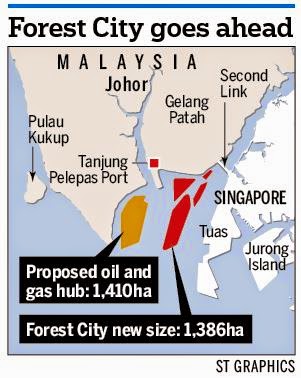
Apart from the project which is called Forest City, a group of investors is also planning a 1,410ha reclamation project for an oil and gas hub farther west off Tanjung Piai.

The DoE last Friday announced on its website that the Forest City project had been approved.

On Wednesday, the project's master developer, China-based Country Garden Pacificview (CGPV), said in a statement that reclamation will continue, but with the project's total size slightly reduced.

The project, now divided into four reclaimed islands instead of one huge island nearly three times the size of Ang Mo Kio as originally planned, will have total size of 1,386ha (3,425 acres).

This is smaller than 1,623ha proposed by the company.

The master developer is a joint venture between China's property developer Country Garden and a Johor state agency, with reports saying that the project's backers included Johor's Sultan Ibrahim Ismail.

Country Garden is controlled by China's richest woman and one of the world's youngest billionaires, Ms Yang Huiyan, 33, who is the second daughter of businessman Mr Yang Guoqiang, 59.

Datuk Md Othman, executive director of CGPV, said: "Our next step is to ensure that all compliance monitoring, in terms of air, noise, water quality and sediment, are robustly implemented and carried out."

"Upon completion, it is expected that new job opportunities will be created for vast numbers of citizens."

The development will diversify the income base of the local communities by providing workshops and training schools in different sectors, CGPV said in its release.

It will also rejuvenate the area infrastructure, by building a new access road, constructing power stations and new water reticulation systems, CGPV said.


Read more!

STB to partner Temasek Holdings for Mandai nature project

Nicole Tan and Nadia Jansen Hassan Channel NewsAsia 14 Jan 15;

SINGAPORE: The Singapore Tourism Board (STB) will partner with Temasek Holdings to create a large-scale nature project in the Mandai precinct, the Ministry of Trade and Industry (MTI) announced in a press release on Wednesday (Jan 14).

Temasek is the majority shareholder of Wildlife Reserves Singapore (WRS), which operates the existing stable of Mandai attractions - the Singapore Zoo, the Night Safari and the River Safari - and Jurong Bird Park. It submitted a “compelling proposal to build on their existing attractions to shape Mandai into a leading nature destination in Asia”, said MTI.

According to Temasek, the first phase alone, scheduled to be completed by 2020, will cost about S$1 billion.

"The development is still in its early stages. Based on our estimates and this very draft plan, as well as some of the benchmarks that we have done, phase one of the project could cost about a billion dollars," said Temasek's Managing Director of Enterprise Development Neo Gim Huay. "Phase one will include relocation and rejuvenation of the Bird Park, as well as opening up public access areas for everyone to enjoy."

The planned development of Mandai was first announced by Prime Minister Lee Hsien Loong in September last year. When completed, the precinct outside the Nature Reserves will comprise about 120 hectares, MTI said. This will include the development of new attractions that will be integrated with the existing Singapore Zoo, Night Safari and River Safari. Already, these attractions draw close to 5 million visitors annually.

Temasek said in its own press release on Tuesday that the site includes the former Mandai orchid farm and an abandoned village. Describing the project as an "integrated wildlife and nature heritage precinct", it said the development will be a "multi-generation endeavour" that is expected to be completed in phases over about 10 years.

In addition to new public spaces and waterfront trails, the space will also be used for research and conservation, MTI said.

The idea of a "cageless zoo" is being explored, said Ms Neo, "where we introduce large immersive habitats where the visitors can immerse themselves in the natural habitats of the animals watching them in their natural behaviours - whether it's foraging for food, nesting or even doing courtship. Every visit will be different and every visit will be an adventure in itself".

CREATING A 'WORLD-CLASS DEVELOPMENT'

Mr S Iswaran, Minister in the Prime Minister’s Office and Second Minister for Home Affairs and Trade and Industry, said: "Temasek’s concept builds on and significantly enhances the current WRS attractions in Mandai. The proposal is sensitive to the area’s unique environment, while including exciting ideas and developments that will bring benefits to both Singaporeans and tourists."

The area in question is both "rich with potential" and "deeply treasured by Singaporeans," he told Channel NewsAsia. As an important stakeholder in the area, Temasek "will therefore have a very keen understanding of the uniqueness of the place, its importance to Singaporeans and its potential of what can be done there in a manner that is sensitive to the environment while enhancing its attractiveness to all".

With the expertise and experience it has gained from WRS, and its international network, Temasek will be able to create outstanding content for a world-class development in Mandai, he added.

A multi-agency collaboration will guide Mandai’s development, according to MTI. "Both the Government and Temasek strongly believe in the importance of carrying out this development in an environmentally-sustainable and sensitive manner," MTI said. "Through sensitive design and management, the proposed development could potentially strengthen and enhance the nearby Nature Reserves."

Temasek will also work closely with agencies such as PUB to ensure continued reservoir water quality, and consult with stakeholders like nature groups and wildlife experts, it added.

Said Mr Iswaran: "Water bodies there are also sources of water supply to Singapore - we have to preserve the integrity of the water supply system. These are objectives that Temasek and government bodies all share."

Temasek said it has undertaken study trips "to understand best practices and experiences of various nature attractions around the world". It is also working with the National University of Singapore, including the Lee Kong Chian Natural History Museum, to undertake an Environmental Impact Assessment of the development, and to explore sustainable solutions for water and energy use and design.

BUILDING ON 'CITY IN A GARDEN' CONCEPT

“Our proposal seeks to build carefully and thoughtfully on this wildlife heritage in Mandai for present and future generations," said Mr Dilhan Pillay Sandrasegara, Head of Enterprise Development Group at Temasek. "We see the new Mandai as a haven for our broader community of Singaporeans and visitors, young and old, to enjoy nature in a fun and inspiring way. We aim to do this through an integrated, sustainable and inclusive approach, with Mandai developing as a nature destination to celebrate and protect our biodiversity. We would very much like to build on the concept from the National Parks Board of Singapore as a city in a garden, and also our rainforest and wildlife heritage in Mandai.”

Added WRS Chairman Claire Chiang: "Our Zoo, Night Safari, River Safari and Bird Park are very popular – they are packed during weekends and holidays. This reflects strong public demand for wildlife attractions set in natural habitats. We are looking forward to this as an opportunity to further improve and innovate on the visitor experience, and create more green space for free public access.”

- CNA/xy

Mandai to feature new 'immersive zoo-type experience'
LAURA ELIZABETH PHILOMIN TodayOnline 14 Jan 15;

SINGAPORE — The Government’s plans for a mega-nature attraction at Mandai will possibly feature a new “immersive zoo-type experience”, on top of the three existing wildlife attractions in the area as well as the proposed relocation of Jurong Bird Park from Jurong.

These plans were revealed by the Ministry of Trade and Industry (MTI) and government-owned investment firm Temasek Holdings today (Jan 14) — the latter would be partnering the Singapore Tourism Board (STB) to develop Mandai into a nature-themed attraction in phases, set to be completed around 2020.

A concept video posted on its website showed a “zoo in the air” with aerial walkways weaving through a forest, a waterfall cavern for boat rides and a walkway for wildlife crossings. In all, the development in Mandai, including current attractions, will span 120ha.

But first up is an Environmental Impact Assessment (EIA), which Temasek will conduct with the National University of Singapore and Lee Kong Chian Natural History Museum, under the guidance of the National Parks Board. The plans, first announced by Prime Minister Lee Hsien Loong last year, had caused concern among nature advocacy groups here, due to its proximity to the swathes of forest in the Central Catchment Nature Reserve, the largest in Singapore.

Temasek, the majority shareholder of Wildlife Reserves Singapore — which operates the Singapore Zoo, Night Safari, River Safari and Jurong Bird Park — will also work with relevant government agencies like PUB to ensure reservoir water quality is unaffected.

The two parcels of land earmarked for the development – one bound by Mandai Road, Mandai Lake Road and part of the nature reserve, and the other bordered by Mandai Track 15 and a military firing range – are in line with plans first floated by the STB in 2007 to develop an eco-tourism project in the area.

The STB reached out to potential partners — international and local — to explore suitable concepts, but went with Temasek in the end.

In a statement, Temasek said it first submitted a proposal in 2010. Apart from discussions with government agencies, nature experts, academics and other potential partners, the company also took study trips to nature attractions around the world to understand best practices and experiences.

Stressing that no plans have been finalised and early concepts are still being developed, Temasek’s managing director of strategic and public affairs Stephen Forshaw said: “We will continue to discuss concepts and plans with nature groups and the wider public as the proposal is further developed.”

While there will be ticketed attractions, Temasek also plans to open up public spaces for free access. “For example, one of the ideas is to open up more trails that could be linked to the park connectors,” he said.

He added: “The relocation of the Bird Park would mean one new attraction, and quite possibly another immersive zoo-type experience, in keeping with the nature surroundings.”

In an interview today (Jan 14) on Singapore’s tourist sector outlook, Minister in the Prime Minister’s Office and Second Minister for Home Affairs and Trade and Industry S Iswaran noted the need to rejuvenate Singapore’s existing attractions, but also reiterated that development plans will have to be environmentally sensitive and preserve the integrity of the water supply system.

The initial plans surfaced in 2007 had prompted Nature Society (Singapore) to publish a report in the same year highlighting key concerns. The area’s forests are already in a “fragmented and degraded state” and such a project would degrade the area and result in the loss of habitat variety, the group said. Following last year’s announcement, nature groups had called for buffer zones to be created between any future man-made and existing forest areas.

When contacted, Nature Society (Singapore) executive committee member Ho Hua Chew said: “(Temasek) should wait until EIA is finalised before they consider their plans.”

Animal Concerns Research & Education Society chief executive Louis Ng said he would be meeting Temasek and the relevant agencies to decide on the parameters of the EIA.

Noting that it is premature to comment on the impact of the development, he said: “If the EIA is done, (and) shows they really shouldn’t be used because maybe there are some rare species there, then perhaps we can have alternative sites on standby already,” he said.

Major makeover of Mandai zoo precinct to be led by Temasek Holdings and STB
MOK FEI FEI Straits Times 14 Jan 15;

SINGAPORE - The major makeover and expansion of the zoo precinct at Mandai in the nation's north will be led by the Singapore Tourism Board (STB) and Temasek Holdings.

The Ministry of Trade and Industry (MTI) said on Wednesday that the partnership will help to realise the Government's vision for Mandai to become a world-class nature themed attraction.

In September last year, Prime Minister Lee Hsien Loong announced that Mandai would be transformed with a bigger and better zoo by about 2020.

The 41-year-old Singapore Zoo is located at Mandai, along with the Night Safari and the relatively new River Safari. The proposals include using other land in the area to build the larger precinct.

Temasek is a majority shareholder of Wildlife Reserves Singapore (WRS), which operates the existing stable of zoos as well as the Jurong Bird Park.

It responded to STB's invitation to explore concepts for Mandai in about 2010.

MTI said Temasek shared the Government's vision for Mandai and submitted a compelling proposal to build on their existing attractions to shape Mandai into a leading nature destination in Asia.

It is envisioned that the Mandai project will have a total site area of 120 ha when completed, with tranquil and rich green spaces to see wildlife in their natural habitat.

New public spaces and waterfront trails are likely to be built.

Minister in the Prime Minister's Office and Second Minister for Trade and Industry and Home Affairs S. Iswaran said in a statement: "Temasek's concept builds on and significantly enhances the current WRS attractions in Mandai.

"The proposal is sensitive to the area's unique environment, while including exciting ideas and developments that will bring benefits to both Singaporeans and tourists."

Temasek head of enterprise development group Dilhan Pillay Sandrasegara said in a separate statement: "We see the new Mandai as a haven for our broader community of Singaporeans and visitors, young and old, to enjoy nature in a fun and inspiring way.

"We aim to do this through an integrated, sustainable and inclusive approach, with Mandai developing as a nature destination to celebrate and protect our biodiversity."

Temasek said it will work with the National University of Singapore to undertake an environmental impact assessment of the development and to ensure sustainable solutions in the areas of water and energy use.

STB, Temasek to lead Mandai zoo revamp
Mok Fei Fei My Paper AsiaOne 15 Jan 15;

SINGAPORE - The major makeover and expansion of the zoo precinct at Mandai in Singapore's north will be led by the Singapore Tourism Board (STB) and Temasek Holdings.

The Ministry of Trade and Industry (MTI) said yesterday that the partnership will help to realise the Government's vision for Mandai to become a world-class, nature-themed attraction.

In September, Prime Minister Lee Hsien Loong announced that Mandai would be transformed into a bigger and better zoo by about 2020.

The 41-year-old Singapore Zoo is located at Mandai, along with the Night Safari and the relatively new River Safari. The proposals include using other land in the area to build the larger precinct.

Temasek is a majority shareholder of Wildlife Reserves Singapore (WRS), which operates the existing stable of zoos as well as Jurong Bird Park.

It responded to STB's invitation to explore concepts for Mandai in about 2010.

MTI said Temasek shared the Government's vision for Mandai and submitted a compelling proposal to build on its existing attractions to shape Mandai into a leading nature destination in Asia.

It is envisioned that the Mandai project will have a total site area of 120ha when completed, with tranquil and rich, green spaces to see wildlife in their natural habitat.

New public spaces and waterfront trails are likely to be built.

Mr S. Iswaran, Minister in the Prime Minister's Office and Second Minister for Trade and Industry, said in a statement: "Temasek's concept builds on and significantly enhances the current WRS attractions in Mandai.

"The proposal is sensitive to the area's unique environment, while including exciting ideas and developments that will bring benefits to both Singaporeans and tourists."

Temasek head of enterprise development group Dilhan Pillay Sandrasegara said in a separate statement: "We see the new Mandai as a haven for our broader community of Singaporeans and visitors, young and old, to enjoy nature in a fun and inspiring way.
"We aim to do this through an integrated, sustainable and inclusive approach, with Mandai developing as a nature destination to celebrate and protect our biodiversity."

Temasek said it will work with the National University of Singapore to undertake an environmental-impact assessment of the development and to ensure sustainable solutions in the areas of water and energy use.


Read more!

NUS team tracking benefits of giant clams

Carolyn Khew The Straits Times AsiaOne 15 Jan 15;

Conserving giant clams is not just good for biodiversity, but it also brings benefits to coral reefs and the quality of waters - and there is now stronger evidence to support that.

A new study by five researchers from the National University of Singapore (NUS) sought to quantify just how much giant clams contribute to coral reef ecosystems around the Indo-Pacific.

The paper, entitled The Ecological Significance Of Giant Clams In Coral Reef Ecosystems, found that giant clams play an important role in the building of coral reefs.

The giant clams produce calcium carbonate from their shells which is eventually deposited on the coral reef framework, leading to bigger reefs.

After the clams die, their shells are also deposited on the reefs.

That would attract more marine life to live there, thus enhancing overall biodiversity, said lead researcher Neo Mei Lin from the Tropical Marine Science Institute (TMSI).

It is estimated that dense populations of giant clams living in coral reefs can contribute hundreds to thousands of kilograms per hectare of shell material to the reef annually.

To quantify the giant clams' ecological contributions, the research team reviewed more than 400 publications and extracted relevant data to calculate productivity and clearance rates for three giant clam species.

Dr Neo and Assistant Professor Peter Todd from the NUS Experimental Marine Ecology Laboratory, who was also part of the research team, said they sought to "add numbers" to existing research on giant clams, which has, so far, been anecdotal.

They hope that the study can provide a greater push for the conservation of giant clams.

Among other findings, the bivalves were also found to help keep waters clean.

A population of 432 Tridacna gigas - the biggest among the species of giant clams - in the Great Barrier Reef, Australia, was found to be able to filter over 28,000 litres of water per hectare per hour.

By filtering large volumes of water, the giant clams "can potentially counteract eutrophication", said the researchers in the paper, which was published in scientific journal Biological Conservation last month.

Eutrophication refers to the process where nutrients, such as those found in fertiliser, accumulate and affect water quality, causing algae bloom, which can reduce light penetration to the sea bottom.
Coral reefs and giant clams need sunlight to photosynthesise.

Habitat loss, reef degradation and overfishing of the reef-dwelling giant clams for food in the past are believed to have led them to become endangered.

Today, two species of the giant clam - the horse's hoof clam and the Tridacna gigas - are locally extinct. Three other giant clam species - the fluted giant clam, the boring giant clam and the small giant clam - are either endangered or critically endangered. Extensive surveys conducted around more than 20 reef sites in Singapore waters found just over 50 giant clams.

The Experimental Marine Ecology Laboratory has been working with the TMSI to breed giant clams and it is hoped that they can eventually be reintroduced into reef sites here.

The TMSI's marine biology research group has a giant clam hatchery housed in an outdoor aquarium on St John's Island, where the group is based. The hatchery has about 500 juvenile fluted giant clams which TMSI hopes to put out to reef sites once they are bigger.

The group is also trying to grow the Tridacna gigas in its hatchery.

This species can grow to more than 1m in size and weigh more than 200kg. It is believed to have once lived in Singapore waters.


Read more!

Fresh, filleted barramundi delivered to your doopstep

ELGIN CHONG Today Online 14 Jan 15;

SINGAPORE — Singaporeans can look now look forward to getting fresh, filleted barramundi fish delivered directly to their tables from the ocean pen.

Today (Jan 14), Barramundi Asia launched a new ‘farm-to-fork’ model — the first that does filleted processing with an unbroken cold chain. This means that when the fish is harvested, they are kept under sub-zero temperatures until the barramundi fillets reach the consumers’ doorsteps.

The barramundi fish are harvested to order. When consumers place their orders on www.kuhlbarra.com, the fish is harvested directly from the 7.5 hectare ocean farm located at the south of Singapore, near the Raffles Lighthouse.

Feed containing ingredients such as protein-rich vegetables, soy bean meals and fish meals are given to the barramundi fish up to four times a day to ensure that they grow healthily.

After harvest, the fish are kept submerged in ice, and within hours, they are filleted in a cold room and vacuum-packed. The fillets are then packed in insulated containers before reaching the consumers’ doorsteps.

Currently, Barramundi Asia is offering an introductory price of S$50 per kg, which is inclusive of delivery. Single portions are also available at S$10 per 200g fillets.

Fish farm goes online to reel in customers
Elgin Chong, Channel NewsAsia 14 Jan 15;

SINGAPORE: Ever wanted fresh, filleted barramundi fish delivered directly to your table from the ocean pen? Barramundi Asia launched a new service on Wednesday (Jan 14) with a "farm-to-fork" model.

The model is touted to be the first that does fillet processing with an unbroken cold chain, which means that when the barramundi is harvested, they are kept under sub-zero temperatures until the fillets reach the consumers’ doorsteps.

The fish are harvested to order, said Barramundi Asia. When consumers place their orders on www.kuhlbarra.com, the fish is harvested directly from the 7.5-hectare ocean farm located at the south of Singapore, near the Raffles Lighthouse.

After harvest, the fish are kept submerged in ice and, within hours, are filleted in a cold room and vacuum-packed, Barramundi Asia said. The fillets are then packed in insulated containers before reaching the consumers’ doorsteps.

Barramundi Asia said feed containing ingredients such as protein-rich vegetables, soy bean meals and fish meals are given to the barramundi fish up to four times a day to ensure that they grow healthily.

Currently, Barramundi Asia is offering an introductory price of S$50 per kg, which is inclusive of delivery. Single portions are also available at S$10 for 200g fillets.

-TODAY/av

Get fish fresh from the farm - via the Net
Jacqueline Woo The Straits Times AsiaOne 17 Jan 15;

HOME-GROWN fish farm Barramundi Asia launched an online platform yesterday so consumers can buy its products over the Internet.

The barramundi fish are harvested from the firm's 7.5ha ocean farm in Pulau Semakau, filleted and vacuum- packed before being delivered in insulated boxes filled with ice.

The fish are kept at sub-zero temperatures even during the filleting and packing processes.

This is fresher and more hygienic than if consumers were to buy fresh fish and transport them home as the fish would likely thaw on the journey, noted Mr Andrew Kwan, group managing director of Commonwealth Capital, which co-owns the Barramundi Asia.

The fish are being sold under the new brand Kuhlbarra on the site www. kuhlbarra.com.

Barramundi Asia, which claims to be Singapore's largest fish farm, exports around 20 tonnes of fish a month to hotels and restaurants in Australia.

It also supplies fish to local hotels and restaurants.

Mr Kwan said demand for the farm's barramundi has "gone up over the past few years", as people become more discerning about what they eat and more environmentally aware.

"There is a huge potential for the sale of sustainably farmed fish in Singapore, and we look forward to putting more locally grown fish on dining tables in Singapore," he added.

Barramundi Asia will set up a second farm site - of 12ha - within the next two years to cater to the demand.

The firm, established in 2008, stresses its environmentally conscious practices.

The fish are fed high- quality fishmeal from a sustainability-certified manufacturer, it said.

The ocean enclosures off Pulau Semakau are in areas with strong currents so no excess feed builds up while fish waste is dispersed to be naturally recycled in the ecosystem.

"We believe that the best way to grow healthy, good-tasting fish is to feed them with high-quality food and let them swim in clean ocean waters," said managing director Joep Staarman.

"The best evidence of our environmentally sensitive approach can be seen from our farm - a delicate coral reef thrives in the waters just 200m from the sea cages."

Barramundi Asia's fish are going at an introductory price of $50 per kg online, which is inclusive of delivery.

Single portions are also available at $10 for 200g fillets.

Reeling in the benefits of farming fish in Singapore
Jacqueline Woo The Straits Times AsiaOne 23 Jan 15;

SINGAPORE - Building a solid network of contacts - even finding a plumber - did not come easy for Mr Joep Staarman when he set up his fish farm in Singapore in 2008.

"We were starting in a new place and we were starting from zero," said the 57-year-old Dutchman, who is managing director of Barramundi Asia.

"It took us a long time before we found people who were reliable and experts at what they did."

Whenever the farm's harvest boat broke down, for instance, Mr Staarman had to attempt repairing it himself, as he did not know any boat brokers here.

"I would get all greasy - because the boat runs on diesel - and even then, it didn't always work afterwards," he recalled with a laugh in an interview with The Straits Times last week.

Today, however, Mr Staarman, who previously worked at Marine Harvest, one of the world's largest seafood companies, is well acquainted with people in the local aquaculture industry, from boat repair brokers to boatmen.

Barramundi Asia produces 500 tonnes of barramundi fish a year at its 7.5ha European Union-certified farm off Pulau Semakau, which has a maximum capacity of 3,000 tonnes of fish.

The total volume of fish is growing at a compound rate of 11 per cent every month.

The firm exports about 20 tonnes of fish to hotels and restaurants in Australia each month.

It also supplies fish to hotels here, such as the Swissotel hotels, as well as restaurants like Wild Rocket and The Naked Finn.

Being in Singapore was what helped propel and grow the business, said Mr Staarman, who visits the farm four or five times a week.

"Having the same temperature all year round means that the fish always grows," he said, noting that barramundi fish are known to thrive in water temperatures between 28 deg C and 30 deg C.

The country's open southern waters - which comes with "oxygen-rich waters, strong currents and a pristine ecosystem" - are ideal for farming fish as well.

Board member Hans den Bieman, 66, said that Singapore's reliability and efficiency as a logistics and business hub also made it "a very logical choice" for the siting of the farm.

The stringent food safety requirements set by the Agri-Food and Veterinary Authority (AVA) also benefit the firm, as consumers know that the fish produced here are extremely safe to eat, he said.

"It's much more expedient to set up business here compared with some countries in Europe.

Fresh barramundi from farm to doorstep in 48 hours
AsiaOne 31 Jan 15;

SINGAPORE - Off the southern shores of Singapore just a 15-minute boat ride away, is a fish farm with a mission to provide consumers with the freshest barramundi possible.

AsiaOne recently had the opportunity to visit Kuhlbarra, Singapore's largest commercial fish farm. It is also the first to raise barramundi, a type of seabass.

The fish is highly nutritious, being low in fat and high in Omega-3 fatty acids, which fend off the risk of heart disease.

The people behind Kuhlbarra emphasise their "farm to fork" model heavily, meaning that an order of fish will go straight to the doorstep, cutting out middlemen such as supermarkets.

This allows the consumer to know exactly how fresh their barramundi is.

The barramundi are harvested to match orders, then filleted and vacuum packed at a nearby processing plant before being sent directly to the customer, a process taking just less than 48 hours.

To preserve the freshness and the flavour of the fish, the barramundi are kept chilled throughout the processing period, even from the moment they are harvested.

After the fish is delivered promptly, fish lovers will be delighted to know that barramundi can be prepared in a myriad of ways, ranging from a hearty deep-fried version to the traditional steamed fish.

Barramundi is known for its flaky texture, and its mild and sweet taste.

As expected, the barramundi dishes that AsiaOne sampled did not have the slightest hint of fishiness at all.

Managing Director of Kuhlbarra, Mr Joep Kleine Staarman, offered us his favourite recipe: "Put it in a pan and slather it with unhealthy amounts of butter, and just a little bit of olive oil.

"But not so much that it becomes healthy," he joked.

Kuhlbarra has been in business since 2007 under the name Barramundi Asia. The re-branding this year is part of an ongoing process to attach a distinct identity to their products.

As an introductory promotion, Kuhlbarra is currently offering cuts of its barramundi at $50/kg.

For more information, go to http://www.kuhlbarra.com/.

A fortune in fish
Godwin Ng The New Paper AsiaOne 4 Feb 15;

SINGAPORE - For the last six years, he has been living in a small container in the middle of the ocean.

The only time Mr Sagadevan Santhosh, 26, an Indian national, sees land is during his monthly visit to Singapore - a 30-minute boat ride away - to remit money.

But the farm site manager at Barramundi Asia, Singapore's largest commercial fish farm, doesn't mind the isolation.

"I like the peace and quiet of the sea," said Mr Santhosh.

Mr Santhosh, who used to be a fisherman in India, is a farm site manager at Barramundi Asia.

The farm produces 500 tonnes of barramundi (sea bass) a year in its 7.5ha farm off Pulau Semakau. That's roughly the size of 10 football fields.

Every day, Mr Santhosh mends the nets, feeds the fishes and makes sure they are growing well.

"I like my job. It's a very simple lifestyle." When he runs out of necessities, he gets his boss, Mr Joep Kleine Staarman, to buy them for him. "He's a very nice boss. Last year, he gave me four months' leave to get married in India."

BIGGEST

Mr Staarman, 57, is the founder of Barramundi Asia, one of the world's largest barramundi suppliers.

But it was only 14 years ago that he had his first taste of the fish that he farms.

He told The New Paper: "I ate my first barramundi when I was 43. Now, I eat it every day."

Although his love affair with barramundi started late, Mr Staarman is no stranger to fish farming.

The Dutchman, who studied aquaculture in Netherlands' Wageningen University, set up his own company in 1985 building fish farms across southern Europe.

In 1992, he joined British Petroleum and managed its trout farms in Italy, before switching to making fish feed.

He then worked for Marine Harvest as its managing director for the Asia Pacific region, which brought him to Singapore in 2006.

DECIDED TO STAY

Mr Staarman, who is married and has three daughters, said: "When my contract ended in 2008, my family didn't want to leave Singapore.

"Since I know about making fish feed, building a fish farm and running it, why not do everything myself?

"I thought that maybe I could set up my own fish farm."

So in June 2008, Mr Staarman did just that.

But the first few years of operation was not all smooth sailing.

"It was a lot more difficult than I thought," he said.

"I didn't know anything about processing, filleting and marketing in the beginning. It took around four years for everything to run smoothly."

The farm, which started out with one cage, now houses 19 cages, each with 50,000 fish.

His company launched its online retail platform, www.kuhlbarra.com, at the start of the year while a second 12ha farm is slated to begin operations next year.

Barramundi Asia exports its fish to Australia and supplies to local hotels and restaurants like Wild Rocket and The Naked Finn.

Said Mr Staarman: "Things are better now but there's much more work to do."


Read more!