Gardens’ UNESCO success sparks calls for more sites to be protected

VALERIE KOH Today Online 13 Jul 15;

SINGAPORE — The Republic’s successful bid to have the Singapore Botanic Gardens recognised as a UNESCO World Heritage Site earlier this month has sparked discussion, and hope, that more sites reflecting the nation’s heritage may gain recognition and protection.

Top on the wishlist of heritage experts and the public are Pulau Ubin, Bukit Brown and Jalan Kubor cemeteries, Jurong industrial estate, and even the types of public housing built over the years.

As the largest Chinese cemetery outside China with about 100,000 graves, Bukit Brown is a historical site comparable to others around the world, said Singapore Heritage Society vice-president Terence Chong. “More importantly, Bukit Brown is a showcase of the complexity of overseas Chinese culture with Fujian influence lying beside Peranakan aesthetics,” he added.

The society’s president, Dr Chua Ai Lin, said the cemetery was placed on last year’s World Monuments Watch, a global list of endangered cultural heritage sites. This is testimony to the fact that it has considerable heritage value, she said. Jalan Kubor, Singapore’s oldest Muslim cemetery and home to about 15,000 graves, is equally rich in heritage, she added.

The decision to build a road through Bukit Brown in 2012 resulted in consternation among conservation groups, which lamented the ensuing loss of heritage and biodiversity. Meanwhile, calls have been made to preserve Jalan Kubor by making it part of the Kampong Glam conservation district.

Last week, National Development Minister Khaw Boon Wan said the Botanic Gardens was “just the very first site” that Singapore could offer to the world, and that there was much to reflect upon with regard to the nation’s next heritage site.

Indeed, the Gardens’ success has led to much discussion about what else can be done to recognise other heritage sites — even if they do not have the potential to get on UNESCO’s list.

Singapore formally protects heritage sites through the inscription of National Monuments and conserved buildings. But Dr Chua noted that heritage-rich sites such as Bukit Brown slip through the cracks of protection.

“It is neither a building nor a monument,” she said, adding that there needs to be a comprehensive review of heritage legislation. “One of the things we’ve been saying is there is already existing legislation, but are they sufficient in protecting all sites?”

For instance, Singapore University of Technology and Design architecture assistant professor Yeo Kang Shua said public housing, ranging from Singapore Improvement Trust flats to more recent HDB homes, was worthy of consideration too, given the country’s success in this area.

Said Dr Yeo, who is also Singapore Heritage Society’s honorary secretary and whose work includes the restoration of Yueh Hai Ching Temple on Phillip Street: “We can look at the different periods of development and how we keep it as part of our landscape.” However, he acknowledged the challenges of getting public housing inscribed. “It’s a lived environment and, because of that, we have to accept that it’ll change over time.”

Architect and urban historian Lai Chee Kien pointed out that Jurong industrial estate, a “Garden Industrial Estate”, was revolutionary in its planning and design. “It’s the only industrial estate I know that crisscrosses industrial areas with greenery ... the Chinese and Japanese Gardens, Bird Park and lake area provide greenery for workers’ respite,” he said. “Jurong is a lesser-known but important idea that Singapore has given the world — that you can integrate green areas to ameliorate industrial areas, rather than setting them apart.”

Pulau Ubin, said Dr Chua, also needs further protection. “Pulau Ubin is not protected by any legislation now, but is a place that is rich in cultural heritage and deserves to be protected.”

Wishlists aside, Dr Chua said what is more pressing is the need to involve Singaporeans in the ongoing public conversation on heritage. Agreeing, Dr Yeo said: “Having a title tends to raise awareness. We congratulate ourselves for getting Botanic Gardens (listed), but what’s next?” He called for a public platform where people could “discuss heritage openly and transparently, be it our local community heritage, national heritage or world heritage”.

Responding to media queries, the National Heritage Board (NHB) said it has no plans to nominate other sites in Singapore for UNESCO World Heritage Site status. NHB CEO Rosa Daniel said putting up a bid for such a status requires a lot of resources from government agencies and the community, and the work continues even after a successful inscription. But the board is open to exploring possible sites with experts and stakeholders, she added.

While most may expect a World Heritage site to be of certain grandeur, such as China’s Great Wall, Dr Chua felt that in Singapore, it could be any place that is “deeply valued by the local community and which meets UNESCO criteria”.


Read more!

Potong Pasir waterfront gets makeover

LEE YEN NEE Today Online 12 Jul 15;

SINGAPORE — A 400m stretch along Kallang River in the Potong Pasir estate was the latest to be transformed into recreational space under national water agency PUB’s Active, Beautiful, Clean Waters programme.

The area between Potong Pasir Avenue 1 and St Andrew’s Junior School was the 28th site to come under the programme.

At the official opening today (July 12), Mr Sitoh Yih Pin, Member of Parliament (MP) for Potong Pasir, said the project had been part of the 2006 General Election manifesto. “This vision that we set out 10 years ago is now a reality, and today, our Potong Pasir residents are able to use this amenity,” said Mr Sitoh, who became the constituency’s MP in 2011.

The makeover included an open plaza with two shelters that can accommodate about 750 people, four lookout decks and three rain gardens with plants that hold and treat rainwater before discharging it into the river.

Besides the Kallang River initiative, other improvements that have been made to the estate included lift upgrading, adding more childcare and elderly activity centres, as well as equipping the community centre with facilities, such as a supermarket. “That’s not the end of the story. Going forward, we want to continue with what we have begun,” said Mr Sitoh.

Residents of Potong Pasir have welcomed the changes. Student Viviana Xie, 20, who has lived in the estate for 16 years and who jogs frequently along the Kallang River, said: “There used be a smell from the river. Now, with it having been cleaned, it’s a lot nicer to jog here, so I think it’s a good initiative.”

Waterfront in Potong Pasir gets makeover
A 400-metre stretch along the Kallang River in Potong Pasir has been given a makeover, transforming it into a vibrant community space.
Hetty Musfirah Abdul Khamid, Channel NewsAsia 13 Jul 15;

SINGAPORE: Residents of Potong Pasir can now enjoy new community spaces along a 400-metre stretch of the Kallang River that has been transformed into a vibrant and an aesthetically-pleasing waterway.

The makeover cost about S$7 million.

Community events and outdoor learning activities can be held at an open plaza which is able to accommodate about 750 people. Four lookout decks and new seats along the waterfront also allow park users to enjoy the scenery.

Potong Pasir MP Sitoh Yih Pin officiated the opening of the transformed waterfront, which is located between Potong Pasir Avenue 1 and St Andrew's Junior College, on Sunday (Jul 12) morning.

"If you look at our election manifesto in 2006, 10 years ago, we had a dream to create this ABC Kallang River park that will cater to our residents and will cater to the morning joggers and people who walk in the evening. I'm very happy and proud to say that this dream has now become a reality," said Mr Sitoh.

"The bigger plan is to connect the ABC water project from Upper Pierce all the way to barrage at Marina. Going forward for all of us, we want to continue on what we had begun and complete it, so we hope that residents can give their support."

Students from St Andrew’s Secondary School had helped to plant the rain gardens along the waterfront in June.

The gardens, together with the vegetated swales, help to filter out sediments naturally and improve the quality of rainwater runoff entering the river. The transformed area presents learning opportunities for the students.

"We get to learn about the different types of plants and not only that, we get to see things we don't really get to see in our daily lives, like otters in the rivers," said St Andrew's Secondary School student Marcus Lim.

Students also conduct water quality tests regularly, and the data obtained is sent to PUB.

The project is part of the Active, Beautiful, Clean Waters programme by national water agency PUB.

The programme aims to transform drains, canals and reservoirs into beautiful streams, rivers and lakes that are well-integrated with the surrounding parks and spaces.

- CNA/rw/ec

Kallang River waterfront rejuvenated with lookout decks and new plaza
AsiaOne 12 Jul 15;

SINGAPORE - A 400m rejuvenated stretch of waterway along the Kallang River was officially opened on Sunday by advisor for Potong Pasir SMC, Mr Sitoh Yih Pin.

Complete with lookout decks and an open plaza for community events, the project by national water agency PUB's Active, Beautiful, Clean Waters (ABC Waters) took about one and a half years to complete.

Under the $7 million project, plants were grown on the banks of the river and four lookout decks with timber seating were built. The new plaza can accommodate up to 750 people.

Last month, students from St Andrew's Secondary School had lent their hands in planting rain gardens along the waterway. Rain gardens treat rainwater runoff using specially-selected plants and soil media before it is discharged into the river.

The school has been actively conducting frequent clean-ups, river studies and projects along Kallang River since 2005. The school is also developing a learning trail in the long run, which will be conducted for the community on a regular basis.

Mr Tan Nguan Sen, PUB's chief sustainability officer, said he was heartened to receive support from schools, residents and community groups who participated actively in shaping this project.

"Under the ABC Waters Programme, we endeavour to revitalise pockets of blue spaces along Kallang River, the longest river in Singapore serving a large catchment area that includes estates like Toa Payoh, Bishan and Potong Pasir," said Mr Tan.

A breath of fresh air for Potong Pasir
My Paper AsiaOne 13 Jul 15;

REJUVENATED: Residents at a lookout deck along an improved 400m stretch of the Kallang River yesterday.

Residents of Potong Pasir can enjoy a new and improved waterfront near their homes, with viewing decks and a plaza for community events.

The 400m stretch along the Kallang River was officially opened yesterday by Potong Pasir MP Sitoh Yih Pin.

Rain gardens and vegetated swales will cleanse rainwater run-off, and decks with timber seating offer a soothing view of the waterfront.

An open plaza has also been built to accommodate 750 people for community events and outdoor classroom learning.

Said Irene Ong, 62, who has lived in the estate for more than 20 years: "The water is very clean and the scenery, with different types of plants and flowers, really makes people want to come down to have a look."

Last month, students from St Andrew's Secondary School helped to plant rain gardens along the waterway. Rain gardens treat rainwater run-off using specially selected plants, for instance, before it is discharged into the river.

The school has conducted cleanups and projects along the Kallang River since 2005.

The Potong Pasir waterfront has been 11/2 years in the making, under national water agency PUB's Active, Beautiful, Clean Waters (ABC Waters) programme to spruce up water bodies here.

The $7-million project is the 28th under the programme to be completed. Over 100 potential locations have been identified for a makeover under the ABC Waters programme by 2030.

Speaking to reporters on the sidelines, Mr Sitoh cited other work that has benefited residents, including lift upgrading and a home improvement programme.

Potong Pasir was held by opposition MP Chiam See Tong for 27 years, but it elected the People's Action Party candidate in 2011.

"There are still a lot of things to be done," said Mr Sitoh. "We want to carry on and complete the journey that we have started."


Read more!

Malaysia: Pollution suspected in mass fish deaths

The Star 13 Jul 15;

GEORGE TOWN: A strong stench permeated the air as hundreds of dead fish littered the mouth of Sungai Bayan Lepas.

To make matters worse, flies had a feast after the water level subsided in Permatang Damar Laut.

The sudden mass fish death has raised environmental concerns among residents and fishermen living nearby.

Fisherman Saidin Ismail, 69, who has been fishing in the area for decades, said the sight of dead fish shocked him.

“It’s happened before but never this severe. Last year, there were dead fishes floating in the river but it was never this much. This could be due to pollution,” he said.

State Local Government Committee chairman Chow Kon Yeow said water samples had been sent to the laboratory for tests.

He said Drainage and Irrigation Department (DID) and Department of Environment (DOE) officers visited the site to conduct checks.

“They took away water samples. It will take around two weeks for the results to be out.

“According to DOE, the dead fish are mullets which are usually near the river mouth.

The incident could be due to pollution at the river mouth,” he said in a statement.


Read more!

Phillipines: BFAR widens red tide areas

James Konstantin Galvez Manila Times 12 Jul 15;

The Bureau of Fisheries and Aquatic Resources (BFAR) has widened anew its red tide warning after sampling in five coastal waters in the country showed positive for paralytic shellfish poison that is beyond the regulatory limit.

In its Shellfish Bulletin No.18-2015, BFAR warned the public from catching and consuming shellfish from coastal waters of Balite Bay in Mati, Davao Oriental; Mandaon in Masbate; Irong-irong Bay and Cambatutay in Western Samar; and Dauis in Bohol as the areas remained affected by the toxin.

BFAR also said that the coastal waters of Milagros in Masbate are now positive for the red tide toxin.

The agency said that all types of shellfish and acetes or alamang gathered and collected from the areas are not safe for human consumption.

BFAR, however, said that several species—including fish, shrimps and crabs—are safe to eat provided that they are fresh and washed thoroughly, and internal organs such as gills and intestines are removed before cooking.

Other major fishing grounds in the country, besides the aforementioned areas, continued to be unaffected by the toxins.

Red tide occurs when algae rapidly increase in numbers to the extent that it dominates the local planktonic or benthic community. Blooms are caused by environmental conditions that promote explosive growth.

Such high abundance can result from explosive growth caused by a metabolic response to a particular stimulus or from the physical concentration of a species in a certain area due to local patterns in water circulation, warm sea surface temperatures and high nutrient content.


Read more!

Indonesia: Riau warned about drought, hot temperatures

Arya Dipa, The Jakarta Post 13 Jul 15;

The Meteorology, Climatology and Geophysics Agency’s (BMKG) Pekanbaru station has predicted that the prolonged drought currently hitting the Riau provincial capital will last until August this year and is calling on people to be extremely cautious about the hot temperatures.

“The extreme weather that has been hitting Riau is predicted to end in September,” the station’s data and information section head Slamet Riyadi said in Pekanbaru on Saturday as quoted by Antara news agency.

Slamet said that the dry season, which came with high air temperatures, had been there since May and would continue, although intermittent rain has been predicted to fall occasionally.

He said that the air temperature in Pekanbaru currently hovered between 31º and 34.5º Celsius.

The absence of the sun at night, he said, only made the temperatures go down slightly and he added that land fires could still easily be triggered.

The Aqua and Terra satellites, according to Slamet, had detected at least 215 hot spots across Sumatra Island, with the highest number, 192, found on Riau.

He called on people to be extremely cautious against the hot temperatures, especially while they were fasting. He also called on people to put on masks when doing outdoor activities because of the high intensity of dust and haze.

He expressed hope that the drought would come to an end as the rainy season started at the beginning of September.

He said that although rain would probably fall before September, it would be just of low to medium intensity. Rain of high intensity was expected to come only as August was approaching.

“There is potential that frequent rains will fall in the fourth week of July,” Slamet said.

He added that in general the weather in Riau was cloudy and bright. The chance for uneven rain of low intensity at night or in the early morning is predicted for central and eastern coastal areas of Riau.

Responding to the bad weather in Pekanbaru, Mayor Firdaus called on people to put on masks while conducting outdoor activities. He also banned people from burning domestic waste, or grass when clearing land.

“Do not burn garbage. Turn it into compost. When disposing of cigarette butts, make sure that they have been completely extinguished,” Firdaus said.

Meanwhile Erma Yulihastin of the climate variability team of the National Institute of Aeronautics and Space’s atmosphere technology and science center said the El Niño phenomenon, an anomaly in sea surface temperatures on the equator in the Pacific Ocean, will continue to strengthen until December this year.

“The El Niño index is currently 1.37 and is predicted to increase to between 1.5 and 2.5. This is the strongest index within the last five years,” Erma said in Bandung on Friday.


Read more!

Indonesia: Orangutan threatened with extinction due to habitat loss

N.Adri, thejakartapost.com 12 Jul 15;

An animal conservation activist has warned that habitat loss is the greatest threat faced by orang utans

"What orangutans are facing is a conflict, a fight for land where they live," Borneo Orangutan Survival Foundation (BOSF) executive director Jamartin Sihite said on Sunday.

The conservationist said orangutans were threatened with extinction because forests in which they were living had been degraded or converted.

Citing an example, he said, primary forests that used to be the natural habitats of orangutans in Kalimantan had been converted into production forests, and trees where they used to make a nest or forage food had been chopped down. Parts of the forests had been converted into plantations, mining areas and human settlement.

Sihite said the absence of primary forests had hampered the BOSF’s plans to release hundreds of orangutans it had taken care of in its conservation areas in Samboja Lestari, East Kalimantan, and Nyaru Menteng, Central Kalimantan, back to their natural habitats.

Samboja Lestari is now home to 270 orangutans while in Nyaru Menteng, there are more than 600 orangutans.

"That’s why we focus our attention on providing special area for orangutans," said Sihite.

In 2009, the BOSF established PT Rehabilitasi Habitat Orangutan Indonesia (RHOI), which manages Kehje Sewen, a forest that used to be production forest concession (HPH) areas in Muara Wahau, East Kutai, and now is used as an area where orangutans will be released.

Meanwhile in Central Kalimantan, the BOSF releases orangutans into Bukit Batikap protected forest in North Barito regency.

Sihite said in the BOSF had released more than 100 orangutans in the two forests. (ebf)(+++)


Read more!

Dugongs on brink of extinction, poaching continues in India

P Oppili Times of India 12 Jul 15;

Forest dept, NGOs join hands for IUCN tiger projectBill to use CAMPA fund for increasing green cover introduced in Parli...Whistleblower cites threat to lifeCentre cites more studies to oppose banInfy cites union issue, Technopark non-cooperation
CHENNAI: The Union government's Compensatory Afforestation Fund Management and Planning Authority (CAMPA) on Wednesday declared that dugongs among the five species to be the focus of conservation, but the marine mammals, ironically called the 'angel of the sea', continue to be poached for their meat.

There are just 250 dugongs in the Indian seas, according to a study by Zoological Survey of India in 2013. Conservation in other places like Australia has seen their population crossing 85,000. In the Gulf of Mannar, the dugong population ranged between 77 and 158, said the survey. In Andamans, there could be 41 to 81 dugongs, and in the Gulf of Kutch, some 10 to 15, said ZSI director K Venkataraman.

The species has been categorized in the red list of the International Union for Conservation of Natural Flora and Fauna (IUCN) and the Convention on International Trade on Endangered Species (CITES) had classified it under Appendix I, implying that the mammal is under threat. They are poached for their meat.

Feeding on sea grass, dugongs are found in sea grass beds, sheltered waters, lagoons and bays. Fourteen sea grass species are found in the marine waters in the country of which 13 are found in the Gulf of Mannar and Palk Bay areas. Central Marine Fisheries Research Institute records showed that in 1983-84 more than 250 dugongs were killed in Keelakarai and Periapatnam villages in Ramanathapuram. Researchers said a section of people in villages believed that the dugongs carried boxes full of money in their stomach and poached them indiscriminately.

As dugongs had been brought under Schedule I of the Wildlife Protection Act, the punishment for poaching is imprisonment, but seldom is anyone punished. "The offenders would get the same punishment as that of killing tigers, leopards or elephants," said a senior officer.


Human intervention, fishing activities, pollution, mixing of excessive nutrients from agricultural fields that gets drained into the coastal waters and mixing of sewage are some of the direct threats to dugong habitats.

More cooperation among countries in the South Asian region is needed to protect them from extinction, says Venkataraman. Sri Lanka has made efforts to protect its small dugong population that migrate from the Gulf of Mannar.

Threat evaluation, putting an end to illegal and incidental captures, reducing marine pollution through serious monitoring are some of the measures researchers suggest to protect dugongs from extinction. CAMPA has announced 4 crore each for conserving five species including dugongs, sangai deer, Gangetic dolphins, wild water buffalo and the great Indian bustard.


Read more!

Best of our wild blogs: 11 Jul 15


Encounter with a one-eyed Buffy Fish-owl
Bird Ecology Study Group

Emperor mating
Bird Ecology Study Group

Fires rage in Indonesian park illegally trashed for palm oil
Mongabay.com news


Read more!

Sperm whale carcass found in Jurong Island

Audrey Tan Straits Times 10 Jul 15;


SINGAPORE - The carcass of a sperm whale was found floating near Jurong Island on Friday morning.

The 10m-long carcass was picked up by five staff from the Lee Kong Chian Natural History Museum for analysis.

They are working with the authorities to secure the animal so valuable information can be gleaned from it.

The cause of death is not clear, although The Straits Times saw blood pouring from its fin when the newspaper visited the site where the animal was located.

A pungent smell of dead fish wafted through the air near the site of the carcass.

If the carcass is confirmed to be that of a sperm whale, it would be the first sighting of this species of whale in Singapore.

Lee Kong Chian Natural History Museum head Peter Ng said it was an exciting find.

Mature sperm whales can grow up to 20m in length. They are the largest toothed whales and can be found in all of the world's oceans. Still, it is considered rare in this region.


JUST IN: Sperm whale carcass found in Jurong Island. str.sg/bKuThe 10m-long carcass was picked up by five staff from the Lee Kong Chian Natural History Museum for analysis. The cause of death was not immediately clear.VIDEO: LIM YAOHUI
Posted by The Straits Times on Friday, 10 July 2015


Carcass of sperm whale found near Jurong Island
NEO CHAI CHIN Today Online 10 Jul 15;

SINGAPORE — The carcass of a sperm whale was discovered this morning (July 10) floating near Jurong Island — the first time the species has been sighted in Singapore.

The person who had discovered it posted about it on social media. When Professor Peter Ng of the Lee Kong Chian Natural History Museum learnt about it, he got his team to track it down and last night, the creature was brought in by a Maritime and Port Authority (MPA) boat.

The dead whale — only the third sperm whale recorded in South-east Asian waters — is a notable discovery, and is of scientific and heritage value to Singapore, said Prof Ng. South-east Asian waters are not normally favoured by large whales because of shallow waters; they would normally inhabit the Java Sea, South China Sea and the oceans, he noted.

The whale had multiple lesions on its body, suggesting it could have been hit by a large boat.

The animal would have been beautiful alive, Prof Ng remarked as the carcass arrived at Tuas Marine Transfer Station. The natural history museum engaged a lorry crane to pull it onto land — an exercise that lasted more than two hours — and staff and interns began collecting samples soon after.

“Anything that’s found floating in Singapore waters, the agencies will have to take care of it,” said Prof Ng. “In the water, the MPA has to worry about it because we don’t want boats crashing into it.

“The National Environment Agency has to be informed because, well, it’s a dead whale. So automatically we sought their help to find out where the whale is and what can be done.”

The carcass would either have floated out of Singapore waters or been removed from the water and incinerated. “But we didn’t want that to happen,” said Prof Ng.

When his team found that the ­rare find was over 10m long and freshly dead, “it’s even more important that we secure the whale for science and for Singapore”, he added.

Ideally, its skeleton would be put on display at the natural history museum “for generations to come” but, last night, Prof Ng said he was only focused on securing the carcass so tissue samples could be taken and its important parts such as muscles are preserved. Over the next few days, the animal will be fussed over by scientists.

It is difficult to tell how long the process of removing its flesh and getting the skeleton out will take “because we’ve never done this before ... we’ll do our best”, Prof Ng said.

Dead sperm whale found near Jurong Island
The Lee Kong Chian Natural History Museum says this is the first time a sperm whale sighting has been recorded in Singapore.
Jack Board Channel NewsAsia 10 Jul 15;

SINGAPORE: The bloodied carcass of a sperm whale was found off the coast of Jurong Island on Friday morning (Jul 10).

This is the first time that a sperm whale sighting has been recorded in Singapore, the Lee Kong Chian Natural History Museum said on Facebook. Nine of its staff were deployed to salvage the specimen. "It was identified by our curators to be a sperm whale, which is internationally threatened with extinction," the museum added.

According to the museum, the whale is between 10 and 15 metres in length. Sperm whales can grow up to 20 metres.

A National University of Singapore team said they plan to take DNA samples on Friday night and remove the flesh of the whale on Saturday. The aim is to remove the entire skeleton of the whale intact and researchers hope to study what's inside its stomach. The flesh will be incinerated.

(Photo: Jack Board)

“Currently, the team is trying to secure the whale carcass. The next step will be to try to recover the skeleton and key parts of the carcass for research purposes,” a spokesperson added.
 (Photo: Jack Board)

The process of extracting tissue, removing flesh from the carcass and getting out the skeleton could take up to several weeks, said Professor Peter Ng, Director of Lee Kong Chian Natural History Museum.
 (Photo: Jack Board)

"We have never done it before. The biggest animal we’ve handled is maybe a large dolphin. That’s nothing compared to this," he said.

A member of the public, whom they identified as Mr Jailani, had tipped them off. Another member of the public, Christine, emailed Channel NewsAsia a photo of the whale (below), saying it was seen floating in waters near an offshore tank terminal.

(Photo: Christine)

(Photo: Jack Board)

The last time Singapore retrieved a large animal carcass from the sea was more than 20 years ago, according to Professor Ng. A large dolphin, known as a false killer whale, had washed up in Singapore waters at that time.

Professor Ng also revealed that a dead whale was found off Pedra Branca about six to seven years ago, but it could not be retrieved as it was "very rotten" and was floating in the open sea.

"The last time something this big washed into our waters was, I think, maybe even before independence," he said.

It is uncommon for whales to inhabit Southeast Asian waters as they are too shallow, said Prof Ng.

"For medium-sized to large whales, we speculate that they are just passing through - maybe taking a shortcut," he explained. "They will inhabit deeper waters in the Java Sea, Indian Ocean and South China Sea."

He added that the whale may have bumped into a large boat while passing the area.

The whale was finally brought to shore at 9.15pm on Friday evening, after an operation involving various government bodies, including the Maritime Port Authority and the National Environment Agency, who pitched in to help staff from the Lee Kong Chian Natural History Museum salvage the carcass.
(Photo: Jack Board)

This is the second time Singapore has had a whale carcass in its custody.

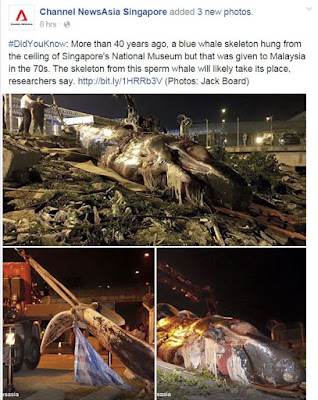
In 1892, a blue whale about 13m long had beached in southern Malacca. Its skeleton was displayed at Singapore's old National Museum. It is, however, no longer there. The skeleton was given to Malaysia's Muzium Negara in 1972.

The National Museum plans put the sperm whale's skeleton on display once research has been completed.


JUST IN: A dead sperm whale has been brought ashore at Tuas. Experts told Jack Board this type of whale is more commonly sighted in Indonesia, but never before in Singapore. http://bit.ly/1JTUEiP
Posted by Channel NewsAsia Singapore on Friday, 10 July 2015


WHALE OF A FIND: How a team from the Lee Kong Chian Natural History Museum recovered the carcass of a sperm whale found off Jurong Island. http://bit.ly/1JTUEiP (Video: Jack Board)
Posted by Channel NewsAsia Singapore on Friday, 10 July 2015

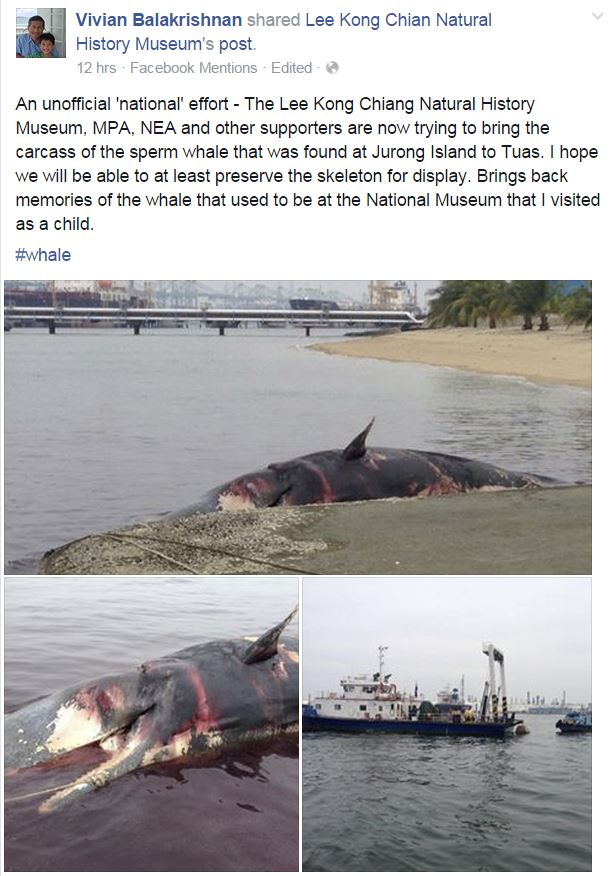
Dr Vivian Balakrishnan, Minister for the Environment & Water Resources also posted about the whale on facebook:

"An unofficial 'national' effort - The Lee Kong Chiang Natural History Museum, MPA, NEA and other supporters are now trying to bring the carcass of the sperm whale that was found at Jurong Island to Tuas. I hope we will be able to at least preserve the skeleton for display. Brings back memories of the whale that used to be at the National Museum that I visited as a child."


Dead whale could take 'several weeks' to dissect: Museum
Built-up gas within it's decomposed stomach poses the main risk to scientists from the Lee Kong Chian Natural History Museum.
Edric Sng Channel NewsAsia 11 Jul 15;
 Staff from the Lee Kong Chian Natural History Museum inserting a tube to release gas from the sperm whale's gut. (Photo: Edric Sng)

SINGAPORE: It could take "up to several weeks" before the rotting carcass of the sperm whale that washed up on Singapore's shores is fully dissected and brought indoors for further examination, staff from the Lee Kong Chian Natural History Museum (LKCNHM) said.

The main risk: The high likelihood of the whale's decomposing innards exploding, said Mr Foo Maosheng, curator of the cryogenic collection at the LKCNHM.

When Channel NewsAsia visited the location of the carcass at Tuas South on Saturday morning (Jul 11), staff from the museum were seen inserting a straw-like metal rod into various parts of the underside of the whale's belly. This was meant to allow the built-up gas in the belly to be released slowly and safely, Mr Foo said.

"We are now working to extract the part that decomposes fastest: The gut," he said. "First we are releasing air from the gut - it's well known that the gut of a dead whale can explode."
"It's hard to tell how long it will take. This is our first time doing anything like this, it could take at least a week to several weeks to deflesh the whole thing," Mr Foo added. "We are not working through the night. Its not safe to work overnight. It's a biohazard. And there's not much light, we need to stay safe."

Apart from preserving the skeleton for possible display, Mr Foo said they also plan to extract some tissue for DNA tests as well as study the contents of the whale's stomach, which could give some clues on the whale's final days and the route it took to Singapore.

The bloodied carcass of the sperm whale was spotted off the coast of Jurong Island on Friday morning. The whale was finally brought to shore at 9.15pm on Friday evening, after an operation involving various government bodies, including the Maritime Port Authority and the National Environment Agency, who pitched in to help staff from the LKCNHM salvage the carcass.

The age and gender of the whale are not yet known.

"We can't tell it's age for sure but it's young," said Mr Foo. "Males can grow up to 18m. This is 10.6m. We can't tell if it's male or female - the genitals are hidden away."

- CNA/av

Dead sperm whale found off Jurong Island
Audrey Tan and Chew Hui Min Straits Times 11 Jul 15;

SINGAPORE - A sperm whale’s 10m-long carcass was found floating off Jurong Island on Friday morning.

The species had never previously been found in the waters around Singapore or peninsular Malaysia.

Oil industry worker Mr Jailani Salleh told The Straits Times that he spotted the dead mammal under a jetty at around 7.45am and posted a video of it on Facebook.

Mr Marcus Chua, curator of mammals and birds at the Lee Kong Chian Natural History Museum, was informed and told The Straits Times it was an “exciting find”. It is to be studied by scientists.

The museum will now work to preserve the specimen, believed to be a young adult. A museum volunteer then informed Mr Chua about the incident at about 9.30am.

At about 2pm, after arrangements were made with the authorities to enter restricted areas and to secure equipment and boats, Mr Chua and eight of his colleagues were deployed to secure the carcass. The cause of death has not yet been determined.

When The Straits Times visited the scene, blood was pouring from its fin. However, Mr Chua said the injury could have been sustained after it died. It was too early to conclude that the wound was the cause of its death, as it could have been afflicted posthumously.

The whale appeared to have been dead for several days because of the rot on its body and tongue. With the help and assistance of the Maritime and Port Authority of Singapore, the whale was towed across the West Johor Strait on a three-hour journey to the Tuas Marine Transfer Station for further examination.

Searchlight deployed to help authorities get whale carcass on shore

It will be left there at the restricted location for around a week while researchers prepare the skeleton and collect data.

This work will include taking samples of its muscle tissue, which contains precious genetic information, and studying the contents of its stomach.

The museum’s scientific officer, Mr Foo Maosheng - one of the team members - said: “By studying its stomach contents, we can possibly tell where it has been feeding and at what depths.”

The whale is estimated to weigh between seven and 10 tonnes. Museum conservator Kate Pocklington said the next step is to remove the skin, internal organs and fat from the whale, which is estimated to weigh three to five tonnes.

Since its bones are porous, researchers must figure out the best way to remove the oil from them while preserving the skeleton, which is important as it will tell researchers more about its length and anatomy.

Ms Isabelle Tan, 23, a dolphin researcher and campaigns executive from the Animal Concerns Research and Education Society, said: "It is encouraging to know that this species of whale was found in our waters, especially as people often think Singapore has no marine life.

“The sightings are a good reminder that they are there and there is a need to protect the marine environment.

"We urge members of the public to continue reporting dolphin and whale sighting to Acres."


5 things to know about sperm whales
Chang Ai-Lien Straits Times 10 Jul 15;

A 10m sperm whale was found dead off Jurong Island on Friday, possibly the first time the giant mammal has been seen in Singapore waters. Here are some sperm whale facts.

1. BIGGER THAN A BUS
The sperm whale is the largest of the toothed whales and can grow to 18m, weighing in at over 40 tonnes. It is part of the cetacean species, which includes all species of whales, dolphins and porpoises. They are found in all the world's oceans.

2. AND BRAINY TOO
They have the largest brain out of any animal known to have lived on earth, and block-shaped heads which can measure up to a third of their length.

3. THEY ARE VORACIOUS EATERS.
These endangered whales eat close to one tonne of fish and squid each day, plunging to depths of 1,000m in search of prey. To do so, they can hold their breath for up to 90 minutes.

4. WHAT'S IN A NAME?
The name sperm whale comes from a mysterious substance in the whale's head called spermaceti, that was originally mistaken for sperm by early whalers. Scientists still do not understand what spermaceti does. One theory is that the fluid, which hardens to wax when cold, helps the whale alter its buoyancy so it can dive deep and rise again.

5. MOBY DICK WAS A SPERM WHALE
The famous white whale of Herman Melville's classic novel was named after a real albino sperm whale, 'Mocha Dick', first spotted by sailors in the 19th Century off southern Chile.


Reseachers start dissecting sperm whale carcass found off Jurong Island
Audrey Tan and Chew Hui Min Straits Times 11 Jul 15;

SINGAPORE - Researchers from the Lee Kong Chian Natural History Museum started dissecting the sperm whale carcass at the Tuas Marine Transfer Station on Saturday morning.

They will try to reach the internal organs and gut by cutting through the outer layers of fat and muscle. Before starting the dissection, the researchers inserted metal tubes into the carcass to release gases that have built up in the abdominal area.

Their work will include taking samples of its muscle tissue, which contains precious genetic information, and studying the contents of its stomach.

The museum’s scientific officer, Mr Foo Maosheng - one of the team members - said: “By studying its stomach contents, we can possibly tell where it has been feeding and at what depths.”

Researchers from the Lee Kong Chian Natural History Museum started dissecting the sperm whale carcass at the Tuas Marine...
Posted by The Straits Times on Friday, 10 July 2015

Dead sperm whale was a female adult: NUS research team
The team from Lee Kong Chian Natural History Museum has removed almost all of the dead whale's internal organs for further research and to find out the cause of death.
Yeo Kai Ting Channel NewsAsia 14 Jul 15;

SINGAPORE: The dead sperm whale that was pulled ashore last Friday (Jul 10) has been identified as a female adult, according to the team from National University of Singapore's Lee Kong Chian Natural History Museum.

The staff has been at work since Friday night taking DNA samples and removing the flesh of the whale to preserve the skeleton structure and examine the stomach contents.

So far, the team has removed about 50 per cent to 60 per cent of the whale's flesh, and almost all of the internal organs have been removed for further research and to find out what caused its death.

Preliminary observations by the team revealed a huge cut, which may have been the result of a propeller slash. It is still unknown whether the wound was sustained before or after her death.

However, due to the immense size of the whale, which is about 10.6 metres and estimated to weigh about 8 to 10 tonnes, the research exercise will be slow and massive, the team said.

Once the skeleton has been properly processed, it will be displayed in the Lee Kong Chian Natural History Museum in NUS.

- CNA/kk

Dead sperm whale was adult female: Museum
NEO CHAI CHIN Today Online 15 Jul 15;

SINGAPORE — The sperm whale that washed up near Jurong Island on Friday (July 10) is an adult female believed to have died a few days before it was discovered, said the Lee Kong Chian Natural History Museum today (July 14).

Museum staff, who have been cutting up the carcass and taking samples for genetic work, are trying to see what is in the whale’s gut and determine what killed it, said the museum in an update on its website.

The whale, which is being processed at Tuas Marine Transfer Station, is 10.6m long and estimated to weigh 8,000 to 10,000kg.

It is the first sperm whale recorded in Singapore, and the third recorded in South-east Asia — sperm whales were earlier recorded near Sarawak in 1995 and Phang Nga in western Thailand in 2012.

“It will be slowly defleshed so its skeleton can be recovered for the museum. Because we are also examining it carefully as a research specimen and due to its immense size, this will be a slow and massive (not to mention very smelly) exercise,” the museum said.

The skeleton, once processed, will be displayed at the museum.

Sperm whales, classified as a vulnerable species, are the largest carnivores on earth and deep-diving squid eaters. Previous records of large whale carcasses in Singapore have been baleen whale species, but scientists have never had a chance to examine them in detail, the museum said.

Museum staff have been racing against time to salvage parts of the sperm whale for research since the carcass was pulled to shore last Friday night. In a Facebook post on Sunday, the museum said taxidermists have peeled blubber off the carcass’ back.

It added that so far, plastic food containers and wrappers had been found in the whale’s gut, which serve as a “grim reminder” to reduce and properly dispose of plastic waste.

Another museum here, the National Museum of Singapore, used to house a baleen whale skeleton up until the 1970s. That whale was 13m long and had been stranded in Malacca in 1892. It was put on display from 1907 and later given to Malaysia’s Muzium Negara. The skeleton is now with the Maritime Museum in Labuan, near Sabah.

Deep cut on dead sperm whale may be caused by propeller
Chitra Kumar, Straits Times AsiaOne 14 Jul 15;

SINGAPORE - The bloodied carcass of a sperm whale found floating off Jurong Island on July 10 has been identified as a female adult.

Initial observations showed that the whale suffered a deep cut along its posterior half that may have been caused by a propeller, according to an update from Lee Kong Chian Natural History Museum.

When the dead whale was retrieved, the wound was still gushing blood. It is still unknown if the wound was sustained after its death or was the reason for its death.

It is believed that the whale had been dead for several days when it was discovered.

Measuring 10.6 metres and estimated to weigh between eight and 10 tonnes, the mammal is part of the cetacean group, which includes all species of whales, dolphins and porpoises.

It is also the only specimen from that group that scientists from Singapore have managed to get hold of in more than 100 years.

The most recent incidents of sperm whales being stranded near Singapore took place in Sarawak near Kuching in October 1995, and Phang Nga in western Thailand in August 2012.

The whale has been towed away to the Tuas Marine Transfer Station for examination.

Staff from the museum have been removing the internal organs of the whale for further research and to ascertain the cause of its death.

Other works include taking samples of its muscle tissue, which contains precious genetic information, and studying the contents of its stomach.

They are also removing its flesh to preserve the skeleton which will be displayed at the museum at the National University of Singapore.

Whale skeleton to be kept at NUS museum
Janice Heng, The Straits Times AsiaOne 15 Jul 15;

The skeleton of the sperm whale found in Singapore's waters last week will eventually find a home in the National University of Singapore's Lee Kong Chian Natural History Museum, according to an update on the museum's website yesterday.

"It will now really be THE 'Singapore Whale' and will enthral a new generation of Singaporeans and residents," said the museum.

It was referring to the famous 'Singapore Whale' skeleton from the old Raffles Museum and National Museum. That whale was not actually from Singapore, having been stranded in Malacca in June 1892.

It will be a while before this new skeleton can be properly processed.

Museum staff are now studying the carcass: collecting tissues for future genetic work, trying to see what was in its gut, and trying to determine how it died.

The flesh will slowly be removed.

But the museum added: "Because we are also examining it carefully as a research specimen and due to its immense size, this will be a slow and massive (not to mention very smelly) exercise."

The 10.6m-long adult female whale is the first recorded sperm whale found in the Republic's territorial waters.

It probably died a few days before it was discovered last Friday, said the museum.

It was found with a huge gash on its back half that was still gushing blood, which may have been due to a slash from a ship's propeller.

"Whether this terrible wound was sustained after its death or was the reason for its demise is not yet known," said the museum.

The carcass is currently at the Tuas Marine Transfer Station next to the National Environment Agency's Tuas Incinerator Plant.

This is a secure place which allows easy disposal of waste and tissues, said the museum.

"It would not have been good if the whale was beached and processed in a public area, which would have presented potential health and logistic problems."

According to daily updates on the museum's Facebook page, the whale's ribs, its spine and the back of its skull have already begun to be exposed by the staff.


Whale of a find in Singapore
Lim Yaohui Straits Times 16 Jul 15;

An adult female sperm whale, 10.6m long and weighing between 8 and 10 tonnes, was found in Singapore waters for the first time.

Sperm whales are the largest toothed whales and largest carnivorous animals on earth. Adult males can grow longer than 20m and weigh over 50 tonnes. The species is regarded by the International Union for Conservation of Nature as vulnerable to extinction.

The mammal was found floating off Jurong Island last Friday. Mr Jailani Salleh, a worker in the oil industry, posted a video of his sighting on Facebook group Nostalgic Singapore on Friday morning.

Singapore got its first and only complete large whale carcass in 1892. The 13m-long baleen whale was found beached in southern Malacca that year and its skeleton was subsequently displayed in the old National Museum from 1907 to 1974.

It was then presented as a gift to Malaysia's Muzium Negara and is now housed in the Maritime Museum on Labuan, off Sabah.

So the Lee Kong Chian Natural History Museum was very keen to recover the recent find for its collection.

The carcass had a huge gash on its posterior half. After museum staff inspected it, divers from the Maritime and Port Authority of Singapore secured it with ropes to the buoy tender vessel Panduan, which had to move slowly across the West Johor Strait to prevent disintegration of the specimen in the rough waters.

When the carcass reached the Tuas Marine Transfer Station at about 9pm, the museum's mammals and birds curator, Mr Marcus Chua, and scientific officer Foo Maosheng, started work on collecting tissue samples while it was still "fresh" .

Over the next few weeks, museum staff will collect tissues, examine gut contents and recover the skeleton for research and educational purposes. The skeleton of the "Singapore Whale" will eventually go on show at the museum.

Anatomy of a Giant
TODAY takes a closer look at this amazing species - the sperm whale.
ADOLFO ARRANZ Today Online 19 Jul 15;


Read more!

Singapore's waste disposal needs get a boost

With the completion of the Phase II development of Semakau Landfill, Singapore now has the capacity to meet waste disposal needs for the next 20 years and beyond, says the NEA.
Chan Luo Er Channel NewsAsia 11 Jul 15;

SINGAPORE: The Republic's waste disposal needs got a 16.7 million cubic metres boost on Saturday (Jul 11), with the completion of the Phase II development of Semakau Landfill.

This size of Phase II is the equivalent of nearly 6,700 Olympic-sized pools. According to the National Environment Agency (NEA), the nation now has the capacity to meet waste disposal needs for the next 20 years and beyond.

Phase II was first conceptualised by NEA in 2010 when Singapore's sole landfill at Semakau island was estimated to be filled by 2016. Phase I currently has 6.5 hectres of sea space left. This will be kept as a reserve when landfill operations for Phase II begins in August 2015. The new 157-hectre development cost S$37 million to build.

NEA said that the landfill shows how sustainable waste management can co-exist with marine life and habitats. NEA had earlier embarked on two major projects to preserve the marine habitats in the development area. Over 700 colonies of corals in the lagoon were harvested and transplanted to Sisters' Island from September 2014 to January 2015. Over the past month, NEA has also been working with nature groups to transfer fish within the lagoon to the open sea.

"The expansion of Semakau Landfill is testament to Singapore's engineering capability and the success of its novel approach to waste management. Singapore's only landfill represents a balancing feat between physical development and environmental conservation. While it is necessary to meet the waste diposal needs of Singapore, our priority has always been to ensure that it is done in an environmentally sustainable way," said Minister of the Environment and Water Resorces Dr Vivian Balakrishnan at the launch of Phase II of the landfill.

The launch also marks the re-opening of the island's educational nature tours to members of the public and nature groups from Jul 12. Tours were suspended in early 2014 when construction for Phase II began.

- CNA/av

Singapore’s waste disposal capacity gets a boost
Today Online 11 Jul 15;

SINGAPORE — The Republic’s waste disposal capacity received an additional boost of 16.7 million cubic metres — equivalent of nearly 6,700 Olympic-size swimming pools — with the completion of the Phase II development of Semakau Landfill.

In a press release today (July 11), the National Environment Agency (NEA) said the nation now has the capacity to meet waste disposal needs to 2035 and beyond.

Phase II was first conceptualised by NEA in 2010 when Singapore’s sole landfill at Semakau island was estimated to be filled by 2016. NEA embarked on the Phase II development in 2011 to convert the remaining 157-hectare sea space into landfill space by closing the 160-metre gap at the southern perimeter bund of Semakau Landfill. TODAY understands that the new 157-hectre development cost S$37 million to build.

According to the NEA, Phase II is designed to maximise the landfill capacity and minimise the amount of sand used, thus lowering the overall construction cost.

To ensure preservation of marine inhabitants around the island, NEA said they conducted two major projects in the Phase II development area. Over 700 colonies of corals in the Phase II lagoon were harvested and transplanted to Sisters’ Island from September 2014 to January 2015. The second project, which is still ongoing since June 2015, sees NEA working with nature groups to transfer fish within the Phase II lagoon into the open sea.

“The expansion of Semakau Landfill is testament to Singapore’s engineering capability and the success of its novel approach to waste management. Singapore’s only landfill represents a balancing feat between physical development and environmental conservation. While it is necessary to meet the waste disposal needs of Singapore, our priority has always been to ensure that it is done in an environmentally sustainable way,” said Minister of the Environment and Water Resorces Dr Vivian Balakrishnan.

NEA added that they will be re-opening Semakau Landfill to members of the public and nature groups from 12 July 2015 for educational and nature-based visits. Tours were suspended in early 2014 when construction for Phase II began. The public can schedule visits by filling out the booking form at https://www.nea.gov.sg/services-forms/forms/booking-form-for-visit-to-nea-installation KHAIRUL AMRI BIN MOHD SIDIK

Biggest rubbish dump grows bigger
Cheryl Faith Wee, Straits Times AsiaOne 13 Jul 15;

Singapore's biggest rubbish dump is ready for more trash.

Yesterday, Environment and Water Resources Minister Vivian Balakrishnan opened a new section of the offshore Semakau Landfill that can hold enough incinerated waste to fill 6,680 Olympic-size swimming pools.

All 11 cells in the Phase I section of the landfill are expected to be filled by next year, and the new added capacity will take it to at least 2035. The National Environment Agency (NEA) started development of the second phase in 2011. Unlike Phase I, which has multiple landfill cells, the second has a single large cell to maximise capacity and lower costs.

Pulau Semakau is also noted for being a recreational area with guided walks. Said Dr Balakrishnan at an event to mark the completion of the second phase: "This is probably one of the few landfill sites in the world that can also become a tourist attraction. "We can bring people here and they can see many things - both on a technological front as well as on the conservation and environmental fronts."

In Phase II, a gap in the southern perimeter bund of the landfill was closed to convert a 157ha sea space into space that could be used for waste disposal.

A 200m floating platform and a floating waste water treatment plant were also constructed.

Dump trucks will transport incineration ash to the landfill via the floating platform, which can move to allow the ash to be spread across the large cell. Water that is displaced is processed at the treatment plant before it is discharged into the open sea.

NEA also carried out two marine life preservation projects, including transplanting more than 700 colonies of corals to Sisters' Island. Dr Balakrishnan stressed that Singaporeans should produce less waste and recycle more.

He said: "In the long run, Singapore can't keep creating more and more Pulau Semakaus."


Read more!

Hazy skies as PSI in Singapore rises

The three-hour PSI reading from the National Environment Agency peaked at 92 at 2pm on Friday (Jul 10). A reading of 101 to 200 is considered “Unhealthy”.
Channel NewsAsia 10 Jul 15;

SINGAPORE: Parts of Singapore saw hazy skies on Friday afternoon (Jul 10), with the three-hour Pollutant Standards Index (PSI) reading crossing 90.

The three-hour PSI reading peaked at 92 at 2pm, according to the National Environment Agency (NEA), while the 24-hour PSI was 65-75. A reading of 51-100 is “Moderate”, while a reading of 101-200 is in the “Unhealthy” range.

"The hazy conditions are due to a change in the prevailing winds to blow from the southwest, and this could have brought in some haze from the fires in central Sumatra," explained a spokesperson from Meteorological Service Singapore, in response to media queries.

"The winds are forecast to blow from the south later today and an improvement in the conditions can be expected," the spokesperson added.

The last time the 24-hour PSI reading entered the "Unhealthy" range was on Nov 3, 2014, peaking at 120. The three-hour PSI reading on that day peaked at 116.

The Meteorological Service Singapore said last week that sporadic hotspot activities with smoke plumes were recently seen in Sumatra. This could affect Singapore, but would depend on factors like wind direction and rainfall, it said.

- CNA/cy

Hazy skies due to change in wind direction
Three-hour PSI peaks at 92 at 2pm, but conditions are expected to improve
LOUISA TANG Today Online 11 Jun 15;

SINGAPORE — The air quality around the island dipped yesterday, with the three-hour Pollutant Standards Index (PSI) hitting 92 in the early afternoon, but conditions are expected to improve.

The three-hour PSI climbed hourly from 52 at 9am, reaching 63 at 11am, 80 at noon, and 91 at 1pm.

It peaked at 92 at 2pm — with the 24-hour PSI between 65 and 75 — before improving steadily, falling to 76 at 4pm and 72 at 5pm. By 7pm, the three-hour PSI reading was 69, and the 24-hour PSI was between 69 and 73.

A PSI reading ranging from 51 to 100 is moderate, while anything from 101 and 200 is considered unhealthy.

In response to TODAY’s queries, the National Environment Agency (NEA) said there had been reports of a burning smell in some parts of Singapore.

“The hazy conditions are due to a change in the prevailing winds to blow from the south-west, and this could have brought in some haze from the fires in central Sumatra.”

It added that conditions would improve as winds were forecast to blow from the south later yesterday.

Last week, the NEA said slightly hazy conditions could be expected on a few days, particularly in the early morning, because of the accumulation of particulate matter under light wind conditions.

Two weeks ago, the Meteorological Service also noted that sporadic hot-spot activities with smoke plumes had been seen recently in Sumatra, which could affect Singapore, depending on factors such as wind direction and rainfall.

The previous time the 24-hour PSI reading entered the unhealthy range was on Nov 3 last year, when it peaked at 120. The three-hour PSI reading on that day peaked at 116.

In 2013, Singapore suffered one of its most serious haze episodes, when the three-hour PSI peaked at 401 on June 21.

Foggy skies as haze returns briefly here
Feng Zengkun and Joanna Seow, Straits Times AsiaOne 11 Jul 15;

The haze returned to Singapore briefly yesterday.

The pollution was worst in the early afternoon with the three-hour Pollutant Standards Index climbing from 63 at 11am to 92 at 2pm.

It then fell steadily for the rest of the day.

The index is published online hourly from 7am to 7pm and linked to the amount of air pollution in the previous three hours.

At no point did the air here become unhealthy, although there were complaints about the familiar acrid smell and foggy skies.

Public servant Puvana Devi, 25, who lives in Choa Chu Kang, was surprised by how thick the haze was when she left home in the morning. "It seemed like my area was being fumigated," she said.

Doctors have been put on alert by the Ministry of Health (MOH) to keep a closer eye on patients with asthma, in case they are affected by the haze.

Several general practitioners told The Straits Times that they were advised by the ministry late last month to take measures such as adjusting the dosage of asthma patients' medication if necessary.

They received similar advice last year.

A spokesman for MOH said it wanted to "remind all medical practitioners of the health advisory for the public during the haze season" and "the appropriate management of asthma patients during a haze period".

Earlier this month, the National Environment Agency warned that the Republic might have slight haze on a few days in the first two weeks of this month.

The Meteorological Service Singapore had also forecast that Singapore and the surrounding region can expect the months of June to early October to be drier and warmer than usual, partly due to the El Nino weather phenomenon.

This could increase the risk of haze in the region during this period, it said.

Meanwhile, forest fires in Sumatra, Indonesia - traditionally the source of haze in Singapore - have also been worsening in the past week.

On Thursday, The Straits Times reported that the Indonesian authorities were expanding cloud- seeding operations in Sumatra to artificially induce rain to put out the fires.

The cloud-seeding operations have been taking place over central Sumatra for more than two weeks.


Read more!

Indonesia to suffer worst drought in five years in 2015: agency

Arya Dipa, thejakartapost.com 10 Jul 15;

The National Institute of Aeronautics and Space (LAPAN) said on Friday that Indonesia would suffer the worst drought in the past five years in 2015.

“Now our index reaches 1.37. Our prediction is it will get higher, between 1.5 and 2.5. This is the highest in the last five years,” Lapan representative Erma Yulihastin said, referring to an index that was measured based on El Nino phenomenon, or the anomaly in sea surface temperatures in the Pacific Ocean.

She also said that the drought in July would happen in 80 percent of Indonesia’s territory.

“Except parts of Kalimantan and Sumatra, which will see rain,” she said.

Erma’s colleague, Lely Qodrita, said similar droughts also occurred between 1982 and 1983 and between 1997 and 1998, suggesting a 15-year cycle for Indonesia’s worst dry seasons.

Therefore, Lapan has warned the government and the public to be prepared for the harsh season, as it will affect agriculture.

“Our national stock will be impacted until the end of this year. We do not recommend to plant any new seed at this time,” Erma said.

Farmers in West Java have started to feel the impact of the prolonged dry season with almost 20 regencies threatened with crop failures. (ika)


Read more!