Best of our wild blogs: 21 Jul 11


In Memoriam: Navjot Sodhi (1962-2011), “May his soul rest in peace!” from The Biodiversity crew @ NUS

Crab hair day
from The annotated budak

Neurobasis chinensis (Green Metalwing)
from Creatures Big & Small

Butterfly Portraits - The Plane
from Butterflies of Singapore

Singapore Biodiversity Encyclopedia is launched!
from wild shores of singapore

Seagrass sunrise at Chek Jawa
from wild shores of singapore


Read more!

At sea over marine life? RWS programme to let pupils get their feet wet

Esther Ng Today Online 21 Jul 11;

SINGAPORE - The Sea Research Foundation, a United States-based non-profit organisation, is collaborating with Resorts World Sentosa (RWS) to jointly develop a marine environmental curriculum for students in South-east Asia.

As part of the three-year agreement, the foundation will work with RWS' new Marine Life Park to bring The JASON Project, a multimedia science programme developed by the National Geographic Society, to the region.

When contacted, a Marine Life Park (MLP) spokesperson told Today: "(The park's) education programme is currently being developed in partnership with Sea Research Foundation. At the initial phase, Mystic Aquarium will be sending its staff to Singapore to assist the Marine Life Park in the development of various education programmes. More details will be shared in due course."

The MLP will become the exclusive manager for The JASON Project in South-east Asia, and the foundation's Mystic Aquarium, known for its marine animal research and husbandry, will develop a comprehensive pre-school to tertiary school programme at the MLP.

In a press release, Sea Research Foundation chief executive Stephen Coan said: "We share a deep commitment to engaging young people and learners of all ages in the importance of marine conservation and the fundamentals of science as a means for understanding the ocean environment."

RWS president and chief executive Tan Hee Teck added: "Our collaboration with Mystic Aquarium and The JASON Project ... will put us in the forefront of science, conservation and education programmes dedicated to our oceans and marine life. These programmes will undoubtedly yield important resources for the students of Singapore and other South-east Asian nations."

Programmes will include "travelling teacher experiences" that will take place in schools, and interpretative and hands-on learning experiences.


Read more!

KTM railway: A temporary park connector?

Minimise makeshift construction along former KTM railway line
Letter from Liew Kai Khiun Today Online 21 Jun 11;

For the last fortnight, Singaporeans from all walks of life have been enthusiastically walking along the now defunct section of the Malayan Railway (KTM) route.

Among them have been ministers such as Brigadier-General (NS) Tan Chuan-Jin and Mr Khaw Boon Wan, who impressed with the possibility of conserving the route as a promising "Green Spine" and have urged the public to come forward with feedback.

However, even as many would like to contribute their ideas towards this concept - which may take years to evolve, according to BG (NS) Tan - several concerns have been raised about public access to this route as well as to the existing historical and natural features along it after the end of this month.

At the moment, the Tanjong Pagar station and its surrounding lands have been closed to the public by the Singapore Land Authority (SLA), disappointing many walkers who thought they could start their journey from the southern tip of the route.

The SLA has also kept silent about whether any construction and redevelopment work would be undertaken that may potentially threaten the existing natural environment and compromise the heritage around the premises.

While we from the Heritage Society and the Nature Society understand the issue of public safety and that of protection against scrap metal thieves and souvenir hunters, we believe the authorities can still make arrangements to keep the entire route open for the public to enjoy the place while discussions are in progress.

In addition, we hope that any temporary and makeshift construction and demolition work will be minimised, especially on thick natural vegetation along stretches from Holland Road to Bukit Timah Station as well as at the religious shrines and gardens that people around the vicinity have built and planted over the years.

It would be a waste if the entire stretch of the route gets boarded up from next month and Singaporeans return possibly to an altered and damaged landscape when these barriers are lifted.

With perhaps minimal improvement work to facilitate public access and some accommodation for safety considerations, we believe the former railway line can be an instant and temporary park connector for Singaporeans for the next few years while plans for its use are being finalised.


Read more!

Indonesia: Haze again covers Dumai, Riau

Antara 20 Jul 11;

Dumai (ANTARA News) - Haze again covered Dumai, Riau Province, on Tuesday evening, after it had been disappearing over the last two weeks.

"We thought the haze would never come back because there was no more plantation fire in Dumai. Suddenly, it reappeared last night," Asnul, a local resident of East Dumai, said here on Wednesday.

The haze started on Tuesday at 8 pm local time and became thicker early Wednesday.

Although the haze looked thin, it affected the respiratory system of some people because it produced a smell that caused breathing difficulties.

"We don`t expect much, but hope that the government will handle this chronic problem because it is affecting our health, especially the health of our children who must go to school," he said.

Another Dumai inhabitant, Bambang, said the haze did not only affect the respiratory system but also people`s eyes.

"It hurts the eyes, and automatically disrupts motorists` concentration forcing them to slow down their motors to avoid traffic accidents," Bambang said.

Early in July, the health authorities in Dumai had warned the public that the air quality in the region has deteriorated due to haze containing excessive sulfur dioxide which is hazardous to human health.

The Air Pollution Standard Index board owned by PT Chevron Pacific Indonesia (CPI) showed the pollutant standard index at 242 meaning a very dangerous level, Head of the Dumai Health Service Marjoko Santoso said here on July 4.

"We have to be careful with such a condition because the air is containing hazardous substance which could harm the people`s health, and even cause death for those chronically affected," he said.

The air condition in Dumai has been very dangerous for people of all walks of life, he said, adding that it could be worse for those having respiratory problems.

Haze covering Dumai and surrounding areas come from forest and plantation fires.(*)

(f001/HAJM/a014)

Editor: Ruslan Burhani


Read more!

U.S.: Attack of the Urban Mosquitoes

Aggressive and Hard to Kill: Two Asian Cityslickers Swarm the U.S. East Coast
Aatekah Mir The Wall Street Journal 20 Jul 11;

The latest scourge crossing the country has a taste for the big city.

The Asian tiger mosquito, named for its distinctive black-and-white striped body, is a relatively new species to the U.S. that is more vicious, harder to kill and, unlike most native mosquitoes, bites during the daytime. It also prefers large cities over rural or marshy areas—thus earning the nickname among entomologists as "the urban mosquito."

"Part of the reason it is called 'tiger' is also because it is very aggressive," says Dina Fonseca, an associate professor of entomology at Rutgers University. "You can try and swat it all you want, but once it's on you, it doesn't let go. Even if it goes away, it will be back for a bite."

Dr. Fonseca is leading a U.S. Department of Agriculture effort to develop a cost-effective method to control the Asian tiger mosquito (Aedes albopictus) population. The university is currently focusing on using larvacides, which render larvae incapable of growing into adults.

Since urban areas tend to be warmer—often by 5 to 10 degrees—than rural areas, cities are seeing tiger mosquitoes earlier and sticking around longer, often into October.

"The Asian tiger mosquito arrived this year in June—three months earlier than last year," says Wayne Andrews, superintendent of the Bristol County Mosquito Control Project in Taunton, Mass.

The species has been traced to 1985, when a ship arrived in Texas loaded with used truck tires, perhaps from Japan, which is a major used-tire exporter, according to research by the Centers for Disease Control and Prevention. The eggs hatched when they were exposed to water. Since then, the species has made its way from Texas to Florida and up the East Coast, says Gary G. Clark, a research leader with the Agriculture Department. "Now, more than half of the states have this aggressive species," he says.

Another species imported from Asia is the rock pool mosquito (Aedes japonicus), which also came to the U.S. through the tire trade, experts say. This species is blackish-brown, with white scales on the lower part of its thorax and legs. It was first detected on Long Island, N.Y., and in areas of New Jersey in 1997, according to Dr. Fonseca. "Even though it is not as vicious a biter as the Asian tiger mosquito, it is a big pest," she says.

These urban mosquitoes are what entomologists call "container mosquitoes." Instead of marshes and natural bodies of water, both Asian tiger and rock pool mosquitoes can breed in small, artificial containers, such as tires, toys, cans and concrete structures. "A rule of thumb for container mosquitoes is: Water plus seven days equals mosquitoes," Dr. Fonseca says.

Weather patterns can help Asian tigers readily spread beyond the Northeast. "As a result of climate change, the summer lasts longer and arrives earlier," says Andrew Comrie, a climatologist at the University of Arizona. Eggs of Asian tiger and rock pool mosquitoes are also able to "overwinter," meaning they can survive a cold, dry climate—all they need is exposure to water in warmer temperatures.

The Asian tiger was responsible for transmitting more than 200 cases of dengue fever, a sometimes-fatal viral infection, in Hawaii in 2001-02. A similar (but less lethal) virus called chikungunya was transmitted in France and Italy, but no cases have been cited in the U.S. from the Asian tiger. Likewise, the rock pool mosquito is capable of transmitting the West Nile virus, but no cases have been traced to the species in the U.S., Dr. Fonseca says.

That does little to take the sting out of their bites. Irritation and itching are the body's allergic reaction to the protein secreted from the female mosquito when it bites.

Cities that spray for mosquitoes may find these latest breeds tough to tackle. "The usual methods of spraying cannot control the population of these species because their preferred breeding areas are difficult to reach," says Mr. Andrews, the Massachusetts mosquito-control agent.

Moreover, the optimum conditions for spraying are early evening, after these mosquitoes retire. Also, Dr. Fonseca, the Rutgers entomologist, explains that spraying kills only the adult mosquitoes and not the eggs or larvae.

To reduce the chances of getting bitten, remove containers that have standing water in them. The best personal protection comes from products that contain DEET. The chemical has been controversial, but "as long as you don't bathe in DEET or inhale too much of it, you should be fine," says Bruce Robinson, a clinical instructor of dermatology at Mount Sinai Hospital in New York. Since the tiger is a low-flying mosquito, keep ankles and legs covered. Also, the Asian tiger is a very visual mosquito, Dr. Fonseca says. "If you wear dark-colored clothes, you will be inviting it to bite you."


Read more!

UN security council to consider climate change peacekeeping

Special meeting to discuss 'green helmets' force to intervene in conflicts caused by rising seas levels and shrinking resources
Suzanne Goldenberg guardian.co.uk 20 Jul 11;

A special meeting of the United Nations security council is due to consider whether to expand its mission to keep the peace in an era of climate change.

Small island states, which could disappear beneath rising seas, are pushing the security council to intervene to combat the threat to their existence.

There has been talk, meanwhile, of a new environmental peacekeeping force – green helmets – which could step into conflicts caused by shrinking resources.

The UN secretary general, Ban Ki-Moon, is expected to address the meeting on Wednesday.

But Germany, which called the meeting, has warned it is premature to expect the council to take the plunge into green peacemaking or even adopt climate change as one of its key areas of concern.

"It is too early to seriously think about council action on climate change. This is clearly not on the agenda," Germany's ambassador to the UN, Peter Wittig, wrote in the Huffington Post.

"A good first step would be to acknowledge the realities of climate change and its inherent implications to international peace and security," he wrote.

Bringing the security council up to speed on climate change could be a challenge, however.

The Pentagon and other military establishments have long recognised climate change as a "threat multiplier" with the potential to escalate existing conflicts, and create new disputes as food, water, and arable land become increasingly scarce.

Wittig seems to agree, noting that UN peacekeepers have long intervened in areas beyond traditional conflicts.

"Repainting blue helmets into green might be a strong signal - but would dealing with the consequences of climate change - say in precarious regions - be really very different from the tasks the blue helmets already perform today?" he wrote.

In an official "Concept Note" ahead of the meeting, Germany said the security council needed to draw up scenarios for dealing with the affects of extreme temperatures and rising seas. How would the UN deal with climate refugees? How would it prevent conflicts in those parts of Africa and Asia which could face food shortages?

But there is a deep divide over whether the security council should even consider climate change as a security issue.

China, for example, argues that the security council should leave climate change to the experts.

However, small island states in the Pacific, which face an existential threat due to climate change, have been pushing the council to act for years.

"The security council should join the general assembly in recognising climate change as a threat to international peace and security. It is a threat as great as nuclear proliferation or global terrorism," Marcus Stephen, the president of Nauru, wrote in a piece in the New York Times.

"Second, a special representative on climate and security should be appointed. Third, we must assess whether the United Nations system is itself capable of responding to a crisis of this magnitude."

That remains an open question.

Wednesday's meeting arrives at a time of growing doubt about whether the UN is equipped to deal with climate change. Last month's climate talks in Bonn produced little progress in key areas.

Meanwhile, Ban has been refocusing his attention from climate change to sustainable development.

The security council has also been stalled in its efforts to deal with the threats posed by climate change.

Its first attempt was at a meeting in 2007 convened by Britain. But the effort swiftly exposed the deep divisions of the common problem.

Small island states, which could disappear entirely beneath rising seas, were anxious for the security council to intervene, saying the threat they faced was as severe as war.

But China and other countries resisted, arguing the security council should stick to maintaining the peace.

UN says climate change threatens world security
AFP Yahoo News 21 Jul 11;

Climate change could exponentially increase the scale of natural disasters while at the same time threatening world security, a senior UN official told the UN Security Council Wednesday.

Though science cannot yet explain all the reasons behind global warming, "a changing climate is a reality," and one that effects all sectors of society, said Achim Steiner, director of the UN Environment Program.

Steiner cited a worst-case scenario prediction that temperatures will rise 4 degree Celsius by 2060 while the sea level will rise one meter over the next century.

There are myriad threats already and their numbers will rise, he said, noting droughts like the one currently afflicting Somalia, floods such as the ones that hit Pakistan, and their implications on the food markets.

"The scale of the the natural disasters will increase exponentially," he added.

Two regions of Southern Somalia, hit by a devastating drought, were declared in a state of famine Wednesday by the United Nations, who called it the worst food crisis in Africa in 20 years and have mobilized efforts to stem the situation before it worsens.

"The signs of climate changing, not only is it happening, it is accelerating," he added.

The famine and rising sea levels "are all threats to peace and security," said Steiner. The next climate conference will take place in Durban in December and "must be decisive."

Developed countries must manage their actions but emerging nations must also play their role and cannot be spectators, he urged.


Read more!

Best of our wild blogs: 20 Jul 11


Seagrasses survived RWS reclamation at Sentosa?
from wild shores of singapore and Special anemone find at Sentosa!

CCNR
from Singapore Nature

Feeding Little Tern chicks with a big fish
from Bird Ecology Study Group

Ashy tailorbirds - Duet, sparring and sonograms
from Bird Ecology Study Group

Harry Potter and the Parliament of Owls
from Lazy Lizard's Tales

The Use of Coal in Singapore
from Low Carbon Singapore


Read more!

One bark to give animal welfare groups more bite

Opportunity for SPCA to play lead role in animal activist community
Judith Tan Straits Times 20 Jul 11;

IF IT takes a village to raise a child, then it looks like it would take a whole inter-agency task force to care for the well-being of cats and dogs.

Well, at least it seems so in Singapore.

Recently, it was announced that a special task force, led by the Ministry of National Development (MND), will be formed to focus on some key concerns related to felines and canines. Its members will include senior officials from the Agri-Food and Veterinary Authority (AVA) and the Housing Board. Its task in hand - reviewing issues on pet ownership and stray animal management policies.

The move provides the first steps to running a fine-tooth comb through the gamut of animal welfare groups' activities and working with such groups to streamline what they do.

This presents a unique opportunity for animal welfare groups, which number more than 10 today. Their focuses might be different, but all of them are campaigning for the same thing - better animal welfare. The groups include Action for Singapore Dogs, Cat Welfare Society, Animal Lovers League and House Rabbits Society Singapore.

When different voices clamour to be heard, one can struggle to get heard above the din. Therefore, these animal welfare groups should organise themselves into a loose alliance to address common concerns with the authorities.

The key here is not that there are too many groups; rather, it is the need to tap their different skills and get them to speak with one clear, coherent voice. This is where the Society for the Prevention of Cruelty to Animals (SPCA) should step up to the plate and become a first among equals.

Many agree that animal advocacy has grown teeth in recent years. The proliferation of animal rights groups could also have stolen the limelight away from the SPCA.

And such groups have been effective. Take the plight of Wander, for example.

The stray dog had its face badly disfigured late last year after it was repeatedly bashed with a metal chain by a man, believed to be a foreign worker. The dog's pain first came to light when its story was posted on citizen journalism website Stomp late last year.

This sparked outrage among many. Apart from urging the authorities to nab the culprit, many groups came forward to help nurse the dog. A $10,000 reward was even put up by the owner of an animal shelter for information leading to the assailant's arrest and prosecution.

Then there was the persistent clawing by the Cat Welfare Society (CWS) to stop the culling of strays and the reinstatement of the Stray Cat Rehabilitation Scheme that was fruitful. The AVA is currently working with CWS and some town councils on a pilot Stray Cat Sterilisation Programme, even subsidising up to half of the neutering cost.

Amid such growing advocacy among various groups, does the SPCA still have a role? The answer is a resounding 'yes'.

After all, it is the oldest and most recognisable animal rights group. The SPCA had been the lone voice in the wilderness for a long time, crying out on behalf of animal welfare since it came into being in the 1800s.

In spite of increasing challenges, such as a lack of awareness of animal welfare issues and funding, the SPCA persisted in being a voice for those who cannot speak.

Its two main objectives then, and now still, are to promote kindness and prevent cruelty to animals and birds. It carries out cruelty investigations, emergency rescues, sterilisation and education programmes for schools.

Despite the rise of other animal activist groups, the SPCA is still holding its own. Recently, the animal rights watchdog sought to reinvent itself to fit into today's climate of animal welfarism.

It announced that Ms Deirdre Moss, its head for 27 years, is stepping down. Taking over is Ms Corinne Fong, a financial advisory representative who is no stranger to the cause. She has knowledge and skill from years of experience as an animal adoption volunteer counsellor and management committee member.

The SPCA's relocation to a much-needed 0.8ha site in Sungei Tengah in three years - double that of its current space - would enable the SPCA to relook its policy of euthanising some of its wards. The SPCA currently takes in an average of 600 animals a month. Due to space constraints, about 70 per cent are put down.

At its new set-up, the SPCA should consider extending its holding period for animals. It could also work with other groups to offer some of these animals, destined for the gas chamber, a second chance.

With such changes in place, the SPCA will be well placed to play a leadership role. This does not mean that its modus operandi should be of a 'top down' nature.

Rather, the SPCA can lead from the front by working with other groups. Tapping their contributions, the SPCA can act as their 'clearing house' to help government agencies formulate policies concerning the breeding of dogs as pets. With the backing of the other groups, the SPCA can then become an animal rights watchdog with teeth.

There is a window of opportunity here for the SPCA, which first started out as a humble-sized outfit along Tomlinson Road (and housed, among other animals, an orang utan). Previously it was difficult for animal welfare groups to reach out to the authorities. Today, the authorities are perceived to be more open to feedback and input.

Nonetheless, there is still a 'them versus us' mentality between activist groups and the authorities. In the middle, reason is often needed in the clash between activist passion and cold officialdom. The SPCA could be such a voice of reason.

In short, the proliferation of other animals rights groups has not affected SPCA's role. Rather, such proliferation has only highlighted the need for a body that will bring together their disparate voices and meld them into one.

To paraphrase The Lord Of The Rings trilogy, one bark (or meow) should 'rule' them all.


Read more!

Malaysia: Crocodile cull questioned

Nature group: What’s the basis for killing crocodiles?
Vanes Devindran The Star 20 Jul 11;

KUCHING: A current operation to hunt and kill about 60 crocodiles at Sungai Seblak in Kabong, Saratok, has raised eyebrows among nature groups.

The Malaysian Nature Society believed there must be a strong reason for an operation as serious as this, and nature and crocodile experts should have been consulted earlier.

Its past president Anthony Sebastian questioned whether the authorities involved had studied the effects that such actions would have on the environment and the habitat of the crocodiles.

“They say they are going for about 60 crocodiles that are 2.5m long, but what is the basis for this? Are they going for the male or female crocodiles? What is that river’s crocodile population? Do they know?

“I think they are doing it just to appease public sentiment. People are understandably upset if a loved one is attacked by a crocodile, but it’s like a road accident, you can’t remove all the vehicles from the road just because there have been many accidents,” he told The Star yesterday.

Anthony was disappointed with the response from the authorities and believed the operation was not based on science or logical thinking.

He said that recent newspaper reports had stated that Sarawak Forestry Corporation was still mulling a reduction of Sarawak’s crocodile population.

“They said they would not cull crocodiles for now, but then we have this big operation going on,” he said.

A thorough discussion involving all parties including crocodile experts must take place before such an operation, he added.

The operation which started at 8am on Monday will go on until Friday.

The Saratok district police have confirmed that they had received a permit from the Sarawak Forestry Department to hunt down the crocodiles, which are protected under the Sarawak Wildlife Ordinance.

Under the law, those caught hunting, killing, eating and trading in crocodiles are liable to a RM10,000 fine or one year in jail.

Riverine folk welcome croc-culling operations
New Straits Times 20 Jul 11;

BETONG: The residents of Kampung Emplam near here are waiting for the five-day Ops Buaya at the crocodile-infested Sungai Seblak, which began two days ago, to be over.

The river, a source of income for the villagers, has become a bane to them of late because the crocodile population along the river has multiplied.

"This is a fishing village. Almost all of the people here rely on this river to earn a living. Besides the fish, there are prawns, squids and crabs.

"But because of the crocodiles, we are afraid to go near the river," fisherman Sony Jahiri said yesterday.

The operation, to hunt and kill the crocodiles, is a collaborative effort between the Sarawak Forestry Department, the Fire and Rescue Department, Rela and the army. It ends this Friday.

Sony said Sungai Seblak was known for its crocodiles, but of late, the crocodiles had grown in number.

"In the past, the crocodiles did not bother us. We used to swim in the river. But, now, they (the crocodiles) are different. They have started attacking us.

"My cousin's cows were attacked by the crocodiles when he took them to the river. Thank God, the authorities are carrying out this operation."

In May, a fisherman died after his left arm was severed by a crocodile while he was out fishing.

Saratok district police chief Lee Chai Lein said the culling was done at the request of the Village Development and Security Committee of Kampung Emplam.


Read more!

Malaysia: Rare crocodile rescued

Rizalman Hammim New Straits Times 20 Jul 11;

MUAR: A team from the Marine Operations Force (MOF) rescued a rare False Gharial or buaya julung-julung at an orchard in Kampung Sawah Laku, Bukit Kepong, here on Monday.

Following a tip-off, the six-man team raided the orchard at 5pm and found the 60kg reptile, measuring 2.5m.

Muar MOF commanding officer Assistant Superintendent Nordin Osman said the orchard was believed to have been used as a transit point prior to the sale of the reptile, which was believed to have been brought in from outside the district.

"The orchard owner escaped during the raid. We found a small shed and a pond containing the crocodile in the middle of the orchard.

"We received a report of two reptiles, but we only found one".

The reptile, whose scientific name is Tomistoma Schlegelii, is a protected species.

Nordin said the police were working closely with the district Wildlife and National Parks Department to identify the owner of the orchard.

"The reptile will be handed to the Muar Wildlife and National Parks Department and later taken to Malacca Zoo."

He said the case was being investigated under Section 68 (2C) of the Wildlife Conservation Act 2010.


Read more!

Rich biodiversity of Asean region

Dr Florangel Rosario Braid Manila Bulletin 20 Jul 11;

“The natural world is the greatest source of excitement, the greatest source of visual beauty, the greatest source of intellectual interest.” — David Attenborough

MANILA, Philippines — Although the ASEAN region occupies only 3 percent of the world’s total land area, it is home to the richest and most unique biodiversity which consists of 15 percent of all known plant and animal species. It has 34 percent of the world’s 284 sq. kilometers of coral reefs.

But it is losing biodiversity at an alarming rate, a threat to the region’s over 500 million people’s well-being This crisis has not yet been brought to the attention of government, media and business leaders who can best respond to this challenge, primarily attributed to lack of awareness of the growing threat.

A recent response, the Asean Champions of Biodiversity, a joint program of development agencies, recognizes projects initiated by the business, media, and youth sectors that have made a demonstrable impact on biodiversity conservation. The three from the business sector are HSBC Brunei (first place), PTT Public Company Lts (2nd), and Chevron Philippines, Inc. (3rd).

HSBC’s Heart of Borneo aims to conserve the transboundary ecosystem, the only place remaining in Southeast Asia where forest, biodiversity, and its ecosystem can still be conserved.

This is perhaps the most ambitious project as it spans some 22 million hectares, stretching across Brunei, Indonesia, and Malaysia and provides a habitat to 44 endemic mammals, birds, fish, and amphibian species. Climate change and forest research, reduction of carbon footprint by reducing fleet fuel and paper consumption, and tree planting; and environment education are also supported by HSBC.

Other award-winning projects in the business category are PTT’s conservation of mangroves and reforestation projects, and Chevron’s marine conservation.

Under the media category, GMA Network’s “Born to be Wild” TV series garnered first place. Gilberto Duavit, network president who cites Attenborough (above), notes local species that are facing extinction – the Tamaraw, the Philippine Crocodile, the Calamian deer, the Visayan Warty Pig, the Golden Fruit Bat, and the Philippine Eagle. Born to be Wild, well-researched and creatively packaged, provides an example of how to bridge the communication gap between scientists and the general public.

The Brunei Times’ editorial pages demonstrate the paper’s commitment to conservation. Managing editor Romulo Luib expresses this by citing environmentalists who say that Brunei’s wealth does not only come from black gold. It is also sitting on another kind of gold – untouched rainforests and their biodiversity.

Business Mirror’s editor, Lourdes Molina Fernandez, describes the paper’s editorial policy – “biodiversity is part and parcel of life, relating especially to our business constituencies.” “It’s (biodiversity) not exactly a simple topic to handle as reporters and editors have to embrace its seamless connection to climate change and the state of human survival,” notes science editor Lynn Resurreccion.

The three selected entries in the Youth category are the Green Community (young people taking action through inventory of plants and animals, empowering locals, and protecting the coastal ecosystems), Sahabat Alam (empowering youth for biodiversity conservation), and ASAPHIL-UP (conserving wetlands, and young architects committed to conservation).

Noteworthy are these initiatives of the business sector as they have successfully integrated biodiversity with priority concerns – harnessing ecotourism for wildlife preservation, linking biodiversity with agricultural entrepreneurship, adopting endangered species, “flying green” (air taxi operations), preserving giant clams, caring for a marine sanctuary, recycling, responsible tourism, mobilizing out-of-school children, and training scouts for nature.

The partners are: ASEAN, ASEAN Centre for Biodiversity, ASEAN Foundation, Asian Institute of Journalism and Communication, European Union, GTZ, Convention on Biological Diversity, and UNESCO are inviting potential partners from industry, national and international development agencies to join them in what they describe as “championing the web of life.”


Read more!

Grand Cayman blue iguana: Back from the brink of extinction

Wildlife Conservation Society's Bronx Zoo and other members of the Blue Iguana Recovery Program close to saving reptile on Grand Cayman
Wildlife Conservation Society EurekAlert 18 Jul 11;


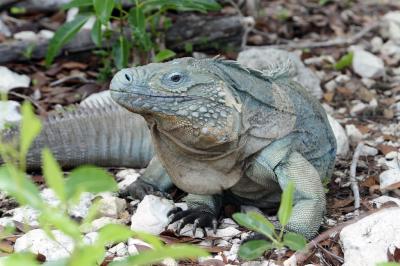
This is an adult Grand Cayman blue iguana on its namesake island. Decimated by a combination of habitat destruction, car-related mortality, and predation by introduced cats and dogs, the reptile numbered between 10-25 individuals by 2002. A recovery program -- assisted by health experts from the Bronx Zoo -- has brought the number of free-ranging iguanas within Grand Cayman's protected areas to more than 500 animals. Photo: Julie Larsen Maher/Wildlife Conservation Society

While thousands of species are threatened with extinction around the globe, efforts to save the Grand Cayman blue iguana represent a rarity in conservation: a chance for complete recovery, according to health experts from the Wildlife Conservation Society's Bronx Zoo and other members of the Blue Iguana Recovery Program.

Coordinated by the National Trust for the Cayman Islands, the Blue Iguana Recovery Program—a consortium of local and international partners—has successfully released more than 500 captive-bred reptiles since the initiative's inception in 2002, when the wild population of iguanas numbered less than two dozen.

"For the past several years, we've succeeded in adding hundreds of animals to the wild population, all of which receive a health screening before release," said Dr. Paul Calle, Director of Zoological Health for WCS's Bronx Zoo.

Fred Burton, Director of the Blue Iguana Recovery Program, said: "We expect to reach our goal of 1,000 iguanas in managed protected areas in the wild in a few years. After that, we will monitor the iguanas to make sure they are reproducing in the numbers needed to maintain the wild population. If we get positive results, we will have succeeded."

The Grand Cayman blue iguana is the largest native species of its namesake island, growing to more than 5 feet in length and sometimes weighing more than 25 pounds. The iguana formerly ranged over most of the island's coastal areas and the dry shrub lands of the interior before becoming endangered by a combination of habitat destruction, car-related mortality, and predation by introduced dogs and cats. The entire island's wild population in 2002 was estimated at only 10-25 individuals.

Recovery efforts to save the Grand Cayman blue iguana have mostly centered on the Salina Reserve, a 625-acre nature reserve located on the eastern side of the island. After being hatched and raised for a year or two in a captive breeding facility, each iguana receives a complete health assessment before release. This involves veterinarians taking blood and fecal samples for analysis, as well as weighing and tagging each reptile. The samples are analyzed in a nearby lab at the St. Matthews Veterinary School while sampling continues. The iguanas are released after the lab results are reviewed and health is verified. This year, the recovery program is releasing iguanas into a new protected area, the Colliers Wilderness Reserve, established last year and managed by the National Trust.


Read more!