Best of our wild blogs: 25 Apr 12


Oil-slicked Tanah Merah still reefy
from wild shores of singapore

nest I eaglet I @ Pasir Ris - 22Apr2012
from sgbeachbum

Weaver Ant Mimicry
from Macro Photography in Singapore

From Lornie Trail To Rifle Range Part 2
from Beauty of Fauna and Flora in Nature

Random Gallery - The Brown Awl
from Butterflies of Singapore

Mobile field guide on Birds of Singapore
from Rojak Librarian

A Walk @ Chinese & Japanese Garden
from Nikita Hengbok


Read more!

Singapore's parks and nature reserves are 'virtually devoid of wildlife'

Nature parks
Straits Times Forum 25 Apr 12;

'Introduce native fauna like the mousedeer, jungle fowl and civet cat.'

MR AJIT KANAGASUNDRAM: 'Our parks and nature reserves, such as the ones at MacRitchie and Bukit Timah, are beautifully landscaped but are virtually devoid of wildlife. The National Parks Board (NParks) should introduce native fauna like the mousedeer, jungle fowl and civet cat. This will increase biodiversity and be interesting for wildlife enthusiasts. Tourists could be taken on nature walks to see them. The NParks and Singapore Zoo could do this as a joint project.'


Read more!

Dino Twinky is here

Baby dinosaur one of trio bought for museum to be built at NUS
Tan Dawn Wei Straits Times 25 Apr 12;


Prof Leo Tan inspecting a crate containing parts of Twinky's tail bone. Twinky arrived last Wednesday packed in 12 crates on a 20-foot container. -- ST PHOTO: NEO XIAOBIN

IT SPENT one month at sea, journeying from the rugged, expansive and cold American state of Utah to the flat, small and tropical island of Singapore.

And last Wednesday night, Twinky, the baby dinosaur, arrived in its adopted land - packed in 12 crates on a 20-foot container.

But it will be a while before Singapore will unveil the rare 12m long find at its new home, as the yet-to-be-built Lee Kong Chian Natural History Museum will be ready only in two years' time.

The 7,500 sq m purpose-built museum at the National University of Singapore (NUS) will house not just Twinky and two larger dinosaurs, but also one of the biggest collections of South-east Asian animals in the region.

For now, Twinky will wait patiently in an undisclosed temperature-controlled and secure warehouse for its star turn - and the arrival of its 'parents'.

Twinky, Apollo and Prince were found buried together in a quarry in Wyoming between 2007 and 2010.

When the Raffles Museum of Biodiversity Research at NUS heard of the discovery last year, it made a successful bid to buy the trio for $8 million.

The museum's team, headed by Professor Leo Tan, 67, and Professor Peter Ng, 52, went on an intense two-month fund- raising drive to buy the giant, pre-historic creatures.

They sealed the deal when Mrs Della Lee, wife of Lee Foundation chairman Lee Seng Gee, stepped in to top up the $2 million collected.

Prof Tan, director of special projects at the Faculty of Science dean's office, is impatient for the arrival of Apollo and Prince.

He said: 'The sooner we get them here, the better. We want them in our hands, on our soil. It belongs to the people of Singapore.'

The duo, both 24m long, are affectionately referred to by the museum as Twinky's parents.

The trio, 80 per cent complete when found, are diplodocid sauropod dinosaurs, one of the biggest animals to walk the Earth some 150 million years ago.

Apollo is expected to arrive within six months, while Prince will arrive in time for the museum's opening.

Prof Tan said the hardest part of the legal paper chase was getting the assurance that the dinosaurs' seller, Dinosauria International, had the right to prospect on the land leased to them by the quarry's owner.

The NUS team also had to ensure no one else had laid claim to the bones.

The museum is embarking on another drive to raise between $5 million and $10 million to pay for professorships, fellowships and the cost of exhibition.

As for what to do with Twinky between now and the museum's opening in two years' time, Prof Tan said the team is still working out plans but there is a possibility of showcasing it for fund-raising purposes.

But there will be no loan of the dinosaurs to museums. 'The risk is too great. We'll always worry, what happens if there is a fire?' said Prof Tan.

But the team is open to working with other museums on joint projects. It will also let corporations and individuals sponsor the display of Twinky at private events.

'People will see him before the opening. It is just a matter of when, how and in what form.'


Read more!

Malaysia: 3 dead turtles with shells cut off found on island

Roy Goh New Straits Times 25 Apr 12;

PROTECTED SPECIES: Hawksbill turtles' eyes also poked protected


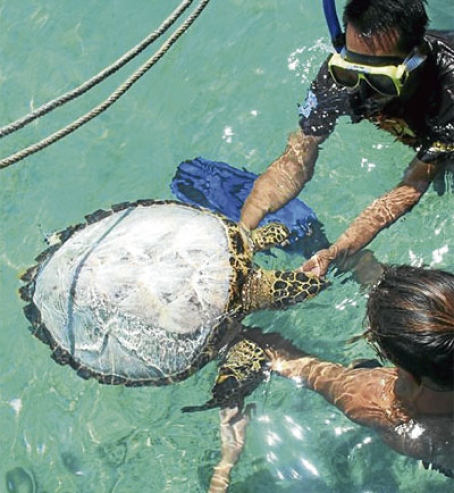
Lodge employees removing a dead hawksbill turtle found on Pulau Mantanani Kecil in Kota Belud.

KOTA KINABALU: THREE dead turtles with their shells removed were found on the shores of Pulau Mantanani Kecil in Kota Belud recently.

The hawksbill turtles were found by employees of a backpackers' lodge on the island between Sunday and Monday. An employee said that apart from the shells, which appeared to have been uniformly cut, the eyes of the turtles were also poked.

The shell of hawksbill turtles, known as tortoiseshell, is used to make combs, guitar picks, knitting needles and ornaments.

Since 1973, the trade of tortoiseshell worldwide was banned under the Convention on International Trade in Endangered Species.

Tortoiseshell is preferred because of its durability.

State Wildlife and National Parks Department director Dr Laurentius Ambu said officers would go to the island to investigate the incident.

"Hawksbill turtles are protected reptiles in the state."

The shells could have been cut by poachers, said Ambu.

In 1996, Malaysia and the Philippines had set up an area to protect turtles in Sulu Sea. The Turtle Islands Heritage Protected Area covers three islands in Malaysia and six in the Philippines.

'Do more to stop turtle cruelty'
Avila Geraldine New Straits Times 28 Apr 12;

KOTA KINABALU: THE recent discovery of three dead hawksbill turtles minus their shells and with their eyes gouged out at Mantanani Islands, off Kota Belud, has caused concern among tourists, conservationists and tourism authorities.

Although they agreed that the incident was an isolated one, all are in favour of more efforts to be taken to prevent a recurrence.

Marine conservation officer Lionel Aaron Lingam, who was among the first to spot one of the turtles, then barely alive at Mantanani Kecil on April 20, called the incident "shocking".

Lionel was with 20 local and foreign divers and staff of Mari Mari Mantanani Dive Lodge where he works, preparing diving gear at the jetty when he spotted the turtle.

"I asked one of the staff to check on it.

"He told me that the shell was white.

"I then sensed something was wrong.

"The guests were angry and saddened.

"They asked me why such things happen.

"I was lost for words," he said, adding that the turtle died 20 minutes later.

Another hawksbill turtle was spotted by a boatman later in the evening between Mantanani Kecil and Mantanani Besar.

The third turtle was found on Saturday morning.

"I've never come across such incidents.

"It was cruel and I believe it was done by the islanders.

"But there is no proof."

Mantanani Islands comprises of Mantanani Besar which is populated and Mantanani Kecil and Lungisan, which are famed for their dive spots.

Mantanani Kecil is also gazetted as a bird sanctuary.

An avid diver and traveller, Jack Otter, also expressed his anger over the incident after reading about it on the New Straits Times' website.

The 46-year-old Australian believed the practice of killing marine turtles for their shells was isolated, but added that awareness must be instilled among islanders.

He said the authorities should take the matter seriously because marine awareness, especially among the islanders, was still low.

"I understand that it is somehow normal for them, who view it (killing turtles for their meat and shells) as a source of income, because they haven't been educated of their importance.

"For islanders who work with the resort, there is no problem because they are exposed to marine conservation efforts and programmes.

"However, for those who are not directly involved with tourism or the resort, there is a crucial need to change that practice and their perception.

"It's difficult, but it can be done slowly."

Otter also called on the state government to gazette Mantanani Islands as a marine park.

Sabah Tourism Board member Clement Lee had also raised concerns over the cruel treatment, describing the turtles' fate as similar to sharks.

Lee, who is also Borneo Divers Mabul Resort managing director, said he had never encountered such an incident in his 30 years of diving, adding that education was important to begin with.

"I've never seen it in Mabul, or other parts of Sabah.

"What happened is a warning for the authorities to do something about it."

Since 1973, the trade of hawksbill turtles' shells worldwide has been banned under the Convention on International Trade in Endangered Species.

In 1996, Malaysia and the Philippines set up an area to protect turtles in the Sulu Sea.

The Turtle Islands Heritage Protected Area covers three islands in the country and six in the Philippines.


Read more!

Vietnam's mangroves trees threatened by rising tide of deforestation

clearances could contribute to coastal erosion and prove a missed opportunity to prevent climate change
Alisa Tang Guardian Weekly 24 Apr 12;

Standing at the entrance to Lang Co town hall, 69-year-old Mai Truc Lam gestured to the two-story building, the sun-drenched parking lot and two-lane road in front, and described the small coastal community as it once was.

"We are standing in an area that used to be mangroves," the weathered fisherman said, and then described the negative impact deforestation has wrought on the area's sea life. "Now, we do not see some species of fish here anymore."

A few minutes' drive away, on a sliver of sand that forms the Lap An Lagoon on the central coast of Vietnam, lies a modest grove of trees – some evergreens that shed a path of soft needles, and where the land meets the sea, Lang Co's few remaining hectares of mangroves, perched above the water upon their stilted, flying buttress-like roots.

Some of the mangrove trees have torpedo-shaped seeds, which have poked into the ground and given birth to a new generation of delicate seedlings, all too easily trampled upon by oblivious passersby. Yet these remaining mangroves face the threat of being razed entirely to make way for a golf course as part of local economic development plans – part of a global development trend that has seen the clearance of as much as 50% of the world's mangroves over the past half a century.

Mangroves grow along the ocean coasts of 118 countries – with a quarter of the world's 40m hectares being in south-east Asia – but with widespread deforestation due to population pressure, expansion of shrimp farms and development, scientists fear mangroves may disappear altogether in as little as 100 years. At their best, mangroves form a vast coastal barrier of trunks and roots against the sea, controlling erosion, protecting communities from storms, and providing an environment for greater fish diversity.

Furthermore, scientists last year unveiled research pointing to mangrove forests as ideal repositories for carbon storage – containing an average of 1,000 tonnes of carbon per hectare, compared with 300 tonnes per hectare of tropical forest – which could help to fight climate change by keeping carbon locked away on land and out of the atmosphere. The scientists found that most of the carbon in mangrove forests – 49% to 98% – is stored below ground in thick, tidally submerged soil in which decomposition is anaerobic in the absence of oxygen. Yet with mangrove conservation up against economic development, the more obvious path to money wins.

"My sense in Lang Co, and in provinces across Vietnam, is that economic development has become a driving force so dominant that environmental precautions have fallen by the wayside," said Evan Fox, a coastal planning consultant. "In villages where local governments are searching for ways to bolster their economic output, it is difficult to justify preservation of an area if managers and local people cannot discern its tangible benefit."

There are laws that protect the forests and mangroves in Vietnam, but enforcement can be lax, rendering such regulations impotent. "My interpretation is that it's illegal but everything is negotiable in Vietnam and since there is no consequence for breaking the law (at least in the environmental domain), mangroves get cut. Anyway, since there are so many conflicting laws, you can probably legalise what you've done by reference to a previous law," said Jake Brunner, programme co-ordinator for the International Union for Conservation of Nature (IUCN) in Vietnam.

Shrimp farms have been one of the big drivers behind mangrove loss. A 2011 analysis of images of Vietnam's southern Mekong delta – an area that is typically mangroves – found that from 1973 to 2008, more than half of the mangroves were converted into shrimp farms, causing serious erosion. Nonetheless, communities and governments have taken little notice of the protective services that mangroves provide until a disaster of epic proportions strikes – such as the Indian Ocean tsunami that killed some 180,000 people in western Indonesia's Aceh province.

"In Aceh, after the tsunami, the result wouldn't have been like this, if we still had mangroves," said Daniel Murdiyarso, a scientist with the Indonesia-based Centre for International Forestry Research and one of the researchers behind the mangrove carbon-storage findings.

Disaster management and risk reduction are now squarely on the Indonesian government's radar, but in most countries – and most of the time – the impact of climate change is incremental and therefore unlikely to spur governments and communities to action. When typhoons have hit Vietnam, mangroves have helped to save lives.

"That's when people noticed that where there were mangroves, people survived," Brunner said. "Thailand and Indonesia suffered a very high magnitude event, the tsunami, and that sent a very clear message. In Vietnam, there have been higher frequency, but lower magnitude events, so it hasn't quite had the same impact, and you still see mangroves being lost."

Initiatives like the Mangroves for the Future (MFF), established after the 2004 tsunami and co-chaired by IUCN and the UN Development Programme, offer grants to communities like Lang Co to protect their mangroves. Since 2008, MFF has implemented about 90 projects in its eight member countries across south and south-east Asia. The $29,000 project in Lang Co – $23,000 from MFF and $6,000 from the grantee organisation, the Centre for Community Research and Development (CCRD), and the local community – is to focus on supporting natural regeneration of existing mangroves, which is less expensive and more effective than planting. According to CCRD, Lang Co had about 100 hectares of mangroves two decades ago, but today only five hectares of poor-quality mangroves remain.

Under the MFF grant, the Lang Co fishing association has been tasked with looking after these mangroves. Local fishermen will be trained in mangrove and aquatic resource management and protection.

Alisa Tang is a Bangkok-based freelance journalist who reports and edits for organisations including the Centre for International Forestry Research, which supported her reporting trip to Vietnam.


Read more!

Best of our wild blogs: 24 Apr 12


Oil-slicked Tanah Merah still fishy
from wild shores of singapore

Pasir Ris Mangrove Boardwalk Guided Tour
from Cheekiemonkies

裕华园噪鹃 Asian Koel@Chinese Garden
from PurpleMangrove

Application for DENSO Youth for Earth Action is now open till 15 May 2012! from Toddycats!


Read more!

21 trees topple over at Pasir Ris Park

Straits Times 24 Apr 12;

The trees, some as tall as seven storeys, toppled over near Carpark C of Pasir Ris Park on Sunday night. Nobody was hurt and no property was damaged. The cause of the incident is being investigated. -- PHOTO: SHIN MIN

TWENTY-ONE trees, some as tall as seven storeys, toppled over near Carpark C of Pasir Ris Park on Sunday night.

The National Parks Board (NParks) was notified of the damage at 7am yesterday, and it set about removing those causing obstruction. It will take a few more days to clear the debris, it said.

Its spokesman said the cause of the incident is being investigated, and would not be drawn into speculating what caused that many trees to fall at one go.

Nobody was hurt and no property was damaged.

NParks general manager Chia Seng Jiang said the stepped-up programme to inspect and prune mature trees, especially those in high-traffic areas, has reduced the percentage of trees affected by storms to 0.1 per cent in the last few years.

Nature Society president Shawn Lum said he suspects Sumatra squalls to have caused the trees to topple.

The Meteorological Service here defines such squalls as eastward-moving lines of thunderstorms bringing heavy rain and gusty winds of 40kmh to 80kmh.

These squalls happen regularly during the inter-monsoon period from April to October.

Mr Lum said there have been intermittent squalls in the last few weeks, so it is not surprising the trees toppled over - 'though it is sad for the trees and tree lovers, of course'.

In March last year, hundreds of trees off Mandai Road fell over in a storm; a few weeks ago, trees in Warrick Road near Alexandra Road were also damaged in what may have been another squall.

LESLIE KAY LIM


Read more!

Paper outlining five population scenarios released

Tan Weizhen Today Online 24 Apr 12;

SINGAPORE - As Singapore marks a "demographic turning point" this year, where the Republic's first cohort of baby boomers turns 65, a paper has been released by the Government projecting that an intake of about 20,000 to 25,000 new citizens each year would keep the citizen population size stable.

This is assuming that future demographic trends prevail, said National Population and Talent Division (NPTD), releasing the paper today.

In one of five scenarios that NPTD put out with varying intakes of new citizens, if Singapore's total fertility rate (TFR) stays at 1.2 births per female and there are no new citizens, Singapore's native population will shrink around 2025.

Under this scenario, there will only be 2.1 working-age citizens to each elderly citizen by 2030, and citizen deaths will exceed births in 13 years, the paper said.

Between now and 2030, over 900,000 baby boomers will retire from the workforce.

The NPTD said it will be involving the public in a 'national conversation' centering around topics related to this paper, following focus groups.

The paper can be accessed at www.nptd.gov.sg/.

Immigration can mitigate rate at which citizen population ages: report
Imelda Saad Channel NewsAsia 24 Apr 12;

SINGAPORE: Singapore needs to continue attracting immigrants to slow down the decline and ageing of its citizen population, according to a paper released by the National Population and Talent Division.

It says that if the country's Total Fertility Rate remains the same, Singapore will need an immigration inflow of between 20,000 and 25,000 new citizens each year to keep the citizen population size stable.

This is one of the five population scenarios set out by the paper.

The scenarios are not predictions or forecasts, but illustrations of the growth and change in population that will occur if certain assumptions about future demographics trends prevail over a projected period.

Singapore's TFR now stands at 1.2, well below the replacement rate of 2.1.

This year has been described as a "demographic turning point", when the first cohort of post-war Baby Boomers born between 1947 and 1965 start turning 65 years of age.

Without immigration, the paper says citizen deaths will exceed births in 13 years.

By 2025, the population will also start to age and shrink, with the median age being 45 - up from the current 39 years.

The citizen workforce will also start to shrink with fewer working-age citizens supporting each elderly citizen.

The paper projects that the trend will be mitigated somewhat with immigration.

It says immigration will help to slow down the decline in the pool of working-age citizens and slow down the rate of ageing among the population.

Taking in 20,000-25,000 new citizens each year will also bump up the citizen old-age support ratio slightly from 2.1 to 2.4 working citizens for every elderly citizen, in 2030.

The paper will form the basis of discussions among focus groups and the public for a White Paper to be released by the National Population and Talent Division by the end of the year.

The White Paper will set out issues important to Singaporeans and strategies for a sustainable population. It will cover things like land use and infrastructure planning.

The public consultation for this is expected to start in the middle of the year.

- CNA/cc

Population will shrink from 2025 without new citizens
Pool of working age citizens will also drop steadily from 2.1m today
Phua Mei Pin Straits Times 25 Apr 12;

SINGAPORE needs 20,000 to 25,000 new citizens each year to prevent a decline in its citizen population from 2025, new government projections show.

That assumes no big uptick in the number of Singaporean babies born here. The Total Fertility Rate (TFR) is now 1.2, one of the lowest in the world.

If it stays put, and the door to new migrants is shut from this year, the citizen population will start shrinking in 13 years' time.

The pool of working age citizens will also drop steadily from today's 2.1 million to about 1.5 million in 2060.

These are some of the five scenarios in a paper that the National Population and Talent Division (NPTD) released yesterday.

As the lead agency for the Government on population matters, it is conducting a comprehensive examination of population goals and policies, Deputy Prime Minister Teo Chee Hean announced during the Budget debate.

The NPTD is releasing information to spur study and discussion in the lead-up to a White Paper on population matters, due by the year end.

It has launched focus group discussions with different segments of the community. From the middle of the year, it will engage the public through various avenues, including dialogues and online channels, to discuss population issues holistically.

'Through this process, we hope to bring to light issues that are important to Singapore and Singaporeans, and develop a shared understanding of our strategies to build a sustainable population that secures Singapore's future,' it told The Straits Times via e-mail.

The five scenarios drawn up by NPTD, using data from the Department of Statistics, are based on the following assumptions:

TFR rises to 2.1

TFR stays at 1.2 and the number of new citizens each year is zero, 15,000, 20,000 or 25,000.

A comparison shows that only with an annual injection of 20,000 to 25,000 new citizens a year can the citizen population size be kept at a constant level of four million. In all other scenarios, the total number of citizens will dwindle.

From 2007 to 2010, Singapore's intake of new citizens ranged from over 17,334 to 20,513. Last year saw 15,777 additions to the citizen population.

A key point from the paper is that, regardless of which scenario comes to pass, Singapore's citizen population will continue to age. In the best-case scenario, median age rises from 39 in 2011 to 42 in 2060. In the worst case, it jumps to as high as 55.

From now to 2030, Singapore will also see 'an unprecedented age shift, as over 900,000 baby boomers will retire from the workforce and enter their silver years', NPTD said in the paper.

Commenting on NPTD's scenarios yesterday, Associate Professor Kalyani Mehta, the head of SIM University's programme for gerontology, pointed to the Retirement and Re-employment Act as a measure that can impact the size of the working population.

'It remains to be seen how much we can improve our labour force productivity. Getting people such as housewives back into the workforce is another strategy that has to be factored in.'

Demographer Gavin Jones noted the paper's silence on the future permanent resident population.

'To become a citizen, you pass through a process of being a PR first. New citizens are drawn from that pool and you do need to look at that aspect,' he said.

Last September, the Institute of Policy Studies drew up 48 scenarios on the resident population, which includes citizens and permanent residents.

Its conclusion: If net migration was zero, the resident population would start bottoming out in 2025, dropping to three million by 2050.

Yesterday, the NPTD also stressed that the Government takes care to accept immigrants who are able to integrate well into Singapore society.

From 2001 to 2010, 49 per cent of new citizens were from South-east Asia, 42 per cent from other parts of Asia and the remaining 9 per cent from other parts of the world.

From 2005 to 2010, about 55 per cent of new citizens were aged 30 or younger.

Members of the public may access the paper and give their comments at www.nptd.gov.sg


Read more!

PUB staff can now take action faster

Officers authorised to enter premises without notice for specified cases
Feng Zengkun Straits Times 24 Apr 12;

STAFF from national water agency PUB can now spring more quickly into action to repair faulty equipment or nab water polluters.

Under a new law introduced earlier this month, its officers can enter homes and other buildings without notice, even if the occupants are not around.

Previously, the agency had to give advance notice of at least six hours, which could be a handicap when it came to gathering evidence of wrongdoing.

It can now react faster to search premises and collect evidence such as documents and water samples, and also compel the relevant parties to help out with investigations.

The PUB can also authorise officers from other statutory boards to carry out these duties. All these changes will allow it to do its work more efficiently, a spokesman said.

Its duties include keeping an eye on the Republic's catchment areas and discharge into the drainage system, investigating and penalising water-related offenders, and protecting water-related installations in the country.

But others have raised concerns over the new law's reach. In a speech in Parliament earlier this month, MP for Aljunied GRC Sylvia Lim noted that the PUB's expanded powers come with 'a lot of grey areas'.

'Tasks such as forced entry into premises, conducting searches and doing investigation work are confrontational by nature, and have a lot of grey areas and decision points where discretion needs to be exercised in a lawful manner,' she said.

She also raised concerns over the PUB's new ability to appoint other statutory board officers to do its work.

'What assurances will the public have that they are properly trained and accountable for the exercise of such powers?' she said.

The new law spells out specific circumstances in which the PUB or its appointed officers can enter buildings without notice.

These include incidents of emergency, fire or drought; cases where the water quality fails to meet standards; and the need to repair, replace or maintain any water installation.

Entry into buildings could also be necessary to stop any disruption of water supply to consumers or to conserve the supply.

But a more general clause also allows entry 'in the interests of public safety'. Some incidents, such as possible large-scale water contamination, have to be addressed with more urgency, said the spokesman.

The new law will also deal a heavier blow to water polluters, she said. In 2010, for example, the PUB received reports of a solvent smell in the air in the Jurong industrial area.

It found an unusual discharge in the public sewers there and traced it to a nearby factory, but was unable to gather samples due to delayed access to the premises.

The spokesman added that the agency's regulatory role will remain critical as the Republic expands its catchment areas and increases the reclamation of used water.

Assuring members of the public that PUB staff will be professional in their work, the spokesman said they can be identified through their staff passes. Contractors should have an authorisation pass from the agency.

The public can also verify the officers' identities through the agency's 24-hour hotline on 1800-2846600. If anything is missing after a visit, the occupant should file a police report and inform the agency by calling the hotline.


Read more!

Malaysia: Preserve the pristine beaches in Johor

The Star 24 Apr 12;

JUST as “Tioman risks being an ecological wasteland” (The Star, April 23), a major ecological disaster is threatening Desaru and Pengerang in Johor.

We are all for development in Pengerang. However, it is important for Petronas and the Government to ensure the preservation of the pristine beaches of Desaru and Pengerang.

Recently, Petronas announced the huge RAPID project to develop Pengerang as the oil and gas hub for Malaysia and South East Asia. This Petronas RAPID project is on fast track basis for the development of a number of oil and gas refineries in Teluk Ramunia.

What is important is for Malaysia to become a developed nation without destroying our pristine environment and fragile ecology.

For example, for this RAPID project, Petronas is to mine sea sand from nearby Teluk Ramunia to be used to top up a mangrove swamp.

This is for a massive housing project to relocate villagers affected by the RAPID project.

This approach of mining and sucking sea sand to top up the mangrove swamp will have a huge environmental impact. A large track of pristine fishing ground will be destroyed, denying the local fisherman of their livelihood.

By mining and sucking sea sand, thousands of acres of pristine beachfront land stretching from Desaru to Teluk Ramunia will be destroyed.

The beautiful beaches of Desaru and Pengerang will be swallowed by the sea. It is common sense that if you take sand from the sea, nearby beaches will be eroded to form new sand in the sea.

In future, remedial work to build embankments to protect the beaches will cost Petronas billions of ringgit.

And, Khazanah Nasional is developing a huge RM6bil project in Desaru into a premier beach resort and theme park.

It is important for the Environment Ministry, the Johor government, the Federal Government and Petronas to seriously study this problem.

I’m sure every proud Malaysian will be happy to see Malaysia become a developed nation, but not at the expense of destroying our fragile eco-system.

We have to take care of our environment for future generations of Malaysians.

ECO-CITIZEN,

Kuala Lumpur.


Read more!

Malaysia: Tioman risks being an ecological wasteland

The Star 23 Apr 12;

I READ the report “Posh Perhentian?” (The Star, April 17) as a tourist on the flight back home earlier this week, and am saddened to report that a similar sorry state of affairs would seem to apply to Pulau Tioman.

I have been to the island with my partner three times over the past 20 years with my last visit one week ago.

We had hoped that despite some negative reviews, that the island would have developed more positively over the years.

On this visit, most of our time was spent on the once outstanding Salang Beach. Sad to say, the first thing we noticed was the pollution from the river leading into the sea, smelling like a third world sewage outlet.

We saw cesspits connected to some buildings, though we had no idea of their eventual destination. However, more telling, was the waste pipes and foul water being vented directly into the river.

Walking along the seafront, our spirits rose initially, as efforts had obviously been made to keep it tidy with collection points for plastic bottles and cans clearly visible.

However, a quick stroll round the back of the chalets and restaurants revealed large quantities of dumped cans strewn amongst huge piles of mixed rubbish.

Seemingly, like Pulau Perhentian, it was all waiting for a rubbish collection policy, or one to take effect.

Granted, the beach seemed clean enough.

However, the snorkelling experience is substantially diminished as there is very little coral left and the water no longer has that appealing translucent quality that I remember from 15 years ago.

It occurred to me that I had seen markedly fewer animals and birds on this visit. Enquiries elicited a sorry story from some locals who spoke about the extinction of porcupines and mouse deer through relentless hunting.

I remembered during my first visit to Tioman over 20 years ago, how proud the locals had been of the rare species on the island.

They were proud of the coral and the beautiful clear water and uninterrupted view of the jungle, white sand and sea that made Tioman one of the 10 most beautiful islands in the world as voted by Time Magazine in the 70s.

The outlying islands are still beautiful, but there seems little understanding or care exercised to preserve this natural beauty with water taxis running over live coral as they take people to these remote beaches.

More care is urgently needed here as the coral has already to contend with the damage from climate change without having to cope with the additional damage from local pollution and breakage from boats and tourists.

It is clear that the ability of the islands to generate tourist ringgit will only work if there exists the natural beauty that they want to see.

Without concerted action, islands like Tioman risk being left as an embarassing ecological wasteland shunned by tourists and unable to support the fishing villages that once lived off the coral reefs before the tourists came.

LUCY SOMMERS,

Stoneyside,

Nr Bridport, England.


Read more!

Malaysia: New regulation seeks to improve zoo conditions

S.S. Yoga The Star 24 Apr 12;

A new regulation spells hope for the betterment of animals kept in zoos.

IF animals could laugh and sing in happiness, there would be some trumpeting of joy emerging from zoos and wildlife parks in Peninsular Malaysia for on Feb 1, the Wildlife Conservation (Operation of Zoo) Regulations 2012 was gazetted.

The new regulation gives voice to the need to regulate zoos systematically and to higher standards. Animal lovers and conservationists have long highlighted the terrible conditions under which wildlife is held in captivity in such establishments. The problem was also widely highlighted in the media last year.

The new regulation is made possible with the enforcement of the Wildlife Conservation Act 2010 in December 2010. It replaces the Protection of Wildlife Act 1972 which had been criticised as lacking bite and failing to address many concerns.

One of the failures was the lack of power for the Department of Wildlife and National Parks (Perhilitan) to act against errant zoos and wildlife parks. Also, the old legislation has no provisions addressing wildlife welfare and cruelty to captive animals. The new regulation resolves these loophole as it provides for some areas where Perhilitan could take action against errant zoos.

Zoo operators have a six-month grace period to comply with the new requirements of the regulation. Those which do will be issued an annual permit. Any person operating a zoo without a permit is liable to a fine not exceeding RM70,000 or/and a prison term not exceeding three years.

The new regulation requires zoos and animal parks to:

> Adhere to minimum cage sizes, which are specified according to various animal groups.

> Have a quarantine area and a veterinary clinic or hospital.

> Employ a full-time consultant veterinarian.

> Provide vaccination of animals by a veterinarian or anyone under his supervision.

> Provide nutritious and sufficient food for the animals, as prescribed by a veterinarian.

> Maintain a record of kept animals and their health care.

> Ensure the cleanliness of the facility.

> Conduct euthanasia of wildlife whenever necessary.

> Conduct wildlife shows that involves the animals’ natural behaviours only.

> Submit a deposit to Perhilitan for the upkeep of animals should they be seized.

Operators who contravene these provisions are liable to a fine not exceeding RM100,000 or/and a prison term not exceeding five years.

Singapore-based non-governmental organisation Animal Concerns Research and Education Society (Acres), which has done several surveys of Malaysian zoos and pointed out the weaknesses of these establishments, views the new regulation positively.

“It is undoubtedly a good start and it shows that Perhilitan is serious about addressing zoo animal welfare issues and has also responded positively to the feedback given by Acres, other non-governmental organisations (NGOs) and members of the public. This is undoubtedly one of the best zoo regulations we have seen in South-East Asia,” says executive director Louis Ng.

Upreshpal Singh, founder of the Friends of Orang Utans Malaysia, concurs. “The new law looks really good and it comes at a time when many zoos still have to improve, some more so,” he says.

While acknowledging that the new regulation is “a good start”, Sahabat Alam Malaysia (SAM) president S.M. Mohamed Idris questions if Perhilitan has the manpower to inspect the many operations that house wild animals. “The new legislation cannot be effective until enforcement officers have acquired expertise in recognising defects in animal husbandry and can devote their time to unannounced physical checks of premises,” he says.

The Natural Resources and Environment Ministry (NRE), however, assures that there will be enough manpower to scrutinise the zoos as it will rely on Perhilitan’s zoo audit team, law enforcement team and wildlife crime units, as well as its own independent zoo review panel. In response to concerns raised by Traffic South-East Asia senior communications officer Elizabeth John, it says the operating permit of a zoo will not be automatically renewed each year. An audit would be done first to ensure compliance with the regulation. In addition, Perhilitan will conduct enforcement checks, attend to public complaints and provide advice to the zoos.

Too lenient

Sean Whyte, founder of Britain’s Nature Alert and a strong critic of Malaysian zoos, describes the regulation as “comprehensive and excellent”. However, he worries about Perhilitan’s dismal record in enforcing the law and the leniency which it has shown to some zoos. “The new law will be useless if not enforced diligently and transparently by Perhilitan. We can only judge them by what they do, not by what they say they will do,” cautions Whyte.

The Ministry counters that NGOs, instead of making accusations, should join Perhilitan in its Teman Zoo Program (Friends of Zoos Programme), an outreach programme launched in July last year for guidance to zoo operators.

“The NGOs can file their complaints to various government agencies, media and political parties if they feel Perhilitan has committed any wrong doings,” it adds.

Measures to monitor the diet of captive animals and their health records are addressed in the Zoo Best Management Guidelines which are now being drafted. On the NGOs’ criticism that the regulation is silent on the type of substrate and furniture used in animal enclosures, the Ministry says these will be controlled by Perhilitan’s zoo audit team and the NRE zoo review panel.

The Ministry says animal inventory – data on births, deaths, acquisitions, escapes, transfers and releases – will be governed by the main Act, specifically in the provisions on “licences and permits”, and also under “duties and obligations”.

“The animal’s record must tally with the tag ID which must be reported to the licensing division for verification when acquiring the animal,” says the Ministry.

But a perusal of the main Act sees some ambiguity in matters concerning animal births, escape and release.

Purely entertainment

One contentious issue with regards to wildlife park operations is the running of animal shows to entertain visitors. Among the acts which had wildlife lovers fuming were: a sun bear made to support itself on a rolling drum; a pig-tailed macaque on a leash made to dive into a tank of water from a raised platform; and orang utans made to cycle.

Previously, zoos have been issued “instructions” to conduct shows which only exhibit the natural behaviour of animals but this was openly flouted. The instruction is now provided for under the regulation.

The Ministry says if zoos fail to comply with the new requirement after the six-month grace period, action will be taken. “The public, too, must do their part by not demanding for circus acts and shy away from it. Awareness is pertinent in this aspect,” it says. To ensure the welfare of captive animals, matters pertaining to cruelty and mistreatment are covered in the main Act.

Meanwhile, three other regulations are being drafted to address other concerns. The proposed Wildlife Conservation (Disposal) Regulations will stipulate matters on euthanasia of animals and require records of disposals to be reported to Perhilitan’s licensing division. The proposed Wildlife Conservation (Commercial Captive Breeding) Regulations will regulate breeding and surplus zoo animals. Transportation of animals to and from zoos will be covered under the proposed Wildlife Conservation (Exhibition) Regulations.

Meanwhile, SAM asks that all proposed new zoos and parks – such as the purportedly largest bird park in South-East Asia, to be sited at the Botanical Gardens in Ayer Keroh, Malacca; the zoo in Kemaman, Terengganu; and the Bukit Gambang Safari Park in Kuantan – be put on hold. It says getting existing zoos to meet the new standards should be the priority for Perhilitan.

The department, however, sees no reason why the new zoos should not be set up as long as they are in accordance with the new regulation. Well, it remains to be seen how effective the policing of the new law will be. Meanwhile, those concerned with the treatment of animals in zoos say they will be vigilant.


Read more!