Best of our wild blogs: 30 Aug 13


A Pragmatic Singaporean's approach to nature
from Bird Ecology Study Group

Diving for Treasure: Singapore Style - a video clip of the Southern Expedition from Mega Marine Survey of Singapore

Butterflies Galore! : Aberrant Oakblue
from Butterflies of Singapore

Ulu Sembawang Park Connector Welcomed Taichung Friends
from Beauty of Fauna and Flora in Nature


Read more!

HDB unveils plans for three new housing areas

Olivia Siong Channel NewsAsia 29 Aug 13;

SINGAPORE: Three new housing areas will be launched over the next few years, offering 40,000 new homes in all. They are Punggol Matilda, Tampines North and the new centrally-located estate of Bidadari.

Homebuyers will be able to apply for units as soon as September -- when some 500 units at Punggol Matilda are launched by the HDB.

From waterfront living at Punggol Matilda, to a boulevard park at Tampines North, and preserving the heritage and greenery at Bidadari -- these plans were unveiled by National Development Minister Khaw Boon Wan at the HDB's "Future Homes, Better Lives" Exhibition.

Mr Khaw said: "The plans for Bidadari, Tampines North, and Punggol Matilda, will capitalise on their individual distinctive character so that they can all achieve a unique identity and provide a unique living experience.

"The planners of HDB have carefully built on each estate's history, distinctive local flavour and features. As we rapidly expand our building programme to create new precincts in new towns, my instruction to HDB is to seize every opportunity of building new precincts, to build on our strong foundation, so as to advance our social mission. Every new town must be better than the previous one."

Punggol Matilda, which is about one-tenth the size of Toa Payoh town, and will be a waterfront home to about 28,000 residents with 8,000 flats.

One of seven distinct districts in Punggol new town, Punggol Matilda will take inspiration from the historic Matilda House in its area -- this will be reflected in a new housing form that will be offered.

The district will also pilot a new "landscaped deck" housing concept -- where centralised amenities are built on elevated decks, with car park facilities underneath. The HDB said this will allow more generous building-to-building space and give residents "door-step" accessibility to precinct amenities located on the landscaped deck.

The second new area is Tampines North -- an extension of the existing Tampines town.

Taking after the town's shape as a leaf, it will see a boulevard linear park serve as the "main vein". With an area of about 240 hectares, it is also about three times the size of Bidadari estate.

The district will house about 21,000 units -- with about 80 per cent being public housing, and the rest private housing. The first public housing units will be launched in the second half of 2014.

Perhaps the most highly anticipated is the Bidadari estate, located in central Singapore.

Once a cemetery, it is now a green space and recreation area for residents around the estate. With a land area of 93 hectares, Bidadari is expected to have 11,000 residential units -- with about 90 per cent set aside for public housing. The first flats will be launched in 2015.

The existing greenery will also be preserved with a new park, and a lake being planned as the green lung for the area.

The Upper Aljunied Road will also be fully pedestrianised.

All the building in the three areas will be about 16 to 17 storeys tall.

Property analysts expect the Bidadari Estate and the Punggol Matilda district in particular, to prove popular with homebuyers.

"Bidadari because it's around the city fringe and also around the Bidadari estates there will be three MRT stations. Another one would be the Punggol Matilda estate, because it has the unique feature of having the pedestrian veranda that can connect the residents all the way to the beach," said Nicholas Mak, Executive Director for Research and Consultancy at SLP International Property Consultants.

Another common feature -- the three new areas will come with cycling paths and pedestrian networks.

Each area will take 10 to 15 years to complete.

- CNA/ac

3 new estates, 40,000 homes
Sumita Sreedharan Today Online 30 Aug 13;

SINGAPORE — Community gardens, huge parks of up to 10 hectares, walkways lined with greenery and landscaped decks integrated with housing blocks. Amenities like these will feature prominently in the three new housing estates of Bidadari, Tampines North and Punggol Matilda, the plans for which were unveiled yesterday at an exhibition at Toa Payoh HDB Hub. Together, these estates will yield 40,000 new public housing units.

Speaking at the exhibition, National Development Minister Khaw Boon Wan said that promoting “pervasive greenery and community gardens” will be one of five characteristics of every new town, or what he described as the “next generation of housing”. The others are encouraging interaction and healthy living among residents, as well as energy efficiency, recycling and higher productivity be it in refuse collection or the construction of the flats.

“As we rapidly expand our building programme to create new precincts in new towns, my instruction to HDB is to seize the opportunity to build on our strong foundation and to advance our social mission. Every new town must be better than the previous one,” Mr Khaw said.

He added: “These fresh planning and design ideas will characterise our next generation of public housing.”

On the three new upcoming towns - which are slated for completion over the next 10 to 15 years - Mr Khaw pointed out that the development plans will “capitalise on their distinctive character to bring about a unique identity and living experience”. “The planners have carefully built on each estate’s history, distinctive local flavour and features,” he said.

For example, Bidadari Park will feature heritage trees, Tampines North will boast a 10 ha Quarry Park - in a nod to Tampines’ past as a sand quarry site - and Punggol Matilda will have verandahs and colonnaded walkways inspired by a conserved property in the vicinity, the Matilda House,

Applications will open for a Build-to-Order project in Punggol Matilda in the BTO exercise next month. Buyers can expect units in Tampines North and Bidadari to come on stream in the second half of next year and 2015, respectively.

HDB said the pricing of projects in these estates will depend on the location, design and the different attributes of the flats such as floor area, design features and orientation, as well as the resale prices of nearby HDB units.

Most analysts whom TODAY spoke to expect the projects in Bidadari to be the most popular among the three new estates, due to its centralised location and links to transportation nodes. PropNex CEO Mohamed Ismail, however, felt that Punggol Matilda could potentially be most attractive. “Punggol is attracting a lot of attention, mainly because of lifestyle amenities and facilities,“ he said.

All three new estates will have extensive cycling and pedestrian networks. In terms of public transport, Bidadari will be served by the North-East Line (NEL) and Circle Line (CCL), while Punggol Matilda will be near the Punggol LRT line. New bus interchanges will also be built in Bidadari and Tampines North. Chris International Director Chris Koh noted that currently, Tampines North is the least accessible by public transport as there are no MRT or LRT stations in the vicinity. Analysts also wondered whether Tampines North would be classified as a mature estate given that it is part of the larger Tampines town, leading to its flats being priced higher.

ERA Key Executive Officer Eugene Lim said: “Tampines North could possibly be considered as part of the mature town of Tampines... residents there will be able to access the regional centre without being directly affected by the hustle and bustle.”

Tampines North: A ‘green shoot’ of Tampines Town
HDB fly-through of Tampines North development plan
Xue Jianyue Today Online 30 Aug 13;


SINGAPORE — Tampines North, with an estimated 21,000 dwelling units spread across 240 hectares, will be added to the existing Tampines Town.

Envisioned as the “green shoot” and extension of Tampines Town, the new estate will consist of four housing districts — Park West District, Green Walk District, Park East District and Boulevard District — each with a unique housing design.

The first housing parcel in the Park West District will be launched in the second half of next year.

A Boulevard Park — featuring a stretch lined with seasonal flowering trees — will run through the estate, providing residents with a seamless connection from Sun Plaza Park to Sungei Api Api. Community spaces and facilities such as childcare centres will be located along the park.

A second major park, Quarry Park, will also be created and could feature a quarry pond, inspired by Tampines’ history as a sand quarry site.

Apart from the two major parks, smaller ones will be scattered across the estate, and linked to one another by a pedestrian and cycling network weaving through the housing districts.

A new landmark mixed development, with mixed commercial and residential use as well as a bus interchange, will be a focal point for residents in Tampines North. The Tampines North Hub could be integrated with a plaza square and a green arcade,

A landbridge will also mark the gateway into Tampines Town, which will consist of 90,000 units with the inclusion of Tampines North.

This bridge will link the Quarry Park to Sun Plaza and Boulevard Park, allowing Tampines North residents to connect with the rest of Tampines Town.

Tampines North is one of three new housing areas being showcased at HDB’s “Future Homes, Better Lives” Exhibition this evening (Aug 29) at the HDB Hub Atrium.

The exhibition showcases the broad development plans for three new housing areas — Bidadari, Tampines North, and Punggol Matilda. It will be held from today to Sept 15.

New Alkaff lake for Bidadari estate
HDB fly-through of Bidadari development plan
Xue Jianyue Today Online 30 Aug 13;


SINGAPORE — The 93-hectare Bidadari estate, with 11,000 housing units, will feature a lake inspired by the former Alkaff Lake Gardens.

The Housing and Development Board (HDB) has envisioned the estate as a “tranquil urban oasis” for residents.

There will be six neighbourhoods — Alkaff, Bartley Heights, Sennett, Park’s Edge and Woodleigh — with the first housing parcel in Alkaff Neighbourhood to be launched by 2015.

The new Alkaff lake will be located in a new Bidadari Park, of around 10 hectares. The park will integrate an existing Memorial Garden commemorating the heritage of Bidadari Cemetery.

When the estate is ready, residents can access the nearby Bartley and Woodleigh MRT stations through pedestrian and cycling pathways.

A 20-metre wide greenway, lined with rest spots, commercial and communal facilities, will also cut across the estate from Bartley Road to Upper Serangoon Road. A town centre called Market Square will feature public housing integrated with community facilities and a bus interchange.

To bring back the rich and fond memories of Bidadari, the estate will feature a Heritage Walk showcasing stories of Bidadari’s history and contributions of prominent personalities, including Syed Shaik Abdulrahman Alkaff, a famous merchant and landowner whom the Alkaff Lake Gardens was named after.

Built in 1929, the garden was an attraction in pre-war colonial Singapore. In its heyday, families rowed boats in the lake and dating couples frequented the surrounding man-made hills. While the garden survived the Japanese Occupation, it was bought by a realty company in 1949 and subsequently redeveloped into a school and a private residential estate.

Bidadari is one of three new housing areas being showcased at HDB’s “Future Homes, Better Lives” Exhibition this evening (Aug 29) at the HDB Hub Atrium.

The exhibition showcases the broad development plans for three new housing areas — Bidadari, Tampines North, and Punggol Matilda. It will be held from today to Sept 15.

New public housing concept at Punggol Matilda
The new form of housing will have a landscaped deck and hybrid car park
Xue Jianyue Today Online 30 Aug 13;


SINGAPORE — To provide residents with a greater sense of spaciousness, the Housing and Development Board (HDB) will be introducing a new form of housing with a landscaped deck and hybrid car park at Punggol Matilda.

This concept consists of housing blocks built around precinct spaces located on elevated decks. Car park facilities are provided beneath it.

There will be longer distances between buildings. Integrated landscaped decks also provide “door-step” accessibility to the precinct amenities.

The HDB has identified a few suitable sites in Punggol Matilda to be designed with this new housing form. About 500 units will be launched next month.

The new Punggol Matilda estate was named after the Matilda House, a colonial house built in 1902 at Punggol’s waterfront. It inspired architects to include verandahs and colonnaded walkways into its design.

Punggol Matilda will thus feature open lawns and dense tree groves to resemble the tropical fruit orchard that once surrounded the house. One of the oldest houses here, the property was given conservation status by the Urban Redevelopment Authority in 2000.

When fully complete, Punggol Matilda, a waterfront housing district, will consist of 8,000 units that are expected to house about 28,000 residents. The development of the district is part of the Phase 2 master plan for Punggol New Town which was unveiled in October last year.

To connect residents to the waterfront, there will be three corridors across the estate.

The central corridor, along Punggol Field, is planned as a community street with pedestrian-friendly features such as an “urban verandah”. The two-storey high verandah will provide shelter for residents walking from the waterfront to future commercial developments. The community street will have amenities such as a proposed waterfront shopping centre, eating houses and shops to serve the residents.

The other two corridors are envisioned by HDB as boulevards lined with trees.

Punggol Matilda is one of three new housing areas being showcased at HDB’s “Future Homes, Better Lives” Exhibition this evening (Aug 29) at the HDB Hub Atrium.

The exhibition showcases the broad development plans for three new housing areas — Bidadari, Tampines North, and Punggol Matilda. It will be held from today to Sept 15.

Ambitious plans for 3 new HDB projects
Charissa Yong Straits Times 30 Aug 13;

FROM lush spaces for neighbourly bonding to cycling trails for healthy living, National Development Minister Khaw Boon Wan promised that each new Housing Board project would be a cut above the rest.

"Every new town must be better than the previous one," he said as he unveiled plans for the upcoming Bidadari, Tampines North and Punggol Matilda districts yesterday.

These projects will yield 35,000 public homes and 5,000 private units in stages over the next 10 to 15 years. While prices have not yet been released, Mr Khaw gave a glimpse of the amenities which will be on offer.

Bidadari, which will offer 10,000 public homes ranging from studio apartments to five-roomers, will have a man-made lake inside a 10ha park which will be a tenth of the estate's size.

Punggol Matilda will include an elevated, landscaped deck with verandahs, colonnades and a pavilion resembling the iconic Matilda House, after which the district is named. The south-western Punggol district, which will have 8,000 HDB units, will also have boulevards leading to a new waterfront shopping centre.

At Tampines North, which will eventually have 17,000 HDB flats, residents can unwind at a new shopping centre, which will be integrated with the bus interchange, or at the estate's two parks. A pond with a sandy beach is also on the cards, a nod to the area's past sand quarries.

Each town will have several common amenities, including public spaces such as community gardens, where residents can mix with one another, said Mr Khaw.

"They create a quality living environment where families and communities can grow."

These new estates will feature more greenery. At Bidadari, for instance, a canopy of mature trees along a stretch of Upper Aljunied Road will be preserved, and the road itself will be converted into a pedestrian walkway.

Cycling and pedestrian networks will also be a part of every new town, to promote healthy lifestyles. "We will look after the interests and safety of pedestrians and cyclists... We will encourage more to cycle and walk rather than drive," said Mr Khaw.

All future towns will also be energy efficient and have separate chutes for recyclables, he added at the launch of an exhibition yesterday featuring these plans at the HDB Hub in Toa Payoh. It runs till Sept 15.

Punggol Matilda's new homes will be the first to be launched, with 500 three- and four-room flats on offer during next month's Build-To-Order (BTO) exercise.

Tampines North's initial batch of BTO flats will go on sale in the second half of next year, followed by Bidadari's in 2015.

Blocks in these areas will be up to 17 storeys high. Details will be available closer to the launches.


Read more!

Residents recall Paya Lebar's civilian airport and kampung days

Memories take flight over 'wide swamp'
Charissa Yong And Joanna Seow Straits Times 30 Aug 13;

MENTION Paya Lebar, and it conjures up many different memories.

For 59-year-old Mr David Sia, what comes to mind is the former Paya Lebar Airport terminal building which he frequented with his cousins in the 1960s.

"We watched the planes from the viewing gallery on the open rooftop.

"It was a joy to look at them coming in and touching down," said the corporate trainer.

For others, Paya Lebar is an industrial town, dotted with low- rise hardware and repair workshops, and offices in the Singapore Post Centre and iPark complex.

The area will be transformed again after 2030 when its iconic airbase moves to Changi, as announced by Prime Minister Lee Hsien Loong during his National Day Rally speech, and new homes, offices and factories take its place.

The space was first used by the international Paya Lebar Airport from 1955.

It was converted into an airbase in 1981, when Singapore became such a popular destination that Changi Airport was opened to accommodate the traffic.

Today, military planes still roar overhead, a familiar sound for many long-time residents.

"They interrupt conversations for minutes," said Mr Sia, who grew up in Paya Lebar.

"Apparently the farmers back then said their chickens were so disturbed they couldn't lay eggs."

But Paya Lebar was also once a notorious gangland, said Mr Sia.

"If you were a stranger and came here, there'd be eyes on you. You might have been challenged to a fight.

"Gangsters would warn us and our neighbours beforehand to stay indoors on the nights that fights took place."

The town began as a "wide swamp" - which is exactly what Paya Lebar means in Malay. Sand quarries and rural settlements dotted the area.

Former residents like Mr Azhari Mohamad remember when home was a wooden kampung house where the current Paya Lebar MRT station now stands.

He and his family had to make way for the new development in 1979.

The 46-year-old drinks stall manager still misses the kampung atmosphere.

Where Paya Lebar starts and ends is loosely defined.

Its two main roads, Paya Lebar Road and Upper Paya Lebar Road, span five MRT stations - Paya Lebar, MacPherson, Tai Seng, Bartley and Serangoon.

Several workers at the SingPost Centre next to Paya Lebar MRT station said they liked the location and the lack of crowds.

That could change though with work already under way on the Paya Lebar Square office complex, which is part of government plans to spruce up the area with more shops, hotels and open spaces.

"It's pretty peaceful here, not as congested as the Central Business District," said information technology security consultant Antara Chakraborty, 30.

Ms Wong Siew Yim, 28, a network engineer, said that the food options were "good and cheap", especially at the hawker centres in the industrial estates nearby.

Further north, Tai Seng is a sprawl of warehouses, factories and headquarters of food and beverage companies like Sakae Sushi and BreadTalk.

Some of the shophouses that used to house bakeries and a flour mill still remain.

Today, several have become popular eateries that sell food like pork rib soup and roast duck rice.

Further up, the low-rise industrial estate of Defu Lane and the peaceful housing blocks of Lorong Ah Soo border the airbase.

On Defu Lane, subcontractors and workshop owners say that not much will change for them when the airbase goes.

"Our customers don't come from here anyway," said Mrs Soma Kumar, 48.

She has been repairing furniture with her husband in the same corner workshop for the past 20 years.

Lorong Ah Soo residents and shopkeepers are curious about what the future will bring.

Several, like minimart employee Rani Veddapan, 58, said that their business may pick up with more people coming to the area.

Residents too are hoping the increase in human traffic will bring benefits.

"Maybe there'll be more eating places nearby and better transport too.

"But taller buildings will block the breeze," said administrative assistant Jocelyn Lam, 53, who lives in a 13th-floor flat in Paya Lebar.

Her neighbour, seamstress Chok May, is looking forward to a new shopping centre or two, and fewer factories.

Said the 50-year-old: "But by then, I'll be old already. It's the next generation, kids growing up now, who will benefit from the changes."


Read more!

ASEAN ministers urged to support recommendation on haze monitoring system

Teo Chia Leen Channel NewsAsia 29 Aug 13;

SINGAPORE: The National Environment Agency (NEA) said ASEAN environment senior officials will propose to the ASEAN environment ministers to support the recommendation of the 15th Meeting of the Sub-Regional Ministerial Steering Committee on Transboundary Haze Pollution regarding the Haze Monitoring System.

At the meeting, Singapore also emphasised the need for continual swift response actions by Indonesia to prevent the number of hotspots in the region from increasing.

NEA said the Indonesian authorities also provided updates on their efforts to respond to fires in Sumatra and Kalimantan that caused transboundary haze.

The 24-hour PSI for the next 24 hours is expected to be in the good band while the 24-hour PM2.5 is expected to be slightly elevated.

NEA said all persons can continue with normal activities.

NEA also said Singapore could still experience slightly hazy conditions over the next few days due to the accumulation of particulate matter under light wind conditions.

- CNA/gn


Read more!

First court case over haze may start next month

Zubaidah Nazeer Indonesia Correspondent In Jakarta Straits Times 30 Aug 13;

THE first case of a company charged with illegal burning may land in a Riau district court next month, said a senior Indonesian official, even as the haze thickened and meteorologists warned of more hot spots through October.

"Most of the cases have moved to the investigations stage and we expect the first case ready to be in court by end of September," Mr Mas Achmad Santosa, deputy of a presidential task force, told The Straits Times on the sidelines of a United Nations-led workshop on Forestry Law.

He declined to name the company, citing ongoing legal proceedings, but said the charges would extend culpability to corporations and executives. "We are serious about nailing them down," he said.

Separately, the Forestry and Environment Ministers told the Straits Times that farmers were still setting fire to land and that changing the habit of burning land to clear it will take a long time.

Yesterday's hot spots over Sumatra dwindled to 28 from 99 on Wednesday. Though the Pollutant Standards Index (PSI) in Pekanbaru went down to 100 today after hitting 320 on Tuesday, televised footage showed villagers there struggling to put out fires after 17 of their houses were burned.

Singapore's air quality stayed in the "Good" PSI range. The National Environment Agency said Singapore could see slight haze in the next few days.

Air quality in the northern Malaysian states hit the unhealthy range before improving yesterday.

The persistent haze prompted Malaysia's Natural Resources and Environment Minister G. Palanivel yesterday to describe Indonesia as "problematic" in dealing with it. Indonesia has yet to ratify an Asean haze treaty and prefers to deal bilaterally with the worst-affected countries.

"They are willing to provide photographs of the hot spot areas to us but not to the Asean secretariat overseeing the issue," he told reporters in Malaysia, referring to Indonesia.


Read more!

Malaysia: No quick solution to haze woes

Sameer Ahmed Shaikh, Hashini Kavishtri Kannan and HAni Shamira Shahrudin New Straits Times 30 Aug 13;

NO AGREEMENT: Indonesia yet to ratify Asean pact on transboundary haze pollution

KUALA LUMPUR: THERE is unlikely to be a quick solution to the haze issue anytime soon. This is because the Indonesian government refuses to take the matter to the Asean Secretariat, said Natural Resources and Environment Minister Datuk Seri G. Palanivel.

He said Indonesia preferred to have a "government to government" meeting with Malaysia and Singapore, rather than taking the matter to the Asean Secretariat.

Palanivel said he was informed by his Indonesian counterpart, Dr Balthasar Kambuaya, that a decision on the matter would be made only after the Indonesian parliament meets in December, either this year or next.

Indonesia has yet to ratify the Asean Agreement on Haze Transboundary Pollution brokered in 2002.

"We are ready to provide all the support needed to them, especially the cloud seeding planes, but we will have to wait for the Indonesian government to make a decision."

Palanivel added that the haze situation in Kedah and Penang improved with a reduction in the API reading yesterday.

He is, however, still concerned that the haze situation may worsen.

"I don't want the schools to be closed again. I am worried that it will affect students sitting their examinations," he said after opening the National Utility Mapping Seminar 2013, themed Utility Mapping -- Driving Sustainable Development, here yesterday.

A total of 300 participants attended the seminar organised by the Survey and Mapping Department.

Meanwhile, the Department of Environment (DoE) said all 51 air monitoring stations nationwide recorded healthy and moderate readings.

"The public is advised to avoid carrying out all forms of open burning, except for cremation, ritual burning, charcoal barbeque grills and the flaring of gas.

"They are also advised to report such activities to the fire and rescue department," it said.

As of 5pm, Air Pollutant Index reading in Sungai Petani, Langkawi and Alor Star showed moderate readings compared with the previous day, when readings shot up to unhealthy levels.

The readings improved from the unhealthy mark (92 and 82) respectively on Wednesday.

Air quality in Seberang Prai, Penang also improved yesterday with an API reading of 63 compared with the day before, which recorded an API of 102.

Palanivel said the seminar was aimed at raising awareness of the need to have an organised and proper underground utility mapping system for all the agencies.

He said the government realised the importance of having an organised, comprehensive and updated underground utility infrastructure to ensure steady development of the country.

'Unhealthy' air in 2 towns
Zarina Zakariah AND Phuah Ken Lin
New Straits Times 29 Aug 13;

LIMIT OUTDOOR ACTIVITIES: Kedah, Penang raise alert as haze makes comeback

KUALA LUMPUR: THE Air Pollutant Index (API) recorded unhealthy air quality in two towns at 5pm yesterday, following the detection of haze since Monday.

Sungai Petani in Kedah recorded an API of 104 at 5pm, but saw a reduction to 102 at 7pm, while Seberang Jaya in Penang recorded a 101 API level at 5pm, but returned to "moderate" level of 100 two hours later.

Other areas nationwide still hovered between "good" and "moderate", according to the Department of Environment (DOE).

Air pollution is considered "hazardous" when the API has a reading of 301 and above; "very unhealthy" at 201 to 300; "unhealthy" at 101 to 200; "moderate" at 51 to 100 and "good" at 0-50.

A total of 33 areas in Johor, Kedah, Perak, Kelantan, Malacca, Penang, Selangor, Terengganu, Negri Sembilan and Kuala Lumpur had recorded "moderate" API levels. The 16 API stations in Sabah and Sarawak registered "good" API readings.

A satellite image from the Asean Specialised Meteorological Centre showed 308 hot spots in Sumatra, Indonesia, believed to be the contributory factor to the haze, compared with to only 264 hot spots registered on Monday.

Thick haze was also reported in Kota Pekanbaru, capital of Riau, and had resulted in flight disruptions at the Sultan Syarif Kasim II Airport.

Indonesia's National Disaster Management Agency said it was assisting its district counterpart in tackling the haze by enlisting the use of water bombers.

The nation last saw the haze last month and an Asean forum was organised in which Indonesia assured its neighbours that it would ratify the Asean Agreement on Transboundary Haze Pollution, brokered in 2002.

In Alor Star, the state Health Department advised those in southern Kedah to take precautionary measures as the API in Sungai Petani hits the unhealthy level.

Its director Dr Ismail Abu Taat said those with asthma should limit outdoor activities.

"Those who feel unwell should seek immediate medical attention, especially if they experience breathing difficulties or discomfort," said Dr Ismail.

The DOE monitoring station in Bakar Arang and Sungai Petani showed the API reading had increased from 94 at 6am to 104 at 5pm yesterday.

The API in Langkawi and Alor Star also showed significance increase from 77 and 71 at 6am yesterday to 96 and 89 respectively.

In Kangar, the API reading also showed an increase from 71 at 6am yesterday to 86 as of 5pm.

In George Town, state Health, Welfare, Caring Society and Environment Committee chairman Phee Boon Poh said the state government had distributed face masks for free to schoolchildren.

Haze blanketed the island and the mainland yesterday with the API reaching "unhealthy" levels.

At 6am, the API readings in Seberang Jaya, Prai and Penang island were 89, 77 and 83 respectively. At 5pm, the API readings increased to 101 in Seberang Jaya, 88 in Prai and 96 in Penang island. It also saw poor visibility along the Penang Bridge.

State DOE assistant director (operations) Badili Shah Ahmad said it was difficult to forecast whether the air quality would worsen, but hoped for rain to clear the air. Additional reporting by Zahratulhayat Mat Arif

Rain helps clear haze in Penang
The Star 30 Aug 13;

GEORGE TOWN: A late night rain brought an improvement in the Air Pollutant Index (API) readings in Penang, a day after the state was heavily shrouded in haze.

As at 5pm yesterday, the API at Universiti Sains Malaysia and Prai were both recorded at the healthy level of 64 as compared to 82 and 87 previously while it was 57 at Seberang Jaya, down from 76.

Visibility in the state had also improved with the Meteorological Department’s website recording a range of 7km in all three locations as at 5pm.

Various locations in Kedah and Perlis also recorded a slight improvement in the API readings.

The API in Bakar Arang, Sungai Petani, which reached an unhealthy level of 104 on Wednes-day, dropped to a moderate level of 55.

Air quality in Langkawi was recorded at 54, an improvement from 69 previously, while in Alor Setar, it was at 56, down from 75.

Perlis also enjoyed good air quality with the API reading dropping to 48 yesterday from 69 on Wednesday evening.


Read more!

Indonesia: Fighter planes monitor fires in Riau

Antara 29 Aug 13;

Pekanbaru, Riau (ANTARA News) - Several of the Air Force`s Hawk 100/200 fighter planes have been deployed to monitor bush fires in Sumatra`s Riau Province.

"Not only helicopters (have been sent), but some Hawk fighter planes have also been used to monitor fires in Riau. We are monitoring the situation while conducting flying exercises," Roesmin Nurjadin Air Force Base spokesman Major Pilfadri said to Antara here on Thursday.

To help the National Disaster Mitigation Agency (BNPB) fight land and forest fires in Riau, he said the air force had also fielded three helicopters, one Cicorski and two Bolcos, to conduct water-bombing operations.

"A Cassa plane that conducts weather-modification operations has also been deployed," he added.

BNPB spokesman Agus Wibowo explained that he had also coordinated with several companies this time around to get assistance with fighting the fires.

"Two companies that have pledged their cooperation are PT Riau Andalan Pulp and Paper and Sinarmas Group," he stated.

He noted that the two plantation and forestry companies had contributed two helicopters to monitor the fires and conduct fire fighting operations.

"During a fire several months ago, these two companies had actively assisted BNPB," he said.

He claimed BNPB does not yet know how much land has been burned due to the actions of irresponsible people.

"What is certain is that the fires are mostly located in lands belonging to plantation or forestry companies," he remarked.

The fires have led to an increase in air pollution in the region.

Light rain fell briefly on Thursday morning, reducing the level of pollution from the fires.

Compared to the day before when visibility was only about 300 meters, "the air this morning is fresher," stated Minem, a resident.

Even so, many people are continuing to wear masks while outdoors.

Head of the local BNPB office Said Saqlul Amri said cloud seeding would continue to produce rain, adding that the Agency of Technology Assessment and Application had put a minimum of two tons of salt into the operation every day.

The local health service announced that air conditions in the region over the past two days since Tuesday have been dangerous, noting that it had recorded an air quality standard of 300 PSI.

The local office of the Meteorology, Climatology, and Geophysics Agency (BMKG) confirmed that the number of fires had dropped drastically.

Based on NOAA 18 satellite images, local BMKG staff member Slamet Riyadi pointed out that there were 26 fires in Riau, across three districts: 15 were in Pelalawan, six in Indragiri Hulu, and five in Indragiri Hilir.

Initially, 152 fires had been recorded, mostly in Pelalawan, creating thick smog above Pekanbaru, he added.

Reporting by Fazar Muhardi, FB Anggoro
(KR-FZR/F012/H-YH/INE)

Haze forces temporary closure of schools in Pekanbaru
Antara 29 Aug 13;

Pekanbaru, Riau (ANTARA News) - The Pekanbaru education office has temporary closed kindergartens and elementary schools partly in the city, which have been hit by haze.

Kindergarten, first, second and third grade students are prone to haze-induced respiratory problems, and therefore, they are spared from going to schools, said Head of the Pekanbaru Education Office Zulfadil on Thursday.

Students from the fourth to 12th grades still have to go to school despite the haze problem, he added.

The Riau provincial health office has warned that the air condition in Pekanbaru, the province`s capital, is categorised as dangerous.

Dewani, the head of the Riau health office, said the pollutant standard index in the city hit 320 PSI on Wednesday but it decreased to 100 PSI on Thursday morning.

The office, therefore, recommended the closures of schools for kindergarten until third grade students.

On Wednesday, three students fell unconscious while joining outdoor sport activities.

Last Tuesday, a state Islamic Junior High School (MTsN) in Pekanbaru was temporarily closed as a result of the haze covering the city following the reemergence of hotspots from forest and plantation fires.

"We have decided to send the students back home because the conditions created by the haze are quite worrying," Sofyan, a teacher at MTsN Andalan, said.

Initially, the students had taken classes as usual in the morning, but as the day progressed, the haze had entered the classrooms, and most of the students had started to complain of eye irritation and respiratory problems due to the fog, he stated.

After getting permission from the city`s religious affairs office, the school discontinued teaching and sent approximately 600 students home.

The haze reduced visibility in Pekanbaru to around 500 meters on Tuesday morning.

According to the National Disaster Mitigation Agency (BNPB), Riau`s 10 districts and cities had a total of 264 hotspots earlier this week.

(KR-BSR/F001)

Editor: Jafar M Sidik


Read more!

Best of our wild blogs: 29 Aug 13


Chek Jawa Boardwalk Anniversary trip on 7th Sep (Sat)
from Adventures with the Naked Hermit Crabs

Flower fly power
from The annotated budak

Butterflies Galore! : Lesser Harlequin
from Butterflies of Singapore

Tiny but mighty: Halophila beccarii on Singapore's northern shores from wild shores of singapore and Beccari the explorer and Singapore

12 new solitary ascidians records for Singapore
from wild shores of singapore


Read more!

Number of hotspots in Sumatra drops sharply

Eileen Poh Channel NewsAsia 28 Aug 13;

SINGAPORE: There has been a sharp drop in the number of hotspots detected in Sumatra.

According to the latest numbers from the National Environment Agency (NEA), 99 hotspots were recorded on Wednesday, a sharp drop from the 308 hotspots detected on August 27.

On August 26, the number of hotspots in Sumatra jumped to 488 to hit its highest in 30 days.

However, NEA noted that the actual number is uncertain due to cloud-cover over Sumatra.

It added that the occurrence of showers may have helped to subdue some of the hotspot activity.

The NEA said showers are forecast over central and southern Sumatra for the next few days.

It also added that Indonesia has said that water bombing and cloud seeding are underway to put out the fires.

- CNA/fa


Read more!

Important for students to learn about climate change from young: Heng Swee Keat

S Ramesh Channel NewsAsia 28 Aug 13;

SINGAPORE: Education Minister Heng Swee Keat said it is important for the nation to start with the young in nurturing responsible citizens.

He said schools prepare students to be conscientious stewards of the planet in many ways.

Presenting prizes to winners of the Senoko Sustainability Challenge organised for schools on Wednesday, Mr Heng noted that the school curriculum covers climate change and sustainability from various angles.

Students learn about biodiversity, global warming and climate change.

Competitions like the Senoko Sustainability Challenge are another avenue for them to learn about environmental sustainability.

More than 100 entries were received for the competition.

- CNA/nd

Energy-saving ideas: Mirror trick and hotel perks
David Ee Straits Times 29 Aug 13;

FOR bright students, a dim classroom is simply not good enough.

So a group of secondary school children has come up with a novel way to let more light in during lessons - using the sun and a system of mirrors and prisms.

These were placed strategically around the classroom, meaning there was less need for ceiling lights during the day.

The idea from students at NUS High School of Mathematics and Science was one of the "practical and doable solutions" that emerged as winners in this year's Senoko Sustainability Challenge.

More than 400 students spent several months putting themselves in the shoes of policymakers. Their goal was to come up with ways for Singapore to stay resilient against the impact of global climate change. Their ideas were judged by a panel that included biologist and former National Parks Board chairman Leo Tan. Yesterday, he praised the level-headed way in which they approached the challenge, saying: "They were not dreaming (about) science fiction... they were saying, 'we can do this today.'"

Other winners included a team from Raffles Girls' School which realised hotel guests would be more inclined to save energy if they were offered perks in return.

Their proposal, pitched to the Intercontinental Hotel Group, offered customers incentives such as spa treatments, dining vouchers and discounted stays if they kept their energy use down.

This could help to both prevent waste and "maximise" guests' enjoyment, said team member Poh Yong Han, 16.

Education Minister Heng Swee Keat told the students they would "grow up to be the leaders and decision makers of tomorrow". This means they must be aware that their small "green" efforts will have a large impact over time, he said at yesterday's ceremony at the Mandarin Orchard hotel.

The Senoko Sustainability Challenge was first launched in 2005. This year, it attracted more than 100 entries from 52 schools.


Read more!

Indonesia: Haze Threatens to Return as Riau Burns Again

Camelia Pasandaran and Dessy Sagita Jakarta Globe 27 Aug 13;


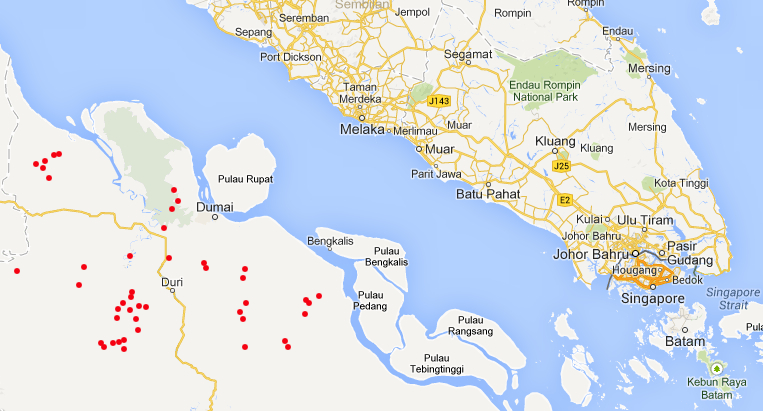
A map from the Indonesian meteorological service shows the increased number of hotspots in Sumatra on Tuesday. (Image courtesy of BPNB)

Singapore and Indonesian officials traded barbs on Tuesday as the haze crisis that cast a shadow on the two countries’ relations in June threatened to reemerge.

“An exercise in frustration — big increase in hot spots (488) in Sumatra today,” Singapore’s Minister for Environment and Water Resources Vivian Balakrishnan said on Facebook. “We have been spared so far because of wind direction.”

Air quality in Singapore remained at “good” levels on Tuesday afternoon, within a range of 26-35. Singapore’s air degraded to “very hazardous” levels on June 21, breaking 400 on the Pollutant Standards Index, the city state’s National Environment Agency reported.

“We remain at risk,” Balakrishnan said. “Have to keep up the pressure on Indonesian authorities and companies to do the right thing for the sake of their own citizens and ours.”

The head of Singapore’s National Environment Agency, Ronnie Tay, said he had spoken with his counterparts in Indonesia about the acute increase in hotspots.

Tay wrote in a public release that meteorological forecasts for the next few days predicted southerly and southeasterly winds flowing over the Strait of Malacca. A shift to a more southwesterly wind direction could, however, bring haze back to Singapore.

Forestry Ministry spokesman Sumarto confirmed to the Jakarta Globe on Tuesday that the number of hotspots was increasing, but denied the total was as high as the 488 reported by Lion City authorities.

“According to [Indonesia’s] National Oceanic and Atmospheric Administration [NOAA], there are 265 hotspots as of this morning,” he said. “Yesterday, 101 hotspots were recorded — a major jump from last week’s 19-25 hotspots.”

The difference between Singapore and Indonesia’s hotspot figures are more instructive of the two countries’ differing methodology, not of an attempt to overdo or underplay the situation on the ground in Sumatra.

Smoke signals?

Yopita Gustini, a resident of Pekanbaru, Riau, said visibility had worsened to less than 500 meters.

“I had to turn on the car lamps even in the morning when I was driving in,” Yopita told the Jakarta Globe. “I drove really slowly out of fear for my safety.”

Air quality on Tuesday was not as debilitating as Riau residents saw in June, she said.

“It’s not as bad as the last time, but what makes me afraid is that it has not been raining the past few days,” Yopita said. “If the weather and the temperature persist, I’m afraid the fire will be just as big as the last time.”

The 30-year-old added that she had begun wearing a face mask three days ago because she had started to experience a degree of respiratory difficulty.

Yopita called on the government to instigate greater weather-modification efforts in the province.

“Don’t wait until weeks later,” she said.

The Indonesian government was criticized during the peak of the haze crisis for the lack of speed with which it took action against hotspots in Sumatra.

As firefighters struggled to stay ahead of the curve in June, the government ordered the National Disaster Mitigation Agency (BNPB) to seed the clouds above Riau province — a method used to create artificial rain — and drop water from agency helicopters’ Bambi buckets.

BNPB spokesman Sutopo Purwo Nugroho confirmed that the government was acting in Riau.

“Today there was water-bombing in Pelalawan with one Boco and one Sikorsky helicopter,” he said. “They can carry 4,500 liters per flight.”

Thick smoke over Pekanbaru disrupted flights at the Riau capital’s international airport — only one flight was able to land yesterday at Sultan Syarif Kasim airport. Planes were instead diverted to nearby airports in Medan and Batam.

Under fire

The Indonesian government confirmed that the Sumatra hotspots were once again caused by slash-and-burn clearance of land — the easiest way to make way for, primarily, palm oil plantations.

“99 percent of the hotspots were caused by individuals or groups,” Sutopo said.

Despite international outcry over the extent of slash-and-burn only weeks ago, Indonesia’s Forestry Ministry said the practice continued to thrive.

“More places are burning because of a rise in temperature and the lack of rain over the past few weeks,” Sumarto said. “Some underground fires that were already burning flared up again, and local people are also burning forest to clear land.”

Sumarto called the hotspots a disaster, and asked that the government be given more time by the people of Sumatra and Singapore to address the intractability of the problem.

“It’s difficult to prevent people from using traditional methods of land clearing,” he said. “It takes a long time for them stop.”

At least one Riau resident believes this a tradition that needs to be nixed.

“What’s even more important is the law enforcement,” Yopita said. “I hope the government will take serious action against those who started the fire, because spending money on artificial rain will not do anything as long as these people keep burning the forest.”

Three flights diverted due to haze in Pekanbaru
The Jakarta Post 27 Aug 13;

Poor visibility, caused by thick haze, at Sultan Syarif Kasim II International Airport in Pekanbaru, Riau, forced the rerouting of three flights.

A Garuda Indonesia aircraft that was scheduled to land at Sultan Syarif Kasim II on Tuesday morning was diverted to Kualanamu International Airport in Medan, North Sumatra.

Meanwhile, a Lion Air plane from Jakarta, which was scheduled to arrive at 8 a.m., was rerouted to Batam, Riau Islands, as visibility dropped to less than 500 meters due to the haze.

The airport’s duty manager Baiquni said the Garuda plane departed from Jakarta at around 4:30 a.m. and should have arrived in Pekanbaru, this morning.

“But due to the low visibility the pilot diverted the aircraft and landed in Kualanamu, Medan,” he said in Pekanbaru on Tuesday, as quoted by Antara news agency.

Meanwhile, an Air Asia plane from Kualanamu Airport, Deli Serdang, was forced to return after it received information about the thick haze that was blanketing Pekanbaru Airport.

“Almost all flights were delayed,” Baiquni said.

Despite the haze at Sultan Syarif Kasim II, several pilots were determined to land there and an Air Asia plane, flying from Bandung, West Java, arrived at 7:30 a.m.

“We, as the airport operator, are only required to inform of the conditions. We leave take off and landing decisions to the pilot and airline company,” said Baiquni.

He said that the haze, from the ongoing forest and peatland fires in Riau, was the worst it had been over the last few months. (hrl/ebf)

Ash rain in Pekanbaru after forest fires
Antara 28 Aug 13;

Pekanbaru, Riau Province (ANTARA News) - Several areas in Pekanbaru have been hit by ash rain, following forest fires for the past two days, said an official.

"There is rainfall in the form of ash particles. We believe this phenomenon occurs when there are forest fires," said Chief of Environmental Health Affairs from the province`s Health Office Dewani on Wednesday.

Earlier, spokesperson for the Riau Administration Office announced that the air quality in the area has deteriorated and is unsuitable for locals. The announcement was made when the Air Pollution Standard Index (ISPU) in Pekanbaru reached 300 (normal pollution index in an area is around 0-50).

Dewani said ash rain causes respiratory disorders and irritation in eyes and skin. Therefore, she urged locals to avoid outdoor activities.

(Reported by FB Anggoro/translated and edited by Amie Fenia Arimbi/KR-BSR/O001)

Editor: Priyambodo RH

Around 200 hotspots detected in C. Kalimantan
Antara 28 Aug 13;

Sampit, Central Kalimantan (ANTARA News) - Around 200 hotspots have been detected in Central Kalimantan, according to Andreas Dodi, a researcher at the Natural Resource Conservation Agency (BKSDA).

"The province is on high alert of possible forest fires, following the presence of hotspots," he said, adding that the high temperature in the province increases the possibility of forest fires.

Based on the information provided by the province`s Meteorology, Climatology and Geophysics Agency (BMKG), the rainy season in Central Kalimantan has just begun. However, people are being warned about the possibility of forest fires. They have been told not to burn large areas of land to create plantations.

"As of now, air quality in the province is at a normal level," he added.

(Reported by Unting Setiawan/translated and edited by Amie Fenia Arimbi/KR-BSR/O001)

Editor: Priyambodo RH


Read more!

Malaysia: Haze comes back with a vengeance as air quality worsens

Christopher Tan, Embun Majid and Winnie Yeoh The Star 29 Aug 13;

GEORGE TOWN: Malaysians feared haze will return with a vengeance as the air quality in several states worsened, especially in Kedah with the Air Pollutant Index (API) in Bakar Arang, Sungai Petani reaching an unhealthy level of 104 – the highest reading in the country.

The API measurement registered at the Department of Environment (DOE) monitoring station recorded the index at 4pm.

It was initially 94 at 6am before it went up to 99 by 10am.

In the tourism haven of Langkawi, it showed 77 at 6am before increasing to 86 by 10am and shot up to 96 at 4pm.

An increase in API was also noted in Alor Setar where the reading showed 71 (6am) and 77 (10am). The API increased to 87 by 4pm.

In Penang, the API in Seberang Jaya saw an increase from 89 at 6am to 94 by 10am before going up further to an unhealthy level of 103 at 4pm.

Moving south, several areas in Ipoh also recorded moderate air quality.

The API in Sri Manjung was 87 at 4pm while other areas such as SK Jalan Pegoh (82), Kampung Air Putih (75), Jalan Tasek (67) and Tanjung Malim (56) recorded such readings at the same time.

In Port Klang, it neared the unhealthy level when it increased from 77 (6am) to 82 (4pm).

In Malacca, the API in Bukit Rambai recorded 91 at 6am and 95 at 4pm while Bandaraya Melaka recorded 73 (6am) followed by 75 (4pm).

An API reading of between 0 and 50 is considered good, 51 and 100 (moderate), 101 and 200 (unhealthy), 201 and 300 (very unhealthy), and 301 and above (hazardous).

This latest haze situation is once again blamed on an increase of hotspots in Sumatra, where the smog shifts direction depending on where the wind blows.

Penang Education Department director Datuk Ahmad Tarmizi Kamaruddin said all schools in areas where the API had hit above the 200 mark would be closed immediately.

“If the API hit more than 150, all outdoor activities such as Physical Education must stop,” he said.

Penang Agriculture, Agro-based Industry, Rural Development and Health Committee chairman Dr Afif Bahardin advised the public to wear three-ply face masks as it offered better protection.

The state government also plans to distribute masks to the public.

Kedah Health Department director Dr Ismail Abu Taat advised residents there to avoid outdoor activities if the API reading in­­creases.

Haze: Penang, Kedah air quality back at unhealthy levels
Christopher Tan and Winnie Yeoh The Star 28 Aug 13;

GEORGE TOWN: Air quality in northern states in Malaysia - especially in Kedah - has worsened with the Air Pollutant Index (API) reaching unhealthy levels.

In Bakar Arang, Kedah, the Department of Environment (DOE) monitoring station recorded an unhealthy API reading of 104 at 4pm, which had been escalating since early morning.

Likewise, the API in Seberang Jaya 2 had an unhealthy reading of 103 at 4pm.

The API in Langkawi was 77 at 6am before increasing to 86 by 10am, but shot up drastically to 96 at 4pm.

An API of 87 was noted in Alor Setar at 4pm, up from 71 (6am) and 77 (10am).

In Penang, the API in Seberang Jaya 2 increased from 89 (6am) to 94 (10am) before reaching unhealthy levels of 103 (4pm).

In Prai, the API reached 88 at 4pm, while Universiti Sains Malaysia a reading of 96 at 4pm.

In Kangar, Perlis, API reading of 85 was recorded at 4pm, up from 71 (6am) and 79 (10am).
An API reading of between 0 and 50 is considered good, 51 to 100 (moderate), 101 to 200 (unhealthy), 201 to 300 (very unhealthy), and 301 and above (hazardous).


Read more!