Singapore Bird Report July 2015
Singapore Bird Group
Peacock Pansy visits Bougainvillea
Bird Ecology Study Group
Read more!


Singapore Bird Report July 2015
Singapore Bird Group
Peacock Pansy visits Bougainvillea
Bird Ecology Study Group
See Kit Tang CNBC AsiaOne 14 Aug 15;
With its Botanic Gardens declared a UNESCO World Heritage Site and its spot at the top of Lonely Planet's Best Travel Destination 2015 list, Singapore has tourism sorted, right? Maybe not, say experts, who told CNBC this was a perfect time for the city-state to reinvent itself yet again.
"For Singapore to remain competitive and relevant in the future, the key is to reinvent," Yu Xian Lim, research analyst at Euromonitor, told CNBC by email. "Home to a collage of museums and heritage sites with rich local histories, Singapore can consider carving a niche in cultural tourism, especially after the recent UNESCO win."
Last year Singapore posted its first decline in visitor numbers since 2009, down 3 per cent on-year to 15.1 million, due mainly to a fall in Chinese holidaymakers to the region amid political unrest in Thailand, the Malaysia Airlines' twin tragedies and tighter regulations on tour packages in the mainland.
The downtrend has continued this year despite the Lonely Planet accolade, with the number of tourists decreasing 4.1 per cent through May.
To give the sector a boost, the Singapore Tourism Board launched a 20 million Singapore dollar-campaign in June in conjunction with the nation's Golden Jubilee celebrations this year. However, Ngee Ann Polytechnic's senior tourism lecturer Michael Chiam said such "piggyback strategies" may not be enough to rejuvenate the industry from a long-term perspective.
And while World Heritage status for the 156-year-old Botanic Gardens is expected boost visitor numbers to the 74-hectare park by as much as 20 per cent, according to National Parks Board, industry watchers who spoke to CNBC were less bullish about the garden's boost on overall tourist arrivals.
Instead, experts say Singapore, best known for its shopping and gastronomic opportunities, as well as an array of man-made marvels such as Marina Bay Sands, needs to cater to the rise of so-called free and independent tourists (FITS) who want alternative ways to explore a country.
"While many tourists came on tour groups in the past, we have more FITs nowadays who plan their own itinerary, like to do what the locals do and are looking for new, authentic experiences," Chiam said. "In recent years, our focus has been on adding new attractions and new events like the Singapore Grand Prix, it may be a good idea to start promoting our own culture and heritage."
According to analysts, Singapore offers a colorful picture of contrasting elements - from a modern metropolis to heritage quarters and pockets of greenery - in one compact location.
"Nobody travels to another country to see more of their own," Kevin Cheong, chairman of the Association of Singapore Attractions, told CNBC.
"They want to experience the local culture and savour the flavours of the land … Singapore has gone through the various stages of tourism development. First, it was 'me too' where I have what you have; second, it was 'me only' where only I have it and finally, I believe we are entering the phase of 'this is me', having the unique Singapore way of life as our tourism positioning."
And even as Singapore celebrates its 50 years of independence, experts say the island should not forget that its history and heritage started well before 1965, pointing out that local war-remembrance sites such as the Kranji War Memorial fare well in comparison to better-known overseas sites.
According to local tour operator Star Holiday Mart, there is definitely rising demand for "less trendy" experiences that are quintessentially Singapore.
"Some of our tours have moved into the heartlands like Toa Payoh … which is an old estate and where the HDB Hub is located. Apart from showing them development plans of our housing estates, tourists can experience the Singaporean life away from glamorous shopping malls and skyscrapers," managing director Dominic Ong said.
Travellers have also put up special requests to visit Pulau Ubin - Singapore's second-largest offshore island, with a charm lies in its quiet rural surroundings with kampung houses and forest paths - and the eastern suburb of Katong, where quaint shophouses offer a glimpse into the Peranakan culture, Ong noted.
MARGIE MASON Associated Press Yahoo News 14 Aug 15;
JAKARTA, Indonesia (AP) — A massive refrigerated cargo ship believed to be loaded with slave-caught fish was seized by Indonesia's navy and brought to shore Thursday, after The Associated Press informed authorities it had entered the country's waters.
The Thai-owned Silver Sea 2 was located late Wednesday and escorted about 80 miles (130 kilometers) to a naval base in Sabang on the Indonesian archipelago's northwestern tip, said Col. Sujatmiko, the local naval chief.
The AP used a satellite beacon signal to trace its path from Papua New Guinea waters, where it was also being sought, into neighboring Indonesia. The navy then spent a week trying to catch it. The ship was close to leaving Indonesian waters by the time it was finally seized.
"I'm so overwhelmed with happiness," said Fisheries Minister Susi Pudjiastuti, adding it was difficult to find because the boat's signal had a delay. "It was almost impossible, but we did it."
The Silver Sea 2 is the same 2,285-ton vessel captured in a high-resolution satellite photo last month in Papua New Guinea showing its hold open and two fishing trawlers tethered to each side, loading fish. Analysts identified the smaller trawlers as among those that fled the remote Indonesian island village of Benjina earlier this year, crewed by enslaved men from poor Southeast Asian countries who are routinely beaten and forced to work nearly nonstop with little or no pay.
An AP investigation revealed their catch reached the supply chains of major U.S. food sellers, such as Wal-Mart, Sysco and Kroger, and American pet food companies, including Fancy Feast, Meow Mix and Iams. The businesses have all said they strongly condemn labor abuse and vowed to take steps to prevent it.
Indonesia freed hundreds of men earlier this year after the AP exposed they were trapped — including some locked in a cage — on Benjina. But 34 boats loaded with slaves escaped before authorities arrived. They remain missing. Seven arrests have been made in Indonesia and two in Thailand related to the case.
Panya Luangsomboon, owner of Silver Sea Reefer Co., which owns several refrigerated cargo ships in Thailand, said Friday that the company has done nothing illegal and has asked Thai officials for help in getting the Silver Sea 2 back.
"We have received numerous calls from Thai agencies ... asking about this and basically we said we have never done anything like it," company manager Venus Pornpasert said Thursday of allegations of human trafficking and illegal fishing. Venus added that all of the ships' crews are Thai nationals and certified by the International Maritime Organization.
However, enslaved workers who recently returned home from Papua New Guinea to Myanmar said they had regularly loaded fish onto Silver Sea cargo ships, which ferried the catch back to Thailand. Burmese slaves rescued from Benjina, among hundreds interviewed by the AP in person or in writing, also said they had been trafficked in Thailand and brought to fish in Indonesia aboard the Silver Sea 2. And late last year, AP journalists saw slave-caught fish in Benjina being loaded onto another reefer owned by Silver Sea.
The Indonesian navy has so far declined to comment on the crew found aboard the captured vessel.
Pudjiastuti, who put a moratorium on all foreign boats last year to crack down on rampant poaching, said the Silver Sea 2 captain will be questioned, and an investigation will be launched into suspected human trafficking, transport of illegally caught fish and transshipment, which involves offloading fish at sea. It allows fishermen to work for months without returning to port, making it easier for their captains to exploit them.
"Indonesia's action here is significant as it demonstrates a commitment to enforcing the actions of vessels within their waters, regardless of whether they are fishing illegally or trafficking labor," said Tobias Aguirre, executive director of California-based nonprofit Fishwise, which advocates for sustainable, slave-free seafood.
Authorities in Papua New Guinea had also been searching for the boat. They instead seized another Thai-owned fish cargo ship, the Blissful Reefer, two weeks ago. Two trafficked Burmese and six Cambodians were found on board.
Indonesian police also are investigating trafficking claims involving 45 Burmese fishermen who were rescued from a Jakarta hotel last week. Arie Dharmanto, who heads the anti-human trafficking unit of the National Police, said the men had fake documents identifying themselves as Thai, and that officials from two Indonesian companies have been questioned about their role.
Associated Press writers Niniek Karmini in Jakarta, Indonesia, Martha Mendoza in Santa Cruz, California, and Nattasuda Anusonadisai in Bangkok contributed to this report.
Arya Dipa and Slamet Susanto, The Jakarta Post 15 Aug 15;
Agencies and experts have recommended methods to preserve water to deal with the prolonged drought and cope with the impacts of it in the long run.
West Java Water Resource Management Agency head Edi Nasution said that his office would build a number of artificial lakes, locally called embung, to store water reserves.
Other measures included dredging Padawaras embung in southern Tasikmalaya, which covered 80 hectares.
“We have to carry out dredging because it is experiencing silting. We need some Rp 7 billion (US$538,461) to do so,” Edi said on Thursday.
He said that the embung could supply water to 1,800 hectares of paddy out of its total capacity of irrigating 2,500 hectares of paddy.
In Yogyakarta, micro-hydro expert Agus Maryono proposed a way to “harvest” rain during the rainy season to help restore ground water.
Agus said the method, in which unused rainwater was channeled to infiltration wells, made use of the abundant supply of water during the rainy season in reservoirs and prevented flooding.
Agus said that the method had been applied in a number of developed countries, including Germany.
Drought during the dry season, according to Agus, occurred because ground water dries up on account of damage to water catchment areas, namely forests.
“That’s why we need to make water catchment areas, in this case infiltration wells,” Agus said.
thejakartapost.com 14 Aug 15;
Lake Limboto in Gorontalo in North Sulawesi is still a haven for migrating birds from various places around the globe, despite concerns that it is gradually getting shallower.
The phenomenon has attracted many, including environmentalists, researchers and photographers.
“September to November is the high season for migrating birds from Australia, Asia and Europe to stop by in several places in Gorontalo, especially around Lake Limboto,” said Gorontalo Photography Society (MFG) chairman Idham Ali on Friday as quoted by kompas.com.
Indeed, Limboto seems to have its own attraction for the flying creatures. Whatever their origins are, in extreme seasons the birds would stop to forage and create nests around the lake.
To celebrate Indonesia's diverse species of birds, MFG is holding various events at the lake, including a bird photo hunt, bird sketching, bird watching and discussions about migrating birds.
During a bird photo hunt held last week, around 13 species of migrating birds were identified in Lake Limboto.
According to Hanom Basri from the non-profit bird conservation organization Burung Indonesia, which is one of the event's collaborators, up to 34 species of migrating birds were listed by the organization, including the red-necked stint, the white-headed stint and the common greenshank.
Amsurya Amsa, program coordinator with Burung Indonesia Gorontalo, said he is hopeful that the government will acknowledge the tourism potential of Lake Limboto and develop it to become the pride of Gorontalo.
According to the province's environmental and regional research agency, Fadli Alamri, the local government is continuously mapping the lake's potential and submitting the data to the Lake Limboto management working group. (nov/kes)(+++)
Limboto attracts migrating birds from around the world
Syamsul Huda M.Suhari, The Jakarta Post 15 Aug 15;
Despite its dismal condition, it appears Lake Limboto in Gorontalo is still able to attract migrating birds that have flown thousands of kilometers from various parts of the globe.
Nature photographer Idham Ali, who has been taking pictures of birds over the past three years, listed at least 40 bird species that have stopped briefly at the biggest fresh-water lake in the province, which is now badly silted.
“Among the dozens of bird species I’ve listed, 14 of them are migrating birds from various countries in Europe, Russia, Alaska and Siberia. They stop over at Lake Limboto to rest before resuming their journey to various destinations,” Idham said recently.
Idham and dozens of environmentalists from different backgrounds observed various species of migrating birds in an area along the shore of Lake Limboto in Hutada’a village in Gorontalo regency on Monday.
“It’s amazing, especially given the fact the peak of bird migration usually occurs between September and October,” said Idham.
But Idham said he was quite saddened by rampant bird poaching around the lake.
“The poachers have even formed communities,” he added.
Bird observer from Wildlife Conservation Society (WCS) Iwan Hunowu said the migrating birds, which were of the water and coastal bird species, had flown distances of up to 18,000 km from their countries of origin.
“Similar to humans who wish to travel long distances, the birds also make various preparations before migrating, such as increasing their body weight over a duration of four months prior to commencing the long trip,” said Iwan.
He added that various bird species generally migrate for survival. “In the northern hemisphere, the weather is known to be extreme during summer and winter, so they migrate to a tropical region like Indonesia,” said Iwan.
He cited the example of the brown and long-beaked little curlew, locally known as gajahan kecil, that avoids winter by migrating to the Philippines, Indonesia and the northern part of Australia.
“It has many names, such as zwerbrachvogel in Germany, chiurlo minore in Italy and zarapito chico in Spain,” he said.
Meanwhile Portuguese bird painter Paulo Alves, who also joined the bird watch at Lake Limboto, said the migrating bird phenomenon could be developed into a potential tourist attraction in Gorontalo, similar to those found in other regions.
“The migrating birds can bring benefits and blessings for the local community around Lake Limboto, provided the government and stakeholders work together to develop the local ecotourism infrastructure,” said Alves.
Local bird activist Amsurya Warman Amsa said that during this year’s Indonesia Bird Variety Day, which is commemorated every July 15, his group had used the theme “Welcome Birds” to usher in various migrating bird species arriving in the country.
“The migrating bird phenomenon signifies that every corner of the Earth is connected and reliant on the other,” said Amsurya.
“This momentum can also serve to remind us of the importance of restoring and preserving the condition of Lake Limboto as it used to be,” he added.
Hans Nicholas Jong, The Jakarta Post 14 Aug 15;
Increasing the number of coal-fired power plants (PLTU) from 42 to 159 will increase the risk of death from air pollutants in Indonesia from 6,500 a year in 2015 to 15,700 in 2024.
The government plans to add some 117 PLTUs in the next decade to meet the demand for more power.
A study conducted by Harvard University revealed that air pollutants from the burning of coal at 42 existing power plants resulted in at least 6,500 deaths per year from strokes, heart and lung cancers and other respiratory and cardiovascular diseases.
The number will increase to 15,700 once the 117 new plants are constructed. The 117 new plants do not include other plants that the current government plans to install in its ambition to produce another 20,000 megawatts of energy. The ambitious project includes the construction of the controversial plant in Batang, Central Java, which continues to face protests from locals in he area.
“Emissions from coal-fired power plants form particulate matter and ozone. Both of these things are detrimental to human health,” Shannon Koplitz, a Harvard researcher from the Department of Earth and Planetary Sciences said during a presentation of the research earlier this week.
Koplitz said that coal burning is the number one source of mercury pollution in the world. Besides mercury, other dangerous substances include a fine particle called PM2.5, comprising dust, nitrogen oxide and sulfur dioxide, toxic metals such as timbale, arsenic, chromium, nickel and cadmium and ozone.
The dangerous particles were transmitted by the wind from the power plant sites to nearby areas. Based on wind speeds, the research showed that PLTU Jati B in Jepara, Central Java, for example, generated air pollution in Jepara, Pecangaan, Kembang, Karangsari, southern Semarang, Rembang, and eastern Rembang.
Air pollutants from PLTU Jati B, contributed to at least 1,020 deaths from the yearly total of 6,500. It is considered one of the biggest power plants that in the country.
The study also analyzed the impact of the controversial PLTU Batang in Central Java.
The Batang power plant is estimated to put at risk roughly 780 lives per year and could impact Pekalongan, Tegal, Semarang and Cirebon by 2020.
Harvard University and Greenpeace Indonesia conducted the study from 2014 to 2015. The methodology used in the survey compared the World Health Organization’s data of diseases caused by emissions in the country to characteristics of pollutants from the coal burning of 42 existing power plants to reach an approximate number of deaths stemming primarily from the emissions of coal-based power plants.
The 42 power plants include six on Sumatra Island, four on the Bangka Belitung Islands, 18 in Java, four on the Nusa Tenggara Islands, five in Kalimantan and five in Sulawesi.
Based on the study, Greenpeace recommended that Indonesia start shifting toward renewable energy sources to generate power. Currently, renewable energy, such as geothermal, solar, mini and micro hydro only contribute 1.25 gigawatts of power for the country.
“We can optimally use renewable energy 10 years from now only if the government provides supporting policies and implements stricter emissions controls,” Greenpeace Southeast Asia Head of Climates Arif Fiyanto said.
Separately, state-owned electricity firm PLN said that every coal-fired power plant project required an environmental assessment (Amdal) to get a green light. Therefore if a power plant was environmentally destructive, it would not pass the assessment.
“And they have to be approved by the government,” PLN corporate secretary Adi Supriono told The Jakarta Post on Wednesday. “As for the report from the Harvard University, I don’t know about that so I cannot give any comment.” (rbk)
Coal-Related Death Toll to Climb, Warns Greenpeace
Erin Cook Jakarta Globe 14 Aug 15;
Indonesia's coal mining industry is set to generate cheap energy for millions — but with a very large human cost. (Reuters Photo/Dwi Oblo)
Jakarta. The international environmental NGO Greenpeace this week released a report slamming the effects of Indonesia’s coal power plants, offering a dire warning for the health of communities and environment around the plants and calling on the country to move toward more sustainable methods of generating power.
The “Human Cost of Coal Power” report used research provided by Harvard University combining both known levels of emissions from the country’s existing power plants and projections for the more than 100 plants currently in planning or construction stages.
“Air pollution is responsible for over 3 million premature deaths globally every year,” the report said. Of this figure, 6,500 deaths are in Indonesia.
Greenpeace predicts that each new 1,000-megawatt power plant will directly cause an additional 600 Indonesian deaths each year — resulting in a figure of 28,300 deaths across the archipelago annually.
The research found pollution emitted from these plants can contain toxic particles “including mercury, lead, arsenic and cadmium,” causing “increased risks of lung cancer, stroke, heart diseases and respiratory diseases” for communities in plant-impacted areas. Children, the elderly and pregnant women are most at risk of sustaining life-threatening illness and disease.
The report cites President Joko Widodo’s announcement, made shortly after he was elected last year, to expand Indonesia’s energy generation with a strong focus on coal power. Heralded by the business community as a boon for greater foreign investment, Greenpeace has condemned the move.
“[It] will clearly dramatically increase the existing estimate of mortality and mobility resulting from power generation,” the report said.
In addition to causing hundreds of “avoidable” deaths, the current energy policy puts Indonesia at odds with much of the rest of the world, which is moving toward sustainable, and ultimately more lucrative, methods of energy generation.
“The current plans to increase reliance on coal power in Indonesia directly contradict the global trend of recognizing the problems with fossil fuels and shifting to renewable energy.”
Greenpeace disputes government policy which argues that, for the millions of Indonesians living without ready access to electricity, coal-generated power is the best option to quickly and efficiently fill the gap.
Of the Joko-endorsed power plants, which are slated to generate an additional 35,000 MW by 2019, “over 65 percent will be built in Java and Bali” — areas in which “the electrification ratio reaches almost 100 percent.”
The NGO goes so far as to suggest the reliance on coal is in fact “unconstitutional,” quoting Article 28H(1) of the Constitution which “protects the right to a healthy environment.” By failing to provide robust clean air and pollution regulations the government has failed to meet its responsibilities to Indonesians, Greenpeace argues.
The report offers a number of recommendations to the energy sector, including stronger monitoring of emissions and violations of environmental standards and the shutting down of plants which fail to meet these standards.
Referring to its own estimates of increased deaths, Greenpeace calls on the government to pivot away from “dirty” methods of energy generation and focus instead on “renewable energy and the latest cutting-edge, energy-efficient solutions [which] enable us to keep the lights on without coals.
“Indonesia must cancel its plan to build more power plants.”
The Northern Expedition: what we found
Mega Marine Survey of Singapore
Little Egret Defaecation Videos
Bird Ecology Study Group
17 species of invertebrates found in northern coast, and researchers expect to find more
Audrey Tan Straits Times 14 Aug 15;
Coral reefs hugging Singapore's southern coast are home to a great diversity of marine life, but they are not the only undersea palaces here.
New research has uncovered a living treasure trove in lesser-known marine habitats.
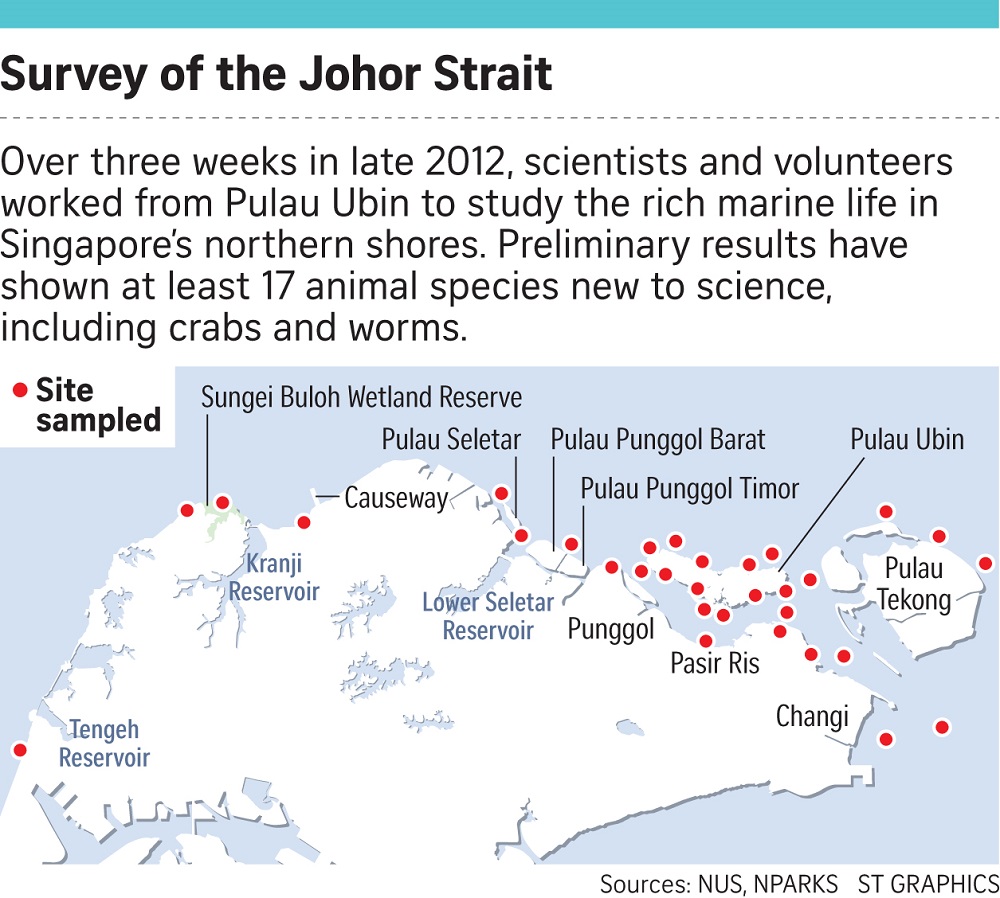
Seventeen species of invertebrates (animals without backbones) new to science have been discovered in Singapore's northern shores - and researchers are expecting to find more.
"Singapore is one of the busiest ports in the world, yet we are still able to find new species, and a diversity of new species, in our waters," said Dr Lena Chan, director of the National Parks Board (NParks) National Biodiversity Centre.
"The great species diversity can be attributed to the varied ecosystems existing in Singapore, which are inter-linked, since some animals inhabit different ecosystems at their various life stages."
The new finds include a sea cucumber less than 2cm long, a 4cm polychaete (worm), and a 2mm gastropod (snail).
The discoveries are part of Singapore's first Comprehensive Marine Biodiversity Survey led by NParks. It roped in researchers from the National University of Singapore's (NUS) Tropical Marine Science Institute (TMSI) and the Lee Kong Chian Natural History Museum and aimed, for the first time, to get a clear picture of sea life here.
As part of the survey, NParks and NUS organised a three-week workshop on Pulau Ubin in late 2012 to study the marine life of the Johor Strait. There, the shores are characterised by mangroves, mudflats and sandy shores, largely due to sheltered conditions and the influx of sediment-laden freshwater from rivers into the Johor Strait.
Thirty-one sites were surveyed, and some 12,000 specimens were collected. These are being kept at TMSI and the Lee Kong Chian Natural History Museum and many are still being processed.
TMSI senior research fellow Tan Koh Siang said that new nematodes (roundworms) were among the more exciting finds as there has been little research on Singapore's marine meiofauna - complex multi-cellular animals generally less than 1mm in size.
"Because meiofauna have high turnover rates, they may act as good sentinels of environmental change, and we are keen to pursue this further," he said.
Unlike the more open waters of the Singapore Strait in the south, the marine environment up north is comparatively sheltered. The 50km-long Johor Strait separates Singapore from Malaysia, and is only 2km wide at its broadest. Down south, Singapore is separated from Batam by 15km of water, and experiences significant water exchanges.
Another difference between the two marine environments is salinity. The Johor Strait receives freshwater from rivers in Johor, whereas the Singapore Strait is saltier.
"Some organisms, such as kinds of sponges, snails and fish, have flexible physiologies and there are certainly species that can be found in both the Johor and Singapore straits," he noted. "But it is clear that the composition of species, taken in total, is different in the Johor and Singapore strait."
For example, while coral reefs thrive in southern waters, they do not seem to do as well in the north due to the fluctuating salinities and heavier sedimentation there. Corals need sunlight to thrive but sediment suspended in the water column blocks the light.
The sedimentation has also led to deposits on Singapore's coast, forming the mudflats and sandflats characteristic of the northern shores.
Researchers found many different types of polychaetes in the mudflats, and a variety of gastropods and molluscs in mangroves, said Ms Linda Goh, NParks' deputy director of the biodiversity information and policy division at the National Biodiversity Centre.
"The mudflats and mangroves are important habitats for birds, which feed on these organisms," she said.
But species recognition is only the first step in understanding more about our marine habitats, Dr Tan added. Delving into the ecology, diet, reproduction, interactions with other species, larval dispersal and settlement is the next step, he explained.
"Despite being small and constantly disturbed by coastal development, Singapore still has numerous small pockets of different marine habitats that are used by different species," he said. "It is important that we recognise and define these habitats in detail, so we can manage and conserve them properly."
Marine worms wriggle their way into teacher's heart
Straits Times 14 Aug 15;

Teacher Heng Pei Yan, 29, sorting through samples collected during an expedition to survey Singapore’s shores.
Many may squirm at being knee-deep in mud and handling worms, but teacher Heng Pei Yan, 29, could not have been happier doing so.
As one of the 270 volunteers involved in a three-week workshop on Pulau Ubin to study the marine plants and animals in the Johor Strait in 2012, the passionate marine enthusiast had to process marine worms. This involved removing the tubes which the worms lived in and preserving them in chemicals so scientists could study them later.
"The removal of worm tubes was the most challenging task as some worms are very small and have small tubes," she said. "It required patience, steady hands and staring through a microscope."
Ms Heng, who has been involved in marine conservation work since 2009, also helped scientists from the National Parks Board (NParks) and the National University of Singapore (NUS) sort through specimens collected from dredging surveys.
Dr Tan Koh Siang, senior research fellow from the NUS Tropical Marine Science Institute, said the volunteers played a crucial role.
"Not only did they help to collect material from various sites by going out with the scientists, but they also helped wash and sort the specimens - a time-consuming but necessary task - so scientists could immediately see what was collected."
Before the workshop, Ms Heng was already volunteering actively with nature group Naked Hermit Crabs, leading groups on walks to the Chek Jawa wetlands.
But when she read about various animals found during earlier parts of the Comprehensive Marine Biodiversity Survey, she wanted to do more.
"What wowed me was that despite most of our coastline being reclaimed, the marine animals somehow managed to find their way back to settle.
"The diversity may not be as large as what Singapore used to have, but it is the resilience of the animals, their reappearance and their choice of location that make me curious to know more about them," said Ms Heng.
"I felt that this was a great opportunity for someone like me, without a biology background, to experience fieldwork and learn more about our marine life."
Dr Lena Chan, director of NParks National Biodiversity Centre, said such citizen science efforts could help raise awareness about Singapore's marine life.
"If people don't know the ecosystems and the species within them, they wouldn't know why they need to be conserved," she said.
Audrey Tan
GENEVIEVE SARAH LOH Today Online 14 Aug 15;
SINGAPORE — The recent controversial killing of Cecil the Lion, who was a popular tourist attraction at Hwange national park in Zimbabwe, has brought the perennial question of responsible tourism to the forefront, reigniting the ethics surrounding trophy hunting and the poaching of wild animals in Africa.
Rhinos, for example, may become extinct within the next two decades.
“The African rhino is under serious threat from poachers who have intensified their search of rhino for their horns since 2007, driven by growing market demand in Asia,” said Dr Joseph Okori, head of WWF’s (World Wildlife Fund) African Rhino Programme.
More than 1,000 rhinos are slaughtered each year, said Dereck Joubert, a wildlife film-maker, conservationist and National Geographic explorer-in-residence, mostly so their horns can be hacked off and sold in China and Vietnam on the black market. In Asian traditional medicine, the highly prized rhino horn is believed to be the treatment for a variety of illnesses.
“There are an estimated 4,000 to 5,000 black rhinos and 20,000 southern white rhinos left in Africa, with another one killed by poachers every seven-and-a-half hours,” said Joubert in a National Geographic article.
This startling rate of rhino poaching and inevitable extinction is the main reason Quotient TravelPlanner, a customised travel agency in Singapore, has chosen to support Rhinos Without Borders, a non-profit campaign initiated by Joubert’s Great Plains Conservation and safari company andBeyond, to move 100 rhinos from the highest poaching zones in South Africa to the lowest poaching zone in Botswana. The homegrown company aims to raise US$50,000 (S$70,000, the cost of moving one rhino between the two countries) by the end of next year to help with the expensive translocation. It has also pledged to commit a portion of the proceeds from all its safari holidays to Rhinos Without Borders during the campaign period.
Quotient TravelPlanner co-founder and director Lim Hui-Juan said responsible travel has always been a fundamental value held by the homegrown company, which offers vacations that combine authentic native experiences and luxury without sacrificing culture or environment. With its latest corporate social responsibility initiative centring on wildlife conservation, the eight-year-old travel agency hopes to spread the ethos of conscious tourism.
Although the wildlife crisis may seem very far from our local shores, Lim said Asia cannot claim not to be a part of that problem. “A number of species face extinction because of demand in Asia. Many animals’ body parts are valued by Asians and deemed status symbols or to have medicinal properties,” she said. “To solve the problem, we need to go to the root. For wildlife to stay alive, we need to take the issue back to Asia.”
She continued: “With our initiative #RhinosCanFly, we hope to not only raise funds for a worthy cause, but also motivate travellers and the public at large to think and act differently when it comes to wildlife.”
Part of their 18-month-long #RhinosCanFly initiative includes a private fundraising event in conjunction with this year’s edition of National Geographic Live In Singapore event, where proceeds from wildlife-themed merchandise, fine-print photography from acclaimed National Geographic photographers such as Steve Winter and travel offers will all go towards the cause.
There is also Give A Wild A Go, an ongoing six-week-long online contest that will end on Sunday, where participants not only learn more about wildlife conservation, but also stand a chance to win a trip for two to South Africa. Quotient TravelPlanner will be donating S$1 to Rhinos Without Borders for every participant signed up.
To take part in the contest, visit http://www.travelplanner.com.sg/give-a-wild-a-go-contest.
CHUAH BEE KIM New Straits Times 14 Aug 15;
JOHOR BARU: The Johor Strait Development Corridor Master Plan is a good policy, but the timing could be wrong, said a property consultant.
KGV International Property Consultants executive director Samuel Tan, who has viewed the master plan, which is up for public viewing at six venues until Aug 19, said he understood the need for the state government to protect the interest of Malaysian property owners and to ensure sustainability of the environment.
However, he said the implementation of the master plan now could possibly deter investors from coming to Iskandar Malaysia.
Tan said the 99-year lease imposed on foreign property owners, which is one aspect of the master plan, could drive investors to areas which have no such restrictions.
“This would drive the investors to go to Medini, a premium waterfront urban development that has no restrictions on foreign ownership, no minimum price threshold for foreign property buyers, and where investors are exempted from real property gains tax until December 31, 2025.
“The price threshold of RM2 million for landed properties and RM1 million for strata-title on foreign property owners could spur developers to push up prices of properties built for Malaysians in Iskandar Malaysia,” said Tan, adding that foreigners would pay three times more for quit rent and assessment as compared with Malaysians in the growth region.
Tan was commenting on the Johor Strait Development Corridor Master Plan, which was unveiled last week and covered housing, green technology, sustainability, reclamation and setting up of international zones for foreign property owners.
The corridor for development stretches 98km from the Tanjung Piai in the west to Sungai Johor in the east, and covers areas that are expected to have a population of 1.5 million people by 2025.
State Housing and Local Government Committee chairman Datuk Abdul Latif Bandi said the state government would uphold environmental concerns including preserving the Ramsar wetlands sites in areas of the master plan.
He said that local authorities would not grant approval for the development of new coastal projects situated on environmentally sensitive areas, without a Detailed Environmental Impact Assessment report.
The viewing period for the Johor Strait Development Corridor Master Plan is until Aug 19 at six venues — Johor Baru City Council, Johor Baru Central Municipal Council, Pasir Gudang Municipal Council, Pontian District Council, Iskandar Regional Development Authority office and Dato Abdul Rahman Andak building in Nusajaya. Viewing is from 9am to 4pm.
Apriadi Gunawan, The Jakarta Post 14 Aug 15;
Illegal hunting activities and conflict with local communities have been blamed for the continuous population decrease of elephants in Sumatra.
Wildlife Conservation Society (WCS) Indonesia reported that the current population of elephants in the island was no more than 1,000, a decrease of almost 69 percent over the last 25 years.
WCS’ species conservation specialist Wulan Pusparini said the decreasing population of elephants has led to them being listed as endangered by the International Union for Conservation of Nature (IUCN).
“The population of the elephants is currently far below the population in 2007, which was 2,800,” Wulan told The Jakarta Post on Thursday.
She said areas that had been frequently used as illegal hunting grounds for Sumatran elephants include Riau, Aceh and North Sumatra.
“There are illegal hunting activities in those areas every week,” said Wulan.
She added that six out of the nine previous elephant habitats in the island no longer had a population because of the increasing illegal hunting.
Besides hunting, there have been many reports of conflict between elephants and residents, which is believed to have also contributed to their decline.
To get data about the elephant population, Wulan said that WCS Indonesia Program’s researchers, together with the Eijkman Institute, had recently used DNA techniques.
The method, according to Wulan, had been applied at a number of sites including in Way Kambas National Park in Lampung and Bukit Tiga Puluh and Tesso Nilo National Parks, both in Riau.
“We are now using DNA research methods in South Bukit Barisan National Park,” Wulan said.
She added that the method involved grinding elephant dung and then putting it in a tube containing a special liquid called Queen’s Buffer to preserve the DNA in the dung.
A test was then conducted to extract the DNA sample to estimate the elephant population, she said.
According to Wulan, with this process — called the mark-recapture statistic approach, the dung could also be used to predict the distribution of ages and sexes of a population.
WCS’ Sumatran elephant researcher Simon Hedges said that they had recently succeeded in calculating the population of Sumatran elephants in Way Kambas National Park using the DNA technique.
Simon said that of the 310 samples of elephant dung collected, they predicted that the elephant population in the park was 247.
Simon added that apart from identifying the elephant population, the DNA technique was also used to discover that the ratio between male and female elephants in Way Kambas was one in seven.
While the spread of their ages, was described as comprising 34 percent matured elephants, 43.7 percent young elephants and 22.3 percent of baby elephants, Simon said.
Through the DNA technique, scientists and conservation experts could design the right protection mechanism to save Sumatran elephants from extinction, he added.
Luc Cohen PlanetArk 14 Aug 15;
A U.S. government weather forecaster on Thursday raised the likelihood that El Nino conditions would last into the Northern Hemisphere's early spring to 85 percent, boosting the probability that drought-stricken California could see increased rains.
The Climate Prediction Center, a National Weather Service agency, last month forecast an 80 percent chance that conditions would last through early spring. The CPC still says there is a more than 90 percent chance that El Nino conditions would last through the Northern Hemisphere winter.
The new forecast marginally raises the risk that the El Nino phenomenon, the warming of Pacific sea-surface temperatures, will unleash a period of extreme and potentially damaging weather across the globe.
Past instances have caused heavy rains and floods, hitting grain crops in South America, and scorching weather as far as Asia and East Africa.
But one potential El Nino beneficiary could be California, where record-low rainfall has prompted water usage restrictions and contributed to the spread of devastating wildfires.
"It definitely would increase the likelihood of heavy rains in the winter there, which would certainly improve their situation tremendously," said Donald Keeney, senior agricultural meteorologist with Maryland-based MDA Weather Services.
California could begin to get increased rainfall as early as October and definitely by November or December, Keeney said.
Rainfall will probably not increase in the Pacific Northwest states of Oregon and Washington, which are also suffering from droughts, although they could experience higher temperatures like much of the northern United States, Keeney said.
The CPC said the effects of El Nino were likely to remain minimal across the contiguous United States for the rest of the summer but would increase into the late fall and winter.
El Nino would probably contribute to a below-normal Atlantic hurricane season, the CPC said. That would reduce the likelihood of storms disrupting energy operations in the Gulf of Mexico.
However, the agency said El Nino was likely to lead to above-normal hurricane seasons in both the central and Eastern Pacific hurricane basins.
(Editing by W Simon and Lisa Von Ahn)
Federal experts: This El Nino may be historically strong
SETH BORENSTEIN Associated Press Yahoo News 14 Aug 15;
WASHINGTON (AP) — The current El Nino, nicknamed Bruce Lee, is already the second strongest on record for this time of year and could be one of the most potent weather changers of the past 65 years, federal meteorologists say.
But California and other drought struck areas better not count on El Nino rescuing them like in a Bruce Lee action movie, experts say.
"A big El Nino guarantees nothing," said Mike Halper, deputy director of the National Oceanic Atmospheric Administration's Climate Prediction Center. "At this point there's no cause for rejoicing that El Nino is here to save the day."
Every few years, the winds shift and the water in the Pacific Ocean gets warmer than usual. The resulting El Nino (ehl NEEN'-yoh) changes weather worldwide, mostly affecting the United States in winter.
In addition to California, El Nino often brings heavy winter rain to much of the southern and eastern U.S.
It's also likely to make the northern winters warmer and southeastern U.S. winters a bit cooler, but not much, Halpert said. The middle of the U.S. usually doesn't get too much of an El Nino effect, he said.
California's state climatologist Michael Anderson noted that only half the time when there have been big El Ninos has there been meaningfully heavy rains. The state would need 1½ times its normal rainfall to get out of this extended drought and that's unlikely, Halpert said Thursday.
Still, this El Nino is shaping up to be up there with the record-setters, because of incredible warmth in the key part of the Pacific in the last three months, Halpert said. He said the current El Nino likely will rival ones in 1997-1998, 1982-83 and 1972-73.
NASA oceanographer Bill Patzert said satellite measurements show this El Nino to be currently more powerful than 1997-98, which often is thought of as the king. But that one started weaker and finished stronger, he said.
This El Nino is so strong a NOAA blog unofficially named it the "Bruce Lee" of El Ninos after the late movie action hero. The California-based Patzert, who points out that mudslides and other mayhem happens, compares it to Godzilla.
Economic studies favor the hero theme, showing that El Ninos tend to benefit the United States. Droughts and Atlantic hurricanes are reduced. California mudslides notwithstanding, the U.S. economy benefited by nearly $22 billion from that 1997-98 El Nino, according to a study.
El Nino does tend to cause problems elsewhere in the world. And while El Nino often puts a big damper on the Atlantic hurricane season, that means more storms in the Pacific, such as Hawaii, Halpert said. So far this year, tropical cyclone activity in the Pacific is far higher than normal.
NOAA's El Nino page: http://www.cpc.ncep.noaa.gov/products/precip/CWlink/MJO/enso.shtml
NASA's El Nino page: http://sealevel.jpl.nasa.gov/elnino2015/index.html


 Posts
Posts


 visitors since Nov 07