PUB to take action against contractor over Upper Thomson floods

Channel NewsAsia 17 Jan 17;

SINGAPORE: National water agency PUB on Tuesday (Jan 17) said that it will take action against a contractor over flash floods that hit Upper Thomson Road on Christmas Eve.

On Dec 24 last year, businesses in the area were flooded with knee-deep water after heavy rain. Reports said that some of the businesses suffered damage worth thousands of dollars.

An investigation by PUB at the nearby Upper Thomson MRT station construction site found that the contractor, Sato Kogyo, had carried out works that affected the public drainage system.

“A temporary diversion drain constructed by the contractor within the worksite was found to be undersized, and the contractor did not inform PUB prior to the commencement of these works,” PUB said.

A public drainage system across Upper Thomson Road, near Lorong Mega, was also found to have been altered by the contractor without approval, it said.

The agency said it will take action against the contractor under the Sewerage and Drainage Act. The contractor has also been instructed to carry out rectification work to improve the drainage in the area.

“Contractors must seek approval from PUB and notify PUB before carrying out any works affecting the stormwater drainage systems within and near their construction sites to ensure that these do not affect the functioning of the public drainage system,” PUB said.

Contractors may be fined up to S$50,000 for works affecting the public drainage system, and up to S$20,000 for unauthorised alteration of the public drainage system.

CANAL WIDENING WORKS TO BE EXPEDITED: LTA

In response to queries from Channel NewsAsia, the Land Transport Authority (LTA) said it has been widening the existing canal along Upper Thomson Road and Jalan Keli as part of construction works for the Upper Thomson MRT station.

It added that Sato Kogyo is currently carrying out canal widening works along Jalan Keli where a temporary canal needs to be constructed. "Due to the narrow site conditions along Jalan Keli, the contractor was not able to achieve the desired width, resulting in a localised constriction," an LTA spokesperson said.

LTA added that since the flash flood incident, it has instructed Sato Kogyo to expedite the completion of the canal widening works. "Once the canal is complete, it will improve the recurring flash flood situations at Jalan Keli," said the spokesperson.

- CNA/cy/am


PUB to take action against MRT contractor over works that caused Upper Thomson floods
Today Online 17 Jan 17;

SINGAPORE — Sato Kogyo had carried out unauthorised works that affected the public drainage system, and the national water agency PUB will be taking action against the company, it said after it carried out investigations into the Upper Thomson flooding incident.

The works carried out had contributed to the flooding, which took place on Christmas Eve, filling the area with knee-deep water. Some of the businesses in the vicinity were reported to have suffered damage worth thousands of dollars.

In a statement on Tuesday (Jan 17), the PUB said after the incident, it carried out an investigation at the Upper Thomson MRT station construction site and found that Sato Kogyo had carried out works that affected the public drainage system. Sato Kogyo had earlier been awarded the contract for the station’s construction.

“A temporary diversion drain constructed by the contractor within the worksite was found to be undersized, and the contractor did not inform PUB prior to the commencement of these works.

“The public drainage system across Upper Thomson Road (near Lorong Mega) was also found to have been altered by the contractor without PUB’s approval.”

The contractor, which has been told to carry out rectifications to improve the drainage in the area, will also be facing action under the Sewerage and Drainage Act, PUB said.

Contractors may be fined up to S$50,000 for works affecting the public drainage system, and up to $20,000 for unauthorised alteration of the public drainage system.

In its statement, PUB noted that contractors must seek approval from the agency and notify it before carrying out any works affecting the stormwater drainage systems within and near their construction sites. This is to ensure that these do not affect the functioning of the public drainage
system.

“They must not construct, alter, discontinue or close up any stormwater drain without approval from PUB. PUB takes a serious view of unauthorised works on the public drainage system,” it added.


PUB takes action against contractor responsible for Upper Thomson flood
Lydia Lam, The New Paper AsiaOne 18 Jan 17;

Singapore's national water agency PUB will take action against a contractor for carrying out unapproved drainage works at Upper Thomson.

The unauthorised drainage diversions led to flooding last month that cost businesses thousands of dollars.

PUB investigations showed that the contractor, Sato Kogyo, had constructed an undersized temporary diversion drain at the Upper Thomson MRT station construction site.

The contractor failed to inform PUB before constructing the drain, PUB said in a press release yesterday.

Upper Thomson Road was flooded on Christmas Eve last year after a heavy downpour.

The drain at the construction site was choked, leading to a flash flood.

Eight businesses there were affected by the flood, The New Paper reported last month.

PUB said it would be taking action against Sato Kogyo under the Sewerage and Drainage Act and has also instructed the contractor to carry out rectification works to improve drainage in the area.

It said in a release: "Contractors must seek approval from PUB and notify PUB before carrying out any works affecting the stormwater drainage systems within and near their construction sites to ensure that these do not affect the functioning of the public drainage system.

"They must not construct, alter, discontinue or close up any stormwater drain without approval from PUB.

"PUB takes a serious view of unauthorised works on the public drainage system."

Contractors who carry out works that affect the public drainage system can be fined up to $50,000, and up to $20,000 for unauthorised alteration of the system.

LOSSES

The Roti Prata House, one of the businesses affected, lost about $15,000.

Mr Syed Ridzwan, 39, a waiter at the eatery, told TNP that they had to repair three chillers.

He said: "We don't get any benefit from PUB fining the contractor. We already suffered the losses, and we spent $2,000 repairing the three chillers."

Udders, an ice cream parlour, was also affected.

The director of Udders, Miss Wong Peck Lin, told TNP: "Our first concern is that it should not happen again because it was a disruption of business. We're trusting that the people in charge will ensure that the drainage will be cleared."

She added that its estimated loss was $3,000, including damaged products and lost business.


Read more!

Malaysia aims to have half of country covered in forests

The Star 18 Jan 17;

KUALA LUMPUR: Malaysia will push to make five million hectares of forests as permanent reserves by 2020, says Natural Resources and Environment Minister Datuk Seri Dr Wan Junaidi Tuanku Jaafar.

He said the ministry’s 2017 plan to preserve the country’s green areas was to ensure at least half of the country was covered in forest land.

With timber exports making up nearly RM22bil of the country’s economy, Dr Wan Junaidi said it was time for Malaysia to look at the other potential its forests had to offer besides wood.

“We hope all the state governments can agree on this with us. We want them to see the potential of the forests for tourism and not just timber. But so far it’s not a realisation yet, perhaps because there is a lack of awareness,” he said at the launch of his ministry’s new campaign “Forest Beyond Timber” at Menara KL yesterday.

He said for starters, the ministry would set up a dedicated forestry unit to look after the 68 hectares of forests in the Federal Territories by April.

Meanwhile, the Forestry Department said it planned to increase the size of gazetted forest reserves in Peninsular Malaysia from 4.94 million hectares to five million hectares by 2020.

Currently, 44.7% of the peninsula was still covered in forests, he said.

“That is not enough,” he said.

As the country continues its rapid growth, he expressed concern that Malaysia would end up like “Western countries which lost their natural resources” for modernisation.

“Only 17% of Europe is covered in forest now. They have poisoned the world and now expect us to save it for them,” a candid Dr Wan Junaidi told his ministry staff.


Read more!

Indonesia: Army wary of forest and land fires in Riau province

Antara 17 Jan 17;

Pekanbaru (ANTARA News) - The personnel of the Indonesian Army (TNI AD) are wary of the catastrophic forest and land fires in Riau Province, as new hotspots indicating fires were detected across the region in the last week.

"The potential for forest and land fires is currently quite high, especially in the peatlands of the Kunto Darussalam area," Commander of District Military 10 Captain Czi Sudarmaji stated here on Tuesday.

He said the first step to addressing the threat of forest and land fires in the local area is to increase patrols and the dissemination of information.

Patrolling is intended to narrow the space for perpetrators of forest fires, while dissemination of information is expected to educate the community on the dangers and threats of land burning activities.

The next step is to check the firefighting equipment and infrastructure either owned by the military or the Community Care Fire.

"We also began examining the boundaries of canals and ponds that have been built," he stated.

Meanwhile, coordination between the TNI AD, local community, and the Indonesian National Police also continues to increase, as joint partners, in the process of prevention and law enforcement with regard to forest and land fires.

The Meteorology, Climatology and Geophysics Agency (BMKG) began detecting the emergence of hotspots indicating forest and land fires in the province in the past week. Based on data from BMKG, hotspots were detected in the districts of Rokan Hilir, Siak, Pelalawan, Kuantan Singingi, and Indragiri Hulu.

According to Head of the Regional Disaster Management Agency (BPBD) of Riau Province Jim Gafur, several areas were facing drought in recent days that had made them more prone to forest fires.

Hence, the provinces BPBD is closely monitoring the emergence of hotspots by improving coordination between regional authorities in the region.

In addition, the provincial government has adopted a policy to immediately conduct integrated patrols to prevent fires. The effort was supported by the military, police, and other related institutions.

In 2016, forest fires had plagued thousands of hectares of land in Riau Province. However, the fire did not cause smog as was the case in previous years.

(Reported by Anggi Romadhoni/Uu.M052/INE/KR-BSR/F001)


Read more!

Indonesia: Bonn Challenge to discuss water channels in plantation areas

Antara 16 Jan 17;

Palembang (ANTARA News) - Indonesia will host the Bonn Challenge in the South Sumatran city of Palembang to discuss water channel problems on plantation and forest areas.

The Special Staff on Climate Change for the governor of South Sumatra, Najib Asmani, said on Monday that the issue was chosen for discussion as the problem is still present in Indonesia. According to Asmani, disorganized water channels in some plantations are the cause of some water shortages.

The organization, says Asmani, consists of environmental experts from various countries. "Good water channels are needed by plantation and forest areas," Asmani added.

He also said that proper water channels can support environmental preservation in forested areas.

At least 30 countries committed to environmental issues will join the Bonn Challenge that will be held in Palembang City on either March or April in 2017.

President Joko Widodo previously urged the Ministry of Environment and Forestry and the Ministry of Agriculture to rigorously enforce their policies regarding the preservation of ecosystems in utilized areas of peat land, while considering the welfare of the local population.

Jokowi also specifically asked for the maximum protection of the 6.1 million hectares of unutilized peat land.

According to the website www.bonnchallenge.org, the Bonn Challenge is an international effort to restore 150 million hectares of deforested and degraded land around the globe by 2020, and 350 million hectares by 2030.

It aims to put issues such as water and food security and rural development at the top of national priorities for member states, as well as climate change, biodiversity and land degradation.

(Reported by Ujang Idrus/Uu.B019/INE/KR-BSR/A014)


Read more!

Indonesian govt threatens to revoke permits of mining companies

Andi Abdussalam Antara 14 Jan 17;

Jakarta (ANTARA News) - Mining companies have, so far, benefited from exploiting and exporting Indonesias mineral ores without processing it at home, thereby causing losses to the nation.

Hence, in 2009, the government had taken a decision to ban the export of raw minerals and made it mandatory for mining companies to build smelters. It decided to ban the export of unprocessed mineral ores as of January 2004 in a bid to encourage miners to process ore domestically.

However, after protest from the industry, the implementation of the ban was pushed back to January 11, 2017, to give an opportunity to mining companies to build smelters.

The government has currently issued an ultimatum to miners who have yet to build smelters. Energy and Mineral Resources (ESDM) Minister Ignasius Jonan affirmed that he will revoke the concentrate export permits of companies that delayed the construction of their smelters.

"They have to build smelters if they want to export concentrates. They have to at least promise to build the smelters in five years, with a stamped statement, or else I will revoke their permits," Jonan stated at the ESDM ministry building in Jakarta on Thursday (January 12).

According to the minister, if in the span of five years, the construction of the smelters is not yet completed, the government will not extend their concentrate export licenses.

Besides this, the recent issuance of Government Regulation (PP) No. 1 of 2017 necessitates mining companies to change their contract of work (CoW) status to a special mining business license (IUPK). This applies to mining firms willing to export concentrates.

"The change of status to IUPK will not, however, guarantee that a mining firm can have its permit extended if its smelter development had not made progress. The IUPK and permit are two different things. They both have to be applied," Jonan noted.

The government has also set a condition on export fees of about 10 percent on concentrate exports based on the physical progress of the smelters development.

The ministers policy is related to the issuance of PP No. 1 of 2017 on the fourth amendment to PP No. 23 of 2010 on the Implementation of Mineral and Coal Mining Activities.

The government is introducing the policy in a bid to develop smelters and encourage the processing and extraction of mineral ores to increase the added value of the countrys mineral resources. It is also intended to offer maximal benefits to the state and to offer legal certainty to businesses.

In the meantime, PT Freeport Indonesia and PT Amman Mineral Nusa Tenggara are optimistic that the change in the company status from CoW to IUPK will not hinder their operations.

Mining companies operating under the CoW are currently required to change their status to IUPK after the issuance of PP No. 1 of 2017.

The two mining companies continue to operate under the CoW. They are still evaluating PP No.1 of 2017 that allows IUPK companies to export mineral ores. Miners currently having a CoW must obtain the IUPK to continue exporting concentrates.

"What we want is that it would not disturb the companys operations. This will depend on our talks with the government because it would affect us in many ways," spokesman of Freeport Indonesia Riza Pratama remarked at the office of the Directorate General of Mineral and Coal of the ESDM in Jakarta on Friday (January 13).

PT Freeport Indonesia, PT Amman Mineral Nusa Tenggara, and Director General of Mineral and Coal Bambang Gatot Ariyono discussed the new policy that had been signed by President Joko Widodo (Jokowi).

Pratama noted that with the issuance of the new regulation, the company is no longer allowed to export concentrates. Freeport has also halted its exports for six months due to the constraint of the concentrate export license. He could not as yet predict when it would start exporting concentrates again.

He expressed hope that the ban on copper exports would not last too long, as it could have an impact on the states revenues. Nonetheless, Freeport remains committed to developing a mineral smelter.

"We are committed to developing a smelter, but we are still waiting for the contract, as developing a smelter will require contract certainties," Pratama emphasized.

On the same occasion, President Director of PT Amman Mineral Nusa Tenggara Rachmat Makkasau said his company was also still evaluating the new regulation, particularly with regard to the companys obligations to the government.

Makkasau noted that currently, his companys operational activities were still running.

"Our operations remain normal. It is our focus to ensure that our operations will all run well," he added.

The ESDM ministry has issued two ministerial regulations on mineral processing and extraction in Indonesia and on requirements for the issuance of a recommendation for exporting processed and extracted minerals.

Jonan said ESDM Ministers Regulation No. 5 of 2017 and No. 6 of 2017 had been issued.

Ministers Regulation No. 5 of 2017 regulates the added value of mineral ores processed and extracted at home, while Ministers Regulation No. 6 of 2017 concerns procedures and recommendations for exporting minerals after processing and extraction.
(T.A014/INE/KR-BSR)


Read more!

Indonesia: Greenpeace's 'Dirty Bankers' Report Accuses HSBC of Funding Deforestation in Indonesia

Ratri M. Siniwi Jakarta Globe 17 Jan 17;

Jakarta. HSBC, one of the biggest banks in the world, has been accused of funding deforestation in Indonesia by environmental group Greenpeace International.

In a report titled "Dirty Bankers: How HSBC is Financing Forest Destruction for Palm Oil," the environmental activist group accused HSBC of arranging loans and other credit facilities totaling $16.3 billion for six companies profiled in Greenpeace's Dirty Bankers report, as well as nearly $2 billion in corporate bonds since 2012, despite the lender's proclaimed sustainable policy.

The UK-headquartered bank is known as one of the largest lenders to the palm oil industry in the world.

Greenpeace's report specifically highlights a list of HSBC clients that have been linked to unsustainable palm oil practices.

The NGO accused six companies — Singapore’s Bumitama Agri and Goodhope Asia Holdings, Malaysia’s IOI Group, Noble Group, and Korea’s POSCO Daewoo and Indonesia’s Salim Group — of destroying tropical rainforests, land grabbing, operating with zero permits, employing child labor and peatland draining.

"For a bank that proclaims 'sustainability underpins our strategic priorities and enables us to fulfil our purpose,' funding companies like Noble is a strange move!" Greenpeace's campaigner Annisa Rahmawati said on the NGO's website.

Specifically, the NGO said in its report that evidences are now available in the public domain showing that the six companies were responsible for unacceptable activities including having been subjected to Roundtable on Sustainable Palm Oil (RSPO) complaints or suspensions.

They have also been been cited by the Indonesian government in cases of unrestrained fires and or been the subject of numerous critical reports from social and environmental NGOs.

"Even the most basic due diligence on these companies should have set alarm bells ringing, which raises the question: is HSBC failing to apply its policies altogether, or just failing to apply sufficient scrutiny when assessing whether current or prospective customers comply?" the Greenpeace report said.

The NGO called out HSBC to disclose details of all financial services to palm oil companies, halt financing to existing customers and refuse financing or other services to potential customers that do not comply to the "No Deforestation, No Peat, No Exploitation" policy.

HSBC's response

HSBC released a statement on Tuesday (17/01) to comment on the Greenpeace report, which started in a diplomatic tone, saying HSBC shares Greenpeace's concern about deforestation in Indonesia.

The bank said it "has no interest in financing customers involved in: illegal operations; land clearance by burning; the conversion of high conservation value areas; harmful or exploitative child labor or forced labor; the violation of the rights of local communities, such as the principle of free prior and informed consent; and operations where there is significant social conflict."

Regarding companies named by Greenpeace, HSBC said "customer confidentiality restricts us from commenting on specific companies. We recognize that this can cause frustration but do direct stakeholders to public information where we are aware of it."

The lender also claimed that following its policy revision in 2014, it has closed about 60 forestry and 104 palm oil banking accounts for failing to comply with their so-called "No Deforestation, No Peat, No Exploitation" policy.

"We do not consider closing a relationship a success, as we lose influence to promote higher standards, although we have no doubt that our policies benefit from having a bar, below which relationships will be ended," HSBC wrote in the statement.

"We are not aware of any current instances where customers are alleged to be operating outside our policy and where we have not taken, are not taking, appropriate action," the bank added.

Looking specifically at the palm oil sector, HSBC said it "believes that palm oil can bring many benefits to society, such as economic development and the alleviation of poverty. And we agree with Greenpeace that palm oil can also result in negative impacts if not managed legally and sustainably."


Read more!

Myanmar's 'smiling' Irrawaddy dolphins on brink of extinction

Channel NewsAsia 17 Jan 17;

Sin Kyun, MYANMAR: Tears fill Maung Lay's eyes as he describes losing the dolphin he knew since his childhood, the latest casualty of a battle against pollution and electrofishing that may see the species disappear in Myanmar.

Loved for generations for corralling the catch into fishermen's nets, the 'smiling' Irrawaddy dolphins are being killed in record numbers by rogue gangs who use car batteries to stun aquatic life.

The illegal technique now threatens to wipe out the dolphins and the tourist bonanza they promise.

Maung Lay's dolphin, known as Thar Gyi Ma, was found washed up on the banks of the river in November. When locals cut her body open, they found she was pregnant.

"She is irreplaceable because she's like my own parents. I'm heartbroken," the 55-year-old told AFP inside his bamboo hut, in a small village a few hours by boat from Mandalay.

"I laid wreaths and flowers for her by the river."

Irrawaddy dolphins can be found in rivers, lakes and seas across southern Asia, from the northwest Bay of Bengal, in India, to the south of Indonesia.

In Laos, the Irrawaddy dolphin was declared 'functionally extinct' by the World Wildlife Fund in October 2016 (Photo: AFP/World Wildlife Fund)

On this stretch of river in Myanmar the animals have developed a deep bond with local fishermen, who they work with in a generations-old partnership that has become the stuff of local folklore.

With careful choreography, locals call the animals using a throaty purr, splashing their oars and tapping on the side of the boat.

The dolphins signal they are ready to begin with a flick of a fin, before driving the fish towards the fishermen's boats where they are scooped up by waiting nets.

Maung Lay said he had spent more than 30 years fishing with one group of seven dolphins, led by Thar Gyi Ma.

"I'm sorry for the great loss because she's the leader of her group," he said sorrowfully. "The others are not skilled like her."

RECORD DEATHS

In neighbouring Laos, the Irrawaddy dolphin was declared "functionally extinct" by the World Wildlife Fund in October 2016 after just three individuals were counted during their latest survey.

"There is now little hope for a reversal of the situation," the WWF said.

In Myanmar, officials say there only 62 Irrawaddy dolphin thought to be left, after a record three were killed last year.

"We lost the highest number of dolphins (in 2016)," said Jaw Kar, the deputy head of Mandalay's fishery department during a recent visit by AFP.

He blamed pollution from mining upriver in Kachin state, where chemical-heavy gold prospecting has boomed since the former military government stepped down in 2011.

Run-off from agricultural fertilizers is also thought to be poisoning the water.

But fishermen say the greatest danger comes from rogue gangs who are wiping out river life in their quest for easy money.

Initially these electro-fisherman used small batteries attached to wire wound around bamboo poles to shock fish within a close radius, a cheap and effective way to bolster their catch.

Now locals say they have moved on to using car batteries, high-voltage transformers and trawling nets.

"Even a big buffalo couldn't stand such an electric shock," said fisherman Thein San Min, 26, who lives in another village on the river's edge.

Electrofishing around Mandalay is punishable by up to three years in jail and a fine of 200,000 kyat (US$150) - a small fortune for local villagers.

But conservationists say there is little they can do to stop the fishing gangs, who attack anyone daring to venture into their territory.

Villagers refused to take AFP to where the electrofishermen live citing safety concerns.

BROKEN BOND

For Irrawaddy locals, losing the dolphins is not just about destroying traditions from their past - it threatens their future.

With fish stocks plummeting there are hopes ecotourism will prove a lifeline to bolster meagre incomes.

Irrawaddy dolphins can be found in rivers, lakes and seas across southern Asia, from the northwest Bay of Bengal, in India, to the south of Indonesia AFP/Wildlife Conservation Society

Visitor numbers have soared in the five years since the end of military rule and authorities are hoping to lure as many as 7.5 million people a year to Myanmar by 2019.

Wildlife Conservation Society ecotourism manager Thant Zin has set up a dolphin-watching programme to attract tourists, which he believes will incentivise locals to protect the animals and their habitat.

He is training villagers from a string of Irrawaddy villages in cooking, hospitality and environmentally responsible guiding.

"This is a very important business for the community," he said.

But some fishermen fear the electrofishing gangs may already have destroyed the special bond that existed between man and beast.

"Dolphins in the Irrawaddy river used to appear wherever we called them," Thein San Min said.

"We worry because they won't come close to us, although we coax them. It seems now we will have to watch them from far away."

- AFP


Read more!

Best of our wild blogs: 17 Jan 17


Internship special: Youth Corps X Pesta Ubin (Mar-Jul 2017)
wild shores of singapore

How local elites earn money from burning land in Indonesia
Conservation news mongabay


Read more!

Singapore’s Government Breaks Months of Silence Over Sand Scandal

BEN PAVIOUR Cambodia Daily 17 Jan 17;

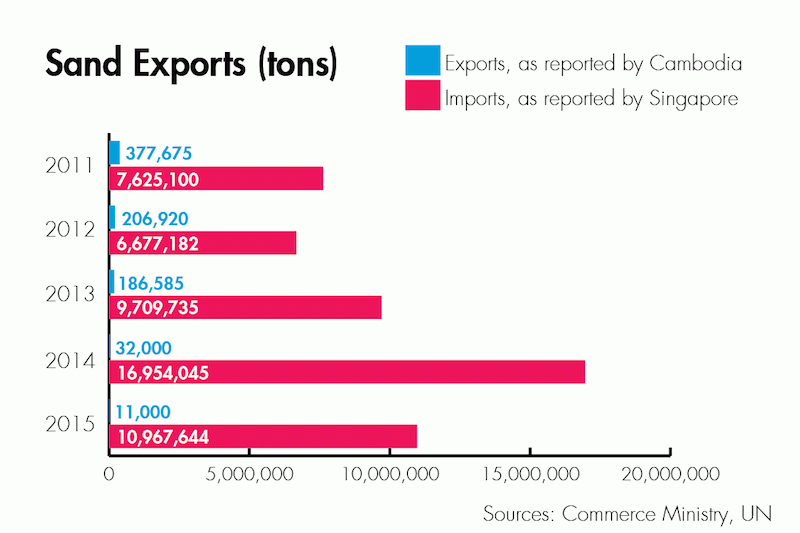
Breaking months of silence over accusations that it imported tens of millions of tons of smuggled sand, Singapore’s government on Monday distanced itself from any wrongdoing, a response an environmental NGO leader deemed “full of lies” and “devoid of any meaning.”

The city-state recorded about 70 million more tons of sand arriving from Cambodia than Cambodia reported sending there from 2007 to last year, according to figures sent by both countries to the U.N. Commodity Trade Statistics Database.


Differing accounts of sand trade from Cambodia to Singapore, measured in metric tons.

The gap has led to speculation from environmental groups and even the Cambodian government that the island was complicit in bringing in smuggled sand from Cambodia or elsewhere to buttress its land-building projects—charges that have gone largely unanswered by Singapore.

In an email on Monday, however, Gene Ng, manager of corporate communications for Singapore’s National Development Ministry, downplayed the significance of the sand gap and suggested contractors, not the government, were legally culpable for any criminal behavior.

“Import or export figures reported by countries are dependent on their own calculation formulas,” Mr. Ng wrote, echoing past statements from the Cambodian government. “The import of sand from Cambodia to Singapore is done on a commercial basis.”

“Singapore does not condone any trade or extraction of sand that breaches the source countries’ laws and regulations on environmental protection,” he wrote. “We have put in place strict criteria to ensure that our suppliers meet the prevailing local rules and regulations of the source country.”

“If there is any evidence that our contractors are not in compliance with the source countries’ laws and regulations, Singapore will respect that legal process will take its course,” he added.

Mr. Ng did not specify what criteria the government used to check that shipments of sand were legally sourced, and did not respond to an immediate request for elaboration. Singapore exempts marine-dredged sand destined for reclamation projects from a licensing scheme that governs most other sand imports.

Environmental NGO Mother Nature, which has blamed poorly monitored coastal sand mining for destroying ecosystems and livelihoods in Cambodia’s Koh Kong province, has hired a law firm to explore possible legal action in Singapore.

Alex Gonzalez-Davidson, the NGO’s exiled founder, said Singapore’s statement did not allay his concerns.

“Their response is not just devoid of any meaning, it is also full of lies and an insult to the Cambodian people, especially to the hundreds of families whose livelihoods have been thrown down the drain,” he said. “If the government of Singapore thinks they can get away with this kind of reply, they are making a very serious mistake.”


Read more!

Prehistory critters' hot, sweaty helpers

Lim Yaohui, The Straits Times AsiaOne 17 Jan 17;

Trudging through warm mud and getting stuck in it while you sweat bullets on a hot and humid afternoon is not everyone's cup of tea.

But for the 86 volunteers at the Mandai mudflats, the discomfort was a small price to pay.

They were there to participate in the Nature Society (Singapore)'s Horseshoe Crab Research and Rescue Programme, which saves the horseshoe crabs that have been caught in nets and collects data for conservation purposes.

"I wore normal shoes to the mudflats and getting stuck knee-deep was an interesting new experience," said Anglo-Chinese Junior College student Brenda Lee, 17.

"It was also frustrating and some of our friends lost their shoes. But rescuing horseshoe crabs is important as they are a vital part of our ecosystem that many of us neglect."

To rescue horseshoe crabs entangled in nets or crab pots, volunteers are given scissors and cutters to cut them loose.

Volunteers also study the crabs they spot and record data such as size, gender and population density on their mobile phones.

No prior experience is needed, only a willingness to go the extra mile for an animal that many hardly give a thought to.

Nor is there an age restriction.

Children as young as three have participated - with parental supervision.

Another objective of the programme is public outreach, to raise awareness of the habitats' existence and the importance of the Mandai mudflats to neighbouring areas like Sungei Buloh.

Horseshoe crabs have been around since before the dinosaur era.

Despite their name, they are not crabs and only superficially resemble crustaceans.

Instead, they belong to a separate sub-phylum, Chelicerata.

They are closely related to arachnids - a group that includes spiders and scorpions.

There are four species of horseshoe crabs in the world, three of which are found in Asia.

Two - the mangrove horseshoe crab and the coastal horseshoe crab - are found in Singapore, but not the Chinese horseshoe crab.

"Here, there is no real status given in the International Union for Conservation of Nature (IUCN) Red List of Threatened Species, so we have no idea whether they are fine or not," said Ms J. Vanitha, 35, a teacher and current leader of the Nature Society's programme.

The IUCN Red List is recognised as the most comprehensive assessment of the conservation status of biological species.

In the United States, the Atlantic horseshoe crab is harvested for its blood, which is used in the pharmaceutical industry.

It is considered vulnerable to extinction.

Scientists in Singapore consider the mangrove horseshoe crab to be vulnerable to extinction and the coastal horseshoe crab to be endangered, owing to irresponsible fishing and habitat loss.

The Mandai mudflats are the only known place these two species gather in such big numbers.

There are mangroves in Pulau Ubin and offshore islands, said Ms Vanitha, but mangrove patches with long, large mudflats are not easily found on mainland Singapore outside the Sungei Buloh Wetland Reserves.

About 400 to 600 horseshoe crabs are counted during each session.

The data is used for research purposes and four scientific papers have been published based on the findings so far.

Data is also shared at local and international conferences, such as the IUCN World Conservation Congress held in Honolulu last September, which Ms Vanitha attended.

Volunteers can sign up for the sessions through the Nature Society's newsletter or website, or through schools and corporations.

The sessions are open to the public.

However, registration for the next session on Feb 11 is full.

For more information, go to https://www.nss.org.sg.


Read more!

Coastal fish farmers struggle to stay afloat in choppy waters

Recent oil spill, harmful algae blooms leave them uncertain about future of trade
Carolyn Khew Straits Times 16 Jan 17;

Over the past five years, Singapore's fish farmers have seen an oil spill and two harmful algae blooms killing off their fish.

It has been one unfortunate event after another, and fish farmers told The Straits Times that they are uncertain about the future of coastal fish farming here.

"There's this sense of nervousness about how much fish we should farm. Fish farming, being what it is, requires a long time to reap returns," said a 50-year-old fish farmer who declined to be named.

His farm, located near Pulau Ubin, was affected by the algae bloom in 2015 and he lost about $200,000 worth of fish.

Another blow came two weeks ago when he had to cancel orders worth about $10,000 - or 25 per cent of a month's revenue - after an oil spill occurred off Pasir Gudang Port in Johor.

Mr Frank Tan, managing director of Marine Life Aquaculture

117 Number of Singapore coastal fish farms in the East and West Johor Strait, and the southern waters.

His farm was among 12 told by the Agri-Food and Veterinary Authority (AVA) to stop sales while it conducts food safety tests.

He said: "If your harvest is wiped out, the work you've put in for nine to 12 months goes into the water."

In urbanised Singapore, fish farms have managed to thrive. There are 117 Singapore coastal fish farms in the East and West Johor Strait, and the southern waters, where most rear their fish in net cages in the sea. There are another six fish farms on land.

The farms mostly produce fish for Singapore's consumption. In 2015, they produced 5,300 tonnes of fish, accounting for about 10 per cent of fish eaten here, said an AVA spokesman.

Mr Ng (right) started his fish farm off Pulau Ubin in 2004. He was forced to suspend sales after this year's oil spill and was also hit by algae blooms in past years.

In 2011, the Government began a push to increase this percentage to 15 per cent to boost food security. A $63 million fund was launched by the AVA to help farmers boost their yields and raise productivity, and the AVA has disbursed more than $1.5 million under its funding schemes so far.

But events in the past few years have put a dent in that ambition.

A total of 77 farms were affected by the algae bloom that took place between February and March 2015, wiping out an estimated 500 to 600 tonnes of fish. This followed another bloom in 2014.

And the problem is unlikely to be decisively resolved.

Algae blooms flower during times of dry weather and an excess of nutrients. Some algae types kill fish by cutting off their supply of oxygen or by damaging their gills - as was the case in 2015.

Dr Sandric Leong, a senior research fellow with the Tropical Marine Science Institute at the National University of Singapore, said climate change has resulted in warmer sea water temperatures and changes in its salinity due to less rainfall, adding: "As harmful algal blooms are a complex issue, there is no single solution to this."

Fish farmer Tan Choon Teck, who has run his farm near Pulau Ubin for about 30 years, said such events seldom happened in the past, and even if they did, they were never of such severity.

He was also affected by the oil spill on Jan 3 and was forced to suspend sales. "Business is definitely affected. In the lead-up to Chinese New Year, I always prepare fish, prawns and lobsters for sale. This is the time when demand is high and we can sell our produce at a premium," said the 54-year-old.

The AVA spokesman said that after the oil spill, fish farms have reported fish mortalities that totalled about 650kg as of last Friday. "Most of the farms in the same area did not report any fish mortality. There is minimal impact to supply," she said.

Experts say farmers need to adopt new ways of farming if they want their trade to be sustainable. Lining net cages with canvas bags, for instance, could help to minimise losses.

Another way is to simply move inland. But aquaculture specialist Matthew Tan from Nanyang Technological University said: "Fish farmers are reluctant to move away from the traditional way of farming as the cost is much less than for land-based farms. They need to change their mindset."

Mr Frank Tan, 42, is among those doing so. His farm in the East Johor Strait started out as a fully coastal farm rearing fish like red snapper and seabass. But he has since moved half of his fish rearing inland, and plastic pipes are used to line the exterior of his net cages to prevent oil spills from getting to his fish.

"We decided to move inland in 2015. The double blow we experienced was devastating," he said, referring to the algae blooms in 2014 and 2015.


Hobby turns into tough business venture
Carolyn Khew The Straits Times 16 Jan 17;

After spending over 30 years at the Inland Revenue Authority of Singapore (Iras), Mr Timothy Ng and his wife decided to set up a fish farm off Pulau Ubin in 2004.

Then deputy commissioner of Iras, he was nearing retirement and was charmed by the idea of having a floating kelong. But he did not expect what was to come.

He was affected by the algae bloom in 2015, and the oil spill this year has caused him to suspend his sales.


"I started this more as a hobby and thought it would be good if I could make money, but I didn't expect it to be this tough," said Mr Ng, 68, who is president of the Fish Farmers Association of Singapore.

His farm rears fish like groupers and red snappers, which he sells to middlemen. They, in turn, sell them to restaurants and wet markets.

This year's oil spill caused him to lose about 60kg of fish, and left the water in net cages covered with black oil about 2.5cm thick.

"The oil was so thick that the bubbles didn't even break the surface," said Mr Ng, referring to the bubbles of his cage aeration system.

In 2015, the algae blooms wiped out his total stock - or 10,000kg - of fish.

Since then, Mr Ng said, he has known of at least two farmers who have sold their businesses and others trying to do the same, or who have scaled down their production because they could not cope with the losses.

Mr Timothy Hromatka, 44, who started his fish farm off Pulau Ubin six years ago, got a new business partner to put money into his farm here after the algae blooms in 2015. He is now running a fish farm in Bali, Indonesia.

"I don't have any more money to put into the farm... The algae blooms in 2015 really shut us down. Not just in terms of monetary loss but also a loss of heart and confidence. In Bali, the waters are deeper and there have been no harmful algae blooms so far," he added.

To minimise his losses, Mr Ng said he is moving to rearing prawns, which can be sold at twice the price of seabass.

On how sustainable coastal fish farming will be, he said: "It all depends on how deep your pockets are... I've pumped in at least a million so far and I haven't made profits yet."

Carolyn Khew


Read more!

More showers expected in second half of January: MSS

Channel NewsAsia 16 Jan 17;

SINGAPORE: More showers are expected in the second half of January with prevailing northeast monsoon conditions in the region forecast to persist, said the Meteorological Service Singapore (MSS) in an advisory on Monday (Jan 16).

The next two weeks of January are expected to be wetter than the first fortnight of the year, though overall rainfall for January 2017 is predicted to be slightly below normal, said MSS. Short-duration thunderstorms are expected on six to eight days, mostly in the afternoon, though these could extend into the evening on a few days.

There is also a chance of a monsoon surge developing over the South China Sea region in the last week of January, and Singapore could experience periods of moderate to heavy rain lasting up to two days, accompanied by occasional windy conditions and cooler temperatures.

The daily maximum temperatures on most days are forecast to be around 32°C or 33°C, and on a few days, this could hit a high of around 34°C. On some rainy days, the daily minimum temperature could range between 22°C and 23°C.

RAINFALL "SIGNIFICANTLY BELOW NORMAL"

Overall rainfall was "significantly below normal" for the first two weeks of the year, said MSS. The lowest rainfall of 12.8mm (88 per cent below average) was recorded around the Jurong area, and rainfall was highest around the Paya Lebar area, where 98.3mm (11 per cent below average) was recorded.

There were a few dry and warm days in the first two weeks of January where temperatures above 33°C were recorded at some stations.

The highest temperature recorded in the first fortnight of January 2017 was 35.1°C at Sembawang on Jan 9, 2017. At the Changi climate station, the mean daily maximum temperature recorded in the first half of January 2017 was 31.3°C, which is 1.1°C above the long-term mean for January.

- CNA/nc


Be prepared for a wet Chinese New Year
Today Online 16 Jan 17;

SINGAPORE — Bring your brolly along when you go visiting this Chinese New Year.

The Meteorological Service Singapore (MSS) warned on Monday (Jan 16) that the next two weeks of January is expected to be wetter than the first fortnight of the year, even though the overall rainfall for January is forecast to be slightly below normal.

“Short-duration thundery showers are expected on six to eight days, mostly in the afternoon, and on a few days, could extend into the evening,” MSS said, adding that there was a chance of a monsoon surge developing over the southern South China Sea region in the second week of the fortnight.

“Singapore could experience periods of moderate to heavy rain lasting up to two days accompanied by occasional windy conditions and cooler temperatures”, the meteorological service added, saying that the daily minimum temperature is expected could range between 22°C and 23°C.

However, in the next fortnight, a few warm days can still be expected, with the daily maximum temperatures on most days are forecast to be around 32°C or 33°C, although it could reach a high of around 34°C.

More information can be found on the MSS website (www.weather.gov.sg).


Read more!