Best of our wild blogs: 26 Apr 12


WBSE eaglet @ nest 2 @ pasir ris - 22Apr2012
from sgbeachbum

Thalassia makes three at Sentosa, Tanjung Rimau
from teamseagrass

Wild shores in the city: Berlayar Creek
from wild shores of singapore

Welcome, Twinky!
from Raffles Museum News

Giant clams featured in ST papers
from Psychedelic Nature

Indian Peafowls on Sentosa
from Bird Ecology Study Group


Read more!

Malaysia: Iskandar Malaysia set to be Asia's gateway for tourists

New Straits Times 26 Apr 12;

JOHOR BARU: Iskandar Malaysia’s diverse landscape, coupled with some key iconic tourism projects that will be opened to the public shortly, is expected to further boost the region's economic growth and tourism industry, as a whole.

According to Iskandar Regional Development Authority (IRDA) chief executive Ismail Ibrahim, Iskandar Malaysia is poised to be Asia's gateway for tourists arriving in Malaysia and the Asean countries.

"With the participation of Cities and Corridors Lab by Pemandu and other state agencies, the target tourist numbers in Iskandar Malaysia are expected to hit seven million people per year by 2020," Ismail announced in a statement here today.

A tourist is defined here as a visitor who spends at least one night in the area, he explained, adding that IRDA is very excited to declare 2012/2013 as a banner year for Iskandar Malaysia.

According to Ismail, this declaration follows IRDA's focus on and facilitation of the opening of world-class, iconic tourist projects, including Legoland Malaysia, the Puteri Harbour Family Entertainment Center and Austin Heights Water Theme Park, to name a few.

In tandem with tourism development, Ismail added, the region will also be promoted as a shopper's haven, with the enhancement of existing shopping complexes and hotels and the introduction of new projects by the end of 2013.

"We are also pleased that Johor has increased its tourism product offerings, particularly with the new developments in the Mersing Laguna and Desaru beach tourism. We believe this will result in an Iskandar Malaysia tourism spillover effect and enhance the region’s economic vitality and excitement," he said.

It was recently reported that Johor was slated to become like Orlando, Florida, with at least 11 leisure attractions in the state, thus making it a major theme and amusement-park destination of Southeast Asia.

In addition to the new attractions, Ismail said, Iskandar Malaysia is already an area full of vibrancy and charm, given the rich heritage, art and culture that can be found in the Johor Baharu city centre.

Most notable of these, he added, is the Puteri Heritage Trail, which tempts the senses by offering an exquisite experience of old coffee shops and charcoal-oven bakeries, in addition to the souvenir-laden Plaza Seni.

For the nature-loving eco-friendly tourist, Ismail pointed out, Iskandar Malaysia offers visits to the Ramsar site in Tanjung Piai, the southernmost tip of mainland Asia, and to the world's largest uninhabited mangrove island of Pulau Kukup.

"The truly iconic thing about Iskandar Malaysia is the entire experience of being in it. I urge everyone to invest in holidays to Iskandar Malaysia, for truly the time is here and now," said Ismail. -- BERNAMA


Read more!

Hong Kong to return rare Philippine turtles

(AFP) Google News 25 Apr 12;

MANILA — Thirty-six turtles seized from smugglers, including 20 of one of the world's rarest species, are to be returned from Hong Kong to the Philippines, an official said Wednesday.

It will mark the first time a protected Philippine species seized from the illegal wildlife trade abroad has been returned, Philippine environment department deputy chief Luz Corpuz told AFP.

Wildlife authorities in Hong Kong will hand the 20 pond turtles and 16 South Asian box turtles to Philippine enforcement officers on Friday, she said.

"They are Philippine species, and returning them back to their natural habitat is a big accomplishment for our conservation efforts," Corpuz said of the Philippine pond turtles, which are found only in the island of Palawan.

"In the past we had routinely allowed protected wildlife confiscated abroad to be turned over to their local shelters because we do not have money.

"This time we're lucky because we have a little money left and we would like to enhance our enforcement activities."

Swiss-based International Union for the Conservation of Nature lists the 21-centimetre (8.3-inch) pond turtle, Siebenrockiella leytensis, as "critically endangered" and "one of the rarest and least known turtles in the world".

The 20-centimetre box turtle, Cuora amboinensis, is listed by as "vulnerable" in the Philippines, though it is also found in other tropical countries of Southeast Asia.

Corpuz said airport authorities in Hong Kong seized the 36 turtles in February after a flight from Manila.

They will be released back into the wild in Palawan, she added.

Trafficking in pond turtles is punishable by a six-year prison term and a million-peso ($23,447) fine in the Philippines, but Corpuz admitted the government did not have enough resources to enforce the law.

"We don't know who were responsible for smuggling them to Hong Kong, but the turtles could have most likely ended up as medicine, as pets, or as food in Chinese restaurants," she said.


Read more!

Rio Summit must address population growth: scientists

Richard Ingham (AFP) Google News 26 Apr 12;

PARIS — A top scientific academy on Thursday called on June's Rio Summit to tackle population growth and voracious consumption that are placing Earth's resources under intolerable strain.

"The 21st century is a critical period for people and the planet," the Royal Society, the world's oldest science academy, said in a report ahead of the June 20-22 UN gathering.

Demography, it said, can no longer be sidelined or treated as separate from the environment or the economy.

"The world now has a very clear choice," said leading British scientist Sir John Sulston, who led the report.

"We can choose to rebalance the use of resources to a more egalitarian pattern of consumption, to reframe our economic values to truly reflect what our consumption means for our planet and to help individuals around the world to make informed and free reproductive choices."

"Or," he said, "we can choose to do nothing -- and to drift into a downward vortex of economic, socio-political and environmental ills, leading to a more unequal and inhospitable future."

Earth's population is expected to roughly triple by 2050 compared to a century earlier.

It stood at three billion in 1950, reached seven billion in 2007 and is likely to reach around 9.5 billion by 2050, according to UN estimates.

Despite this surge, the issue of population growth is dormant in international politics. In the "zero draft" communique being prepared for the Rio summit, there are few references to demography.

The Royal Society report, People and the Planet, said population growth rates were slowing or going into reverse in many countries but were predicted to remain high in least-developed economies.

Rich nations are by far the biggest users of resources per capita, and their wasteful practices are spreading to emerging economies with giant populations, it said.

This combination of a growing global population and an accelerating pattern of consumption has alarming implications, the report warned.

"The Earth's capacity to meet human needs is finite," it said.

For example, a child in the developed world uses between 30 and 50 times as much water as his or her counterpart in a developing country.

Per capita emissions of carbon dioxide in rich countries are up to 50 times higher than in poor ones.

Average consumption of food has risen on average by 15 percent in calorie terms over the past four decades, yet nearly a billion people remain poorly nourished.

The report put forward nine recommendations for tackling the intertwined problems.

It demanded that 1.3 billion people living on less than $1.25 (about one euro) a day -- be brought out of absolute poverty.

"The most developed and the emerging economies must stabilise and then reduce material consumption levels," through investment in energy efficiency and clean technologies, steering them onto a path of sustainable development, it said.

Leaders should urgently commit to programmes of voluntary contraception and education, which are big factors in bringing down fertility rates.

And they should consider the impact of demography when they come to making economic or environmental decisions.

"Demographic changes, and the influences on them, should be factored into economic and environmental debate and planning at international meetings, such as the Rio+20 conference," it said.

Around 100 heads of state or government are expected for the conference, which marks the 20th anniversary of the Earth Summit that declared the environment a priority, according to Brazilian sources.

Scientists call for rethink on consumption, population
Chris Wickham Reuters Yahoo News 26 Apr 12;

LONDON (Reuters) - Scientists have called for a radical rethink of our relationship with the planet to head off what they warn could be economic and environmental catastrophe.

In a report published on Thursday by the London-based Royal Society, an international group of 23 scientists chaired by Nobel laureate Sir John Sulston called for a rebalancing of consumption in favor of poor countries coupled with increased efforts to control population growth to lift the estimated 1.3 billion people living on less than $1.25 a day out of poverty.

"Over the next 30-40 years the confluence of the challenges described in this report provides the opportunity to move towards a sustainable economy and a better world for the majority of humanity, or alternatively the risk of social, economic and environmental failures and catastrophes on a scale never imagined," the scientists said.

The 133-page report, which Sulston describes as a summary of work done over the last two years, comes against a backdrop of austerity-hit governments reducing subsidies for renewable energy, global car companies falling over themselves to meet demand for new cars in rapidly growing economies like China and Brazil, and increasing pressure to exploit vast reserves of gas locked in rocks around the globe through the controversial process known as ‘fracking'.

But the scientists insist the goals in the report are realistic. They argue lifestyle choices, human volition and incentives enshrined in government policy can make a significant difference to patterns of consumption.

They cite the growing appetite for recycling in the developed world, Britain's policy-driven switch to lead-free fuel in the 1980s, and the seemingly prosaic example of air traffic control as examples of where international cooperation can work.

Sulston said governments realized quickly that the consequences of not managing air traffic could be catastrophic: "They said 'this is dangerous; we've got to cooperate'."

The scientists say developed and emerging economies should stabilize and then start reducing their consumption of materials by increased efficiency, waste reduction and more investment in sustainable resources.

Carbon dioxide emissions are 10 to 50 times higher in rich countries compared to poor nations, they say. Rising greenhouse gas emissions are almost certainly responsible for increasing global average temperatures, leading to rising sea levels and more extreme weather, climate scientists say.

Voluntary programs to reduce birth rates, education for young women and better access to contraception urgently need political leadership and financial support.

Professor Sarah Harper of Oxford University, another of the authors, said the issue of population had fallen off the development agenda in the last 10-15 years but it should be reinstated and coupled closely with environmental challenges, starting at the Rio+20 United Nations Conference on Sustainable Development to be held in Rio in June.

WANTED: BRAVE POLITICIANS

The trend to urbanization remains intact. Some 50 percent of the world's population, which surpassed 7 billion last year, is living in cities. The world's population is forecast to rise to 10 billion before flattening off and the urban proportion is forecast to increase to 75 percent by the end of the century.

Eliya Msiyaphazi Zulu, a report author and Executive Director of the African Institute for Development Policy research group, said the need for education about family planning and improved access to contraception was most acute in Africa, which is forecast to contribute 70 percent of the average population growth.

He said all the evidence points to African women wanting fewer children and argued the main reason for high fertility in a country like Niger was the fact that half of all women are married at the age of 16.

The scientists also supported growing calls for a revision in how we measure economic growth. "We are extremely wedded to the idea that GDP increases are a good thing," said Jules Pretty, Professor of Environment and Society at the University of Essex and another of the authors.

He argued that GDP measures many of the ‘bads' in terms of the well-being of the planet as well as the ‘goods', adding: "There is an urgent need for policy change."

The scientists present some startling statistics. A child from the developed world consumes 30-50 times as much water as one from the developing world. Global average consumption of calories increased about 15 percent between 1969 and 2005, but in 2010 almost 1 billion people did not get their minimum calorie needs.

Minerals production rocketed in the 47 years up to 2007; copper, lead and lithium about fourfold and tantalum/niobium, used in electronic gadgets, by about 77 times.

For developed countries, Sulston said the message of the report boils down to something quite simple: "You don't have to be consuming as much to have a healthy and happy life".

But will politicians and consumers respond?

"It is a brave politician who is prepared to tell Western consumers to consume less to let the developing world consume more," said Tim Lang, Professor of Food Policy at City University in London. "But we need such bravery now, urgently."

Lang, who was not involved in the study, welcomed it saying: "The West over- and mal-consumes its way to diet-related ill-health from a diet with a high environmental impact. The evidence is there but will politicians and consumers listen and change?"

(Editing by Janet Lawrence)


Read more!

Best of our wild blogs: 25 Apr 12


Oil-slicked Tanah Merah still reefy
from wild shores of singapore

nest I eaglet I @ Pasir Ris - 22Apr2012
from sgbeachbum

Weaver Ant Mimicry
from Macro Photography in Singapore

From Lornie Trail To Rifle Range Part 2
from Beauty of Fauna and Flora in Nature

Random Gallery - The Brown Awl
from Butterflies of Singapore

Mobile field guide on Birds of Singapore
from Rojak Librarian

A Walk @ Chinese & Japanese Garden
from Nikita Hengbok


Read more!

Singapore's parks and nature reserves are 'virtually devoid of wildlife'

Nature parks
Straits Times Forum 25 Apr 12;

'Introduce native fauna like the mousedeer, jungle fowl and civet cat.'

MR AJIT KANAGASUNDRAM: 'Our parks and nature reserves, such as the ones at MacRitchie and Bukit Timah, are beautifully landscaped but are virtually devoid of wildlife. The National Parks Board (NParks) should introduce native fauna like the mousedeer, jungle fowl and civet cat. This will increase biodiversity and be interesting for wildlife enthusiasts. Tourists could be taken on nature walks to see them. The NParks and Singapore Zoo could do this as a joint project.'


Read more!

Dino Twinky is here

Baby dinosaur one of trio bought for museum to be built at NUS
Tan Dawn Wei Straits Times 25 Apr 12;


Prof Leo Tan inspecting a crate containing parts of Twinky's tail bone. Twinky arrived last Wednesday packed in 12 crates on a 20-foot container. -- ST PHOTO: NEO XIAOBIN

IT SPENT one month at sea, journeying from the rugged, expansive and cold American state of Utah to the flat, small and tropical island of Singapore.

And last Wednesday night, Twinky, the baby dinosaur, arrived in its adopted land - packed in 12 crates on a 20-foot container.

But it will be a while before Singapore will unveil the rare 12m long find at its new home, as the yet-to-be-built Lee Kong Chian Natural History Museum will be ready only in two years' time.

The 7,500 sq m purpose-built museum at the National University of Singapore (NUS) will house not just Twinky and two larger dinosaurs, but also one of the biggest collections of South-east Asian animals in the region.

For now, Twinky will wait patiently in an undisclosed temperature-controlled and secure warehouse for its star turn - and the arrival of its 'parents'.

Twinky, Apollo and Prince were found buried together in a quarry in Wyoming between 2007 and 2010.

When the Raffles Museum of Biodiversity Research at NUS heard of the discovery last year, it made a successful bid to buy the trio for $8 million.

The museum's team, headed by Professor Leo Tan, 67, and Professor Peter Ng, 52, went on an intense two-month fund- raising drive to buy the giant, pre-historic creatures.

They sealed the deal when Mrs Della Lee, wife of Lee Foundation chairman Lee Seng Gee, stepped in to top up the $2 million collected.

Prof Tan, director of special projects at the Faculty of Science dean's office, is impatient for the arrival of Apollo and Prince.

He said: 'The sooner we get them here, the better. We want them in our hands, on our soil. It belongs to the people of Singapore.'

The duo, both 24m long, are affectionately referred to by the museum as Twinky's parents.

The trio, 80 per cent complete when found, are diplodocid sauropod dinosaurs, one of the biggest animals to walk the Earth some 150 million years ago.

Apollo is expected to arrive within six months, while Prince will arrive in time for the museum's opening.

Prof Tan said the hardest part of the legal paper chase was getting the assurance that the dinosaurs' seller, Dinosauria International, had the right to prospect on the land leased to them by the quarry's owner.

The NUS team also had to ensure no one else had laid claim to the bones.

The museum is embarking on another drive to raise between $5 million and $10 million to pay for professorships, fellowships and the cost of exhibition.

As for what to do with Twinky between now and the museum's opening in two years' time, Prof Tan said the team is still working out plans but there is a possibility of showcasing it for fund-raising purposes.

But there will be no loan of the dinosaurs to museums. 'The risk is too great. We'll always worry, what happens if there is a fire?' said Prof Tan.

But the team is open to working with other museums on joint projects. It will also let corporations and individuals sponsor the display of Twinky at private events.

'People will see him before the opening. It is just a matter of when, how and in what form.'


Read more!

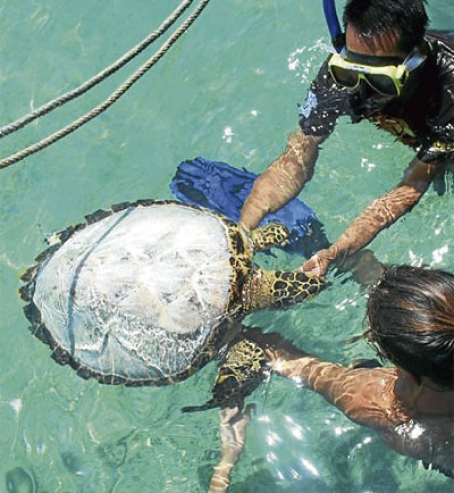
Malaysia: 3 dead turtles with shells cut off found on island

Roy Goh New Straits Times 25 Apr 12;

PROTECTED SPECIES: Hawksbill turtles' eyes also poked protected


Lodge employees removing a dead hawksbill turtle found on Pulau Mantanani Kecil in Kota Belud.

KOTA KINABALU: THREE dead turtles with their shells removed were found on the shores of Pulau Mantanani Kecil in Kota Belud recently.

The hawksbill turtles were found by employees of a backpackers' lodge on the island between Sunday and Monday. An employee said that apart from the shells, which appeared to have been uniformly cut, the eyes of the turtles were also poked.

The shell of hawksbill turtles, known as tortoiseshell, is used to make combs, guitar picks, knitting needles and ornaments.

Since 1973, the trade of tortoiseshell worldwide was banned under the Convention on International Trade in Endangered Species.

Tortoiseshell is preferred because of its durability.

State Wildlife and National Parks Department director Dr Laurentius Ambu said officers would go to the island to investigate the incident.

"Hawksbill turtles are protected reptiles in the state."

The shells could have been cut by poachers, said Ambu.

In 1996, Malaysia and the Philippines had set up an area to protect turtles in Sulu Sea. The Turtle Islands Heritage Protected Area covers three islands in Malaysia and six in the Philippines.

'Do more to stop turtle cruelty'
Avila Geraldine New Straits Times 28 Apr 12;

KOTA KINABALU: THE recent discovery of three dead hawksbill turtles minus their shells and with their eyes gouged out at Mantanani Islands, off Kota Belud, has caused concern among tourists, conservationists and tourism authorities.

Although they agreed that the incident was an isolated one, all are in favour of more efforts to be taken to prevent a recurrence.

Marine conservation officer Lionel Aaron Lingam, who was among the first to spot one of the turtles, then barely alive at Mantanani Kecil on April 20, called the incident "shocking".

Lionel was with 20 local and foreign divers and staff of Mari Mari Mantanani Dive Lodge where he works, preparing diving gear at the jetty when he spotted the turtle.

"I asked one of the staff to check on it.

"He told me that the shell was white.

"I then sensed something was wrong.

"The guests were angry and saddened.

"They asked me why such things happen.

"I was lost for words," he said, adding that the turtle died 20 minutes later.

Another hawksbill turtle was spotted by a boatman later in the evening between Mantanani Kecil and Mantanani Besar.

The third turtle was found on Saturday morning.

"I've never come across such incidents.

"It was cruel and I believe it was done by the islanders.

"But there is no proof."

Mantanani Islands comprises of Mantanani Besar which is populated and Mantanani Kecil and Lungisan, which are famed for their dive spots.

Mantanani Kecil is also gazetted as a bird sanctuary.

An avid diver and traveller, Jack Otter, also expressed his anger over the incident after reading about it on the New Straits Times' website.

The 46-year-old Australian believed the practice of killing marine turtles for their shells was isolated, but added that awareness must be instilled among islanders.

He said the authorities should take the matter seriously because marine awareness, especially among the islanders, was still low.

"I understand that it is somehow normal for them, who view it (killing turtles for their meat and shells) as a source of income, because they haven't been educated of their importance.

"For islanders who work with the resort, there is no problem because they are exposed to marine conservation efforts and programmes.

"However, for those who are not directly involved with tourism or the resort, there is a crucial need to change that practice and their perception.

"It's difficult, but it can be done slowly."

Otter also called on the state government to gazette Mantanani Islands as a marine park.

Sabah Tourism Board member Clement Lee had also raised concerns over the cruel treatment, describing the turtles' fate as similar to sharks.

Lee, who is also Borneo Divers Mabul Resort managing director, said he had never encountered such an incident in his 30 years of diving, adding that education was important to begin with.

"I've never seen it in Mabul, or other parts of Sabah.

"What happened is a warning for the authorities to do something about it."

Since 1973, the trade of hawksbill turtles' shells worldwide has been banned under the Convention on International Trade in Endangered Species.

In 1996, Malaysia and the Philippines set up an area to protect turtles in the Sulu Sea.

The Turtle Islands Heritage Protected Area covers three islands in the country and six in the Philippines.


Read more!

Vietnam's mangroves trees threatened by rising tide of deforestation

clearances could contribute to coastal erosion and prove a missed opportunity to prevent climate change
Alisa Tang Guardian Weekly 24 Apr 12;

Standing at the entrance to Lang Co town hall, 69-year-old Mai Truc Lam gestured to the two-story building, the sun-drenched parking lot and two-lane road in front, and described the small coastal community as it once was.

"We are standing in an area that used to be mangroves," the weathered fisherman said, and then described the negative impact deforestation has wrought on the area's sea life. "Now, we do not see some species of fish here anymore."

A few minutes' drive away, on a sliver of sand that forms the Lap An Lagoon on the central coast of Vietnam, lies a modest grove of trees – some evergreens that shed a path of soft needles, and where the land meets the sea, Lang Co's few remaining hectares of mangroves, perched above the water upon their stilted, flying buttress-like roots.

Some of the mangrove trees have torpedo-shaped seeds, which have poked into the ground and given birth to a new generation of delicate seedlings, all too easily trampled upon by oblivious passersby. Yet these remaining mangroves face the threat of being razed entirely to make way for a golf course as part of local economic development plans – part of a global development trend that has seen the clearance of as much as 50% of the world's mangroves over the past half a century.

Mangroves grow along the ocean coasts of 118 countries – with a quarter of the world's 40m hectares being in south-east Asia – but with widespread deforestation due to population pressure, expansion of shrimp farms and development, scientists fear mangroves may disappear altogether in as little as 100 years. At their best, mangroves form a vast coastal barrier of trunks and roots against the sea, controlling erosion, protecting communities from storms, and providing an environment for greater fish diversity.

Furthermore, scientists last year unveiled research pointing to mangrove forests as ideal repositories for carbon storage – containing an average of 1,000 tonnes of carbon per hectare, compared with 300 tonnes per hectare of tropical forest – which could help to fight climate change by keeping carbon locked away on land and out of the atmosphere. The scientists found that most of the carbon in mangrove forests – 49% to 98% – is stored below ground in thick, tidally submerged soil in which decomposition is anaerobic in the absence of oxygen. Yet with mangrove conservation up against economic development, the more obvious path to money wins.

"My sense in Lang Co, and in provinces across Vietnam, is that economic development has become a driving force so dominant that environmental precautions have fallen by the wayside," said Evan Fox, a coastal planning consultant. "In villages where local governments are searching for ways to bolster their economic output, it is difficult to justify preservation of an area if managers and local people cannot discern its tangible benefit."

There are laws that protect the forests and mangroves in Vietnam, but enforcement can be lax, rendering such regulations impotent. "My interpretation is that it's illegal but everything is negotiable in Vietnam and since there is no consequence for breaking the law (at least in the environmental domain), mangroves get cut. Anyway, since there are so many conflicting laws, you can probably legalise what you've done by reference to a previous law," said Jake Brunner, programme co-ordinator for the International Union for Conservation of Nature (IUCN) in Vietnam.

Shrimp farms have been one of the big drivers behind mangrove loss. A 2011 analysis of images of Vietnam's southern Mekong delta – an area that is typically mangroves – found that from 1973 to 2008, more than half of the mangroves were converted into shrimp farms, causing serious erosion. Nonetheless, communities and governments have taken little notice of the protective services that mangroves provide until a disaster of epic proportions strikes – such as the Indian Ocean tsunami that killed some 180,000 people in western Indonesia's Aceh province.

"In Aceh, after the tsunami, the result wouldn't have been like this, if we still had mangroves," said Daniel Murdiyarso, a scientist with the Indonesia-based Centre for International Forestry Research and one of the researchers behind the mangrove carbon-storage findings.

Disaster management and risk reduction are now squarely on the Indonesian government's radar, but in most countries – and most of the time – the impact of climate change is incremental and therefore unlikely to spur governments and communities to action. When typhoons have hit Vietnam, mangroves have helped to save lives.

"That's when people noticed that where there were mangroves, people survived," Brunner said. "Thailand and Indonesia suffered a very high magnitude event, the tsunami, and that sent a very clear message. In Vietnam, there have been higher frequency, but lower magnitude events, so it hasn't quite had the same impact, and you still see mangroves being lost."

Initiatives like the Mangroves for the Future (MFF), established after the 2004 tsunami and co-chaired by IUCN and the UN Development Programme, offer grants to communities like Lang Co to protect their mangroves. Since 2008, MFF has implemented about 90 projects in its eight member countries across south and south-east Asia. The $29,000 project in Lang Co – $23,000 from MFF and $6,000 from the grantee organisation, the Centre for Community Research and Development (CCRD), and the local community – is to focus on supporting natural regeneration of existing mangroves, which is less expensive and more effective than planting. According to CCRD, Lang Co had about 100 hectares of mangroves two decades ago, but today only five hectares of poor-quality mangroves remain.

Under the MFF grant, the Lang Co fishing association has been tasked with looking after these mangroves. Local fishermen will be trained in mangrove and aquatic resource management and protection.

Alisa Tang is a Bangkok-based freelance journalist who reports and edits for organisations including the Centre for International Forestry Research, which supported her reporting trip to Vietnam.


Read more!

Best of our wild blogs: 24 Apr 12


Oil-slicked Tanah Merah still fishy
from wild shores of singapore

Pasir Ris Mangrove Boardwalk Guided Tour
from Cheekiemonkies

裕华园噪鹃 Asian Koel@Chinese Garden
from PurpleMangrove

Application for DENSO Youth for Earth Action is now open till 15 May 2012! from Toddycats!


Read more!

21 trees topple over at Pasir Ris Park

Straits Times 24 Apr 12;

The trees, some as tall as seven storeys, toppled over near Carpark C of Pasir Ris Park on Sunday night. Nobody was hurt and no property was damaged. The cause of the incident is being investigated. -- PHOTO: SHIN MIN

TWENTY-ONE trees, some as tall as seven storeys, toppled over near Carpark C of Pasir Ris Park on Sunday night.

The National Parks Board (NParks) was notified of the damage at 7am yesterday, and it set about removing those causing obstruction. It will take a few more days to clear the debris, it said.

Its spokesman said the cause of the incident is being investigated, and would not be drawn into speculating what caused that many trees to fall at one go.

Nobody was hurt and no property was damaged.

NParks general manager Chia Seng Jiang said the stepped-up programme to inspect and prune mature trees, especially those in high-traffic areas, has reduced the percentage of trees affected by storms to 0.1 per cent in the last few years.

Nature Society president Shawn Lum said he suspects Sumatra squalls to have caused the trees to topple.

The Meteorological Service here defines such squalls as eastward-moving lines of thunderstorms bringing heavy rain and gusty winds of 40kmh to 80kmh.

These squalls happen regularly during the inter-monsoon period from April to October.

Mr Lum said there have been intermittent squalls in the last few weeks, so it is not surprising the trees toppled over - 'though it is sad for the trees and tree lovers, of course'.

In March last year, hundreds of trees off Mandai Road fell over in a storm; a few weeks ago, trees in Warrick Road near Alexandra Road were also damaged in what may have been another squall.

LESLIE KAY LIM


Read more!

Paper outlining five population scenarios released

Tan Weizhen Today Online 24 Apr 12;

SINGAPORE - As Singapore marks a "demographic turning point" this year, where the Republic's first cohort of baby boomers turns 65, a paper has been released by the Government projecting that an intake of about 20,000 to 25,000 new citizens each year would keep the citizen population size stable.

This is assuming that future demographic trends prevail, said National Population and Talent Division (NPTD), releasing the paper today.

In one of five scenarios that NPTD put out with varying intakes of new citizens, if Singapore's total fertility rate (TFR) stays at 1.2 births per female and there are no new citizens, Singapore's native population will shrink around 2025.

Under this scenario, there will only be 2.1 working-age citizens to each elderly citizen by 2030, and citizen deaths will exceed births in 13 years, the paper said.

Between now and 2030, over 900,000 baby boomers will retire from the workforce.

The NPTD said it will be involving the public in a 'national conversation' centering around topics related to this paper, following focus groups.

The paper can be accessed at www.nptd.gov.sg/.

Immigration can mitigate rate at which citizen population ages: report
Imelda Saad Channel NewsAsia 24 Apr 12;

SINGAPORE: Singapore needs to continue attracting immigrants to slow down the decline and ageing of its citizen population, according to a paper released by the National Population and Talent Division.

It says that if the country's Total Fertility Rate remains the same, Singapore will need an immigration inflow of between 20,000 and 25,000 new citizens each year to keep the citizen population size stable.

This is one of the five population scenarios set out by the paper.

The scenarios are not predictions or forecasts, but illustrations of the growth and change in population that will occur if certain assumptions about future demographics trends prevail over a projected period.

Singapore's TFR now stands at 1.2, well below the replacement rate of 2.1.

This year has been described as a "demographic turning point", when the first cohort of post-war Baby Boomers born between 1947 and 1965 start turning 65 years of age.

Without immigration, the paper says citizen deaths will exceed births in 13 years.

By 2025, the population will also start to age and shrink, with the median age being 45 - up from the current 39 years.

The citizen workforce will also start to shrink with fewer working-age citizens supporting each elderly citizen.

The paper projects that the trend will be mitigated somewhat with immigration.

It says immigration will help to slow down the decline in the pool of working-age citizens and slow down the rate of ageing among the population.

Taking in 20,000-25,000 new citizens each year will also bump up the citizen old-age support ratio slightly from 2.1 to 2.4 working citizens for every elderly citizen, in 2030.

The paper will form the basis of discussions among focus groups and the public for a White Paper to be released by the National Population and Talent Division by the end of the year.

The White Paper will set out issues important to Singaporeans and strategies for a sustainable population. It will cover things like land use and infrastructure planning.

The public consultation for this is expected to start in the middle of the year.

- CNA/cc

Population will shrink from 2025 without new citizens
Pool of working age citizens will also drop steadily from 2.1m today
Phua Mei Pin Straits Times 25 Apr 12;

SINGAPORE needs 20,000 to 25,000 new citizens each year to prevent a decline in its citizen population from 2025, new government projections show.

That assumes no big uptick in the number of Singaporean babies born here. The Total Fertility Rate (TFR) is now 1.2, one of the lowest in the world.

If it stays put, and the door to new migrants is shut from this year, the citizen population will start shrinking in 13 years' time.

The pool of working age citizens will also drop steadily from today's 2.1 million to about 1.5 million in 2060.

These are some of the five scenarios in a paper that the National Population and Talent Division (NPTD) released yesterday.

As the lead agency for the Government on population matters, it is conducting a comprehensive examination of population goals and policies, Deputy Prime Minister Teo Chee Hean announced during the Budget debate.

The NPTD is releasing information to spur study and discussion in the lead-up to a White Paper on population matters, due by the year end.

It has launched focus group discussions with different segments of the community. From the middle of the year, it will engage the public through various avenues, including dialogues and online channels, to discuss population issues holistically.

'Through this process, we hope to bring to light issues that are important to Singapore and Singaporeans, and develop a shared understanding of our strategies to build a sustainable population that secures Singapore's future,' it told The Straits Times via e-mail.

The five scenarios drawn up by NPTD, using data from the Department of Statistics, are based on the following assumptions:

TFR rises to 2.1

TFR stays at 1.2 and the number of new citizens each year is zero, 15,000, 20,000 or 25,000.

A comparison shows that only with an annual injection of 20,000 to 25,000 new citizens a year can the citizen population size be kept at a constant level of four million. In all other scenarios, the total number of citizens will dwindle.

From 2007 to 2010, Singapore's intake of new citizens ranged from over 17,334 to 20,513. Last year saw 15,777 additions to the citizen population.

A key point from the paper is that, regardless of which scenario comes to pass, Singapore's citizen population will continue to age. In the best-case scenario, median age rises from 39 in 2011 to 42 in 2060. In the worst case, it jumps to as high as 55.

From now to 2030, Singapore will also see 'an unprecedented age shift, as over 900,000 baby boomers will retire from the workforce and enter their silver years', NPTD said in the paper.

Commenting on NPTD's scenarios yesterday, Associate Professor Kalyani Mehta, the head of SIM University's programme for gerontology, pointed to the Retirement and Re-employment Act as a measure that can impact the size of the working population.

'It remains to be seen how much we can improve our labour force productivity. Getting people such as housewives back into the workforce is another strategy that has to be factored in.'

Demographer Gavin Jones noted the paper's silence on the future permanent resident population.

'To become a citizen, you pass through a process of being a PR first. New citizens are drawn from that pool and you do need to look at that aspect,' he said.

Last September, the Institute of Policy Studies drew up 48 scenarios on the resident population, which includes citizens and permanent residents.

Its conclusion: If net migration was zero, the resident population would start bottoming out in 2025, dropping to three million by 2050.

Yesterday, the NPTD also stressed that the Government takes care to accept immigrants who are able to integrate well into Singapore society.

From 2001 to 2010, 49 per cent of new citizens were from South-east Asia, 42 per cent from other parts of Asia and the remaining 9 per cent from other parts of the world.

From 2005 to 2010, about 55 per cent of new citizens were aged 30 or younger.

Members of the public may access the paper and give their comments at www.nptd.gov.sg


Read more!